Drug Company Provides Cure for Development Woes
November 18, 2011 — CDJ Staff
Vertex Pharmaceuticals is poised to become the holder of Boston’s biggest commercial lease, paying $72.5 million for 1.1 million square feet on Boston’s waterfront. Vertex’s new buildings are still under construction, but the plans have spurred other development in the Fan Pier area, according to the New York Times. The Times quotes Mary A. Burke, a senior economist at the Federal Reserve Bank of Boston that the Vertex project gives “a big push” to the “momentum for economic growth.”
The Fallon Company is building Vertex’s new laboratory and office space. They are separately planning to build a high-rise with 150 luxury condominium units. According to Joseph Fallon, the chief executive and president of the Fallon Company, there is already a waiting list of 50 buyers for the condominiums.
Across the street from the Vertex site, a group including Morgan Stanley and Boston Global Investors is planning a 23-block mixed use project that would include 1.2 million square feet of retail space. Additionally, the New England Development and the Hanover Group is building a 356-unit apartment building at the adjacent Pier 4.
Read the full story…
Limitations of Liability in Subcontractors’ Contracts May Not Be Enforceable in Colorado to Limit Claims by Construction Professionals.�
October 23, 2012 — Heidi J. Gassman, Higgins, Hopkins, McLain & Roswell
The Colorado Homeowner Protection Act of 2007 (“HPA”), codified at C.R.S. § 13-20-806(7), specifically voids express waivers of, or limitations on, a residential property owner’s ability to enforce any rights, remedies, and damages provided by law in a construction defect case. Practically speaking, this means that limitation of liability provisions in contracts between construction professionals and residential homeowners are void and will not be enforced in Colorado. The HPA can extend even further, however, to subcontractors on residential projects, as seen in a recent District Court ruling.
�The HPA was tested in Thacker v. Gallery Homes, et al., v. Terracon Consultants, Inc., et al., Larimer County District Court Case No. 2007CV1195. Gallery Homes hired Terracon to provide geotechnical and structural engineering services at the Colony Ridge subdivision in Loveland, Colorado. Terracon performed work for Gallery Homes under three separate contracts, each of which included a provision limiting Terracon’s total liability to Gallery Homes.
�After the project was completed, two homeowners filed suit against Gallery Homes for alleged construction defects involving movement of their basement floor systems and foundations and damage to porches, patios, garages, and driveways. Gallery Homes sued Terracon as a third-party defendant, and Terracon sought to enforce its limitation of liability provisions via a partial summary judgment motion.
� Read the full story…
�Reprinted courtesy of Heidi J. Gassman, Higgins, Hopkins, McLain & Roswell, LLC. Ms. Gassman can be contacted at gassman@hhmrlaw.com
�
Contractors with Ties to Trustees Reaped Benefits from LA Community College Modernization Program
March 3, 2011 — Original reporting by Gale Holland, Michael Finnegan and Doug Smith, Los Angeles Times
In the latest installment of the “Billions To Spend” series of investigative reports focused on construction defects, management, and cost issues relevant to LACC’s Community College Modernization Projects, the LA Times examines the costs associated with the various layers of construction management and benefits that accrued to contractors with ties to LACC trustees.
�The reporting by the Times is seemingly critical of the project’s utilization of “body shops” an industry term for companies that function as employers of record. The article segment published today cites a number of circumstances wherein their utilization appears to have escalated costs substantially.
�“To gauge the cost of the staffing system, The Times reviewed thousands of pages of financial records from April 2007, when URS began managing the program, to July 2010. Reporters identified two dozen contractors serving as conduits for pay and benefits for employees they did not supervise.
�At least 230 people were employed in this manner, at a total cost of about $40 million, the records show.
�Approximately $18 million of the total was paid to the employees, according to the Times analysis. The remaining $22 million went to profit and overhead for contractors, the records indicate.
�For employees on its own payroll, the district says that medical and other benefits increase compensation costs 40% above base salaries. So if the district had employed its construction staff directly, the total cost for the period studied would have been $25 million instead of $40 million, a savings of $15 million, The Times calculated.”
�Read Full Story...
Surveyors Statute Trumps Construction Defect Claim in Tennessee
June 19, 2012 — CDJ Staff
The Tennessee Court of Appeals has issued an opinion in the case of Dale v. B&J Enters. (Tenn. App., 2012), affirming the ruling of the Chancery Court for Knox County. The homeowners purchased properties in Knoxville, Tennessee in 2007 and 2008. Subsequently, according to the complaint, they found “significant sink holes and depressions throughout the subdivision.” The plaintiffs determined that a previous developer in 2004 had been aware of the sink holes. The Knox County Metropolitan Planning Commission, upon giving approval, made requirements that included that sink holes, even if they were filled, had to be designated on the site plans. The developer did not indicate these locations on the final plans. The plaintiffs made claims of “failure to disclose, misrepresentation, misrepresentation by concealment, and violation of the Tennessee Consumer Protection Act.” They filed their suit in June 2009.
The defendants in the initial case, argued that they did not create the final plat, the site plan indicating the features and lot lines. This had been the work of the previous developer. In September, 2009, the plaintiffs amended their complaint to include the previous developer and its engineering firm. The engineering firm disavowed any responsibility. The developer noted that the surveyor, Benchmark Associates, had “failed to properly include the sink holes and/or depressions on the final plat.” In June, 2010, the plaintiffs added Benchmark.
Benchmark argued that the plaintiffs’ claims should be dismissed, as Tennessee has a four-year statute of limitations on claims against surveyors. The final plat was recorded on May 19, 2006, and the plaintiff filed their claims against Benchmark on June 16, 2010, slightly less than a month over four years. The plaintiffs argued that “the real issue [was] the tortious misrepresentation by Benchmark.” The Chancery Court found for Benchmark.
On appeal, the plaintiffs raised three issues. They argued that the trial court applied the wrong section of the law, and should have applied the section applying to construction and not surveyors. They also argued that the timeliness of the claim should be based on when the defects were discovered. The also raised the question of whether the laws concerning surveyors bar claims for misrepresentation. The appeals court upheld the decision of the Chancery Court.
For the plaintiff’s first claim, although the statute addressing deficiencies in construction mentions surveying, an earlier court ruling found that the legislature had removed a reference to surveyors in one part of the statute, but failed to do so in the second part. The earlier court had concluded that the “obvious intent of the legislature was to place all limits on actions against surveyors into the new statute.” As the applicable statute states that “any such action not instituted within this four (4) year period shall be forever barred,” the court held that the plaintiffs’ claims must be time barred. Further, as the intent of the legislature was determined to “place all limits on actions against surveyors into one statute,” the court felt that it could not apply the Consumer Protection Act.
Read the court’s decision…
Florida “get to” costs do not constitute damages because of “property damage”
August 11, 2011 — CDCoverage.com
In Palm Beach Grading, Inc. v. Nautilus Ins. Co., No. 10-12821 (11th Cir. July 14, 2011), claimant general contractor Palm Beach Grading (?PBG?) subcontracted with insured A-1 for construction of a sewer line for the project.  A-1 abandoned its work and PBG hired another subcontractor to complete construction of the sewer line.  The new subcontractor discovered that A-1?s work was defective requiring repair and replacement of portions of the sewer line which also required the destruction and replacement of surrounding work.�
Read the full story…
Reprinted courtesy of CDCoverage.com
Mandatory Arbitration Provision Upheld in Construction Defect Case
May 18, 2011 — May 18, 2011 Beverley BevenFlorez - Construction Defect Journal
The Superior Court of New Jersey reversed the decision in Frumer v. National Home Insurance Company (NHIC) and the Home Buyers Warranty Corporation (HBW), stating that the mandatory arbitration provision within the Frumer’s home warranty policy was binding.
�The Frumers alleged that the construction defects were discovered immediately after moving into their million dollar home. After failing to achieve any results from dealing with the builder, they turned to their home warranty. There was some dispute over claims, and a settlement offer was rejected by the Frumers. The Frumers elected to commence litigation rather than utilize the binding arbitration.
�The NHIC and the HBW filed a motion to compel arbitration, however, the motion judge denied the motion: “…the Warranty leaves open the option for [plaintiffs] to commence litigation, which [plaintiffs have] done in this case. The clause also states that ‘the filing of a claim against this limited Warranty shall constitute the election of remedy and shall bar the Homeowner from all other remedies.’ However, the provision does not state that the filing of a claim elects arbitration as the exclusive remedy, and any ambiguity in the language must be inferred against the drafter.”
�The NHIC and the HBW appealed the decision. The Superior Court reversed the decision: “Where, such as here, the homeowner files a claim against the warranty for workmanship/systems defects, the warranty clearly and unequivocally establishes binding arbitration as the exclusive remedy. There is, however, no election of remedies for a dispute involving a major structural defect claim. The warranty clearly and unequivocally establishes binding arbitration as the exclusive remedy.”
�Charles Curley of Halberstadt Curley in Conshohocken, Pa., the local counsel for National Home and Home Buyers, told the New Jersey Law Journal that “the ruling reaffirms New Jersey’s commitment to enforcing arbitration agreements and requiring people to go to mandatory arbitration when the contracts call for it.”
�“At this point, their hope is that the warranty company will do what it's supposed to do — repair covered defects,” Eric McCullough, the Frumer’s lawyer said to the New Jersey Law Journal.
�Read the full story…
Cogently Written Opinion Finds Coverage for Loss Caused By Defective Concrete
November 7, 2012 — Tred Eyerly, Insurance Law Hawaii
If ever in need of a concise, well-reasoned opinion on “occurrence,” “property damage” and applicability of the business risk exclusions, turn to Pamperin Rentals II, LLC v. R.G. Hendricks & Sons Construction, Inc., 2012 Wis Ct. App. LEXIS 698 (Wis. Ct. App. Sept. 5, 2012).
A contractor was hired to install concrete during construction of seven gas stations. Red-D-Mix provided the concrete. The contractor and Red-D-Mix were eventually sued by the gas stations, based upon allegations that the concrete was defectively manufactured and installed. The gas stations alleged that Red-D-Mix supplied concrete that was defective and resulted in damages, including the need to repair nearby asphalt.
Red-D-Mix tendered to its insurers, who denied coverage. Suit was filed and the insurers moved for summary judgment. The trial court determined there were no allegations of either “property damage” or an “occurrence.” Therefore, there was no duty to defend or indemnify Red-D-Mix.
Read the full story…
Reprinted courtesy of Tred R. Eyerly, Insurance Law Hawaii. Mr. Eyerly can be contacted at te@hawaiilawyer.com
Court Requires Adherence to “Good Faith and Fair Dealing” in Construction Defect Coverage
September 30, 2011 — CDJ Staff
The California Court of Appeals has ruled in the case of Allied Framers, Inc. v. Golden Bear Insurance Company. Allied had been sued in a construction defect case and its primary insurer had become insolvent. Coverage for Allied’s defense was paid for by the California Insurance Guarantee Association through June 8, 2006. When warned that CIGA’s involvement was ending, Allied notified Golden Bear, which declined to provide coverage.
In the matters that followed, Golden Bear claimed that Allied had not exhausted its $1 million in primary insurance. Allied then showed that $1 million had already been paid out in the case. A few months thereafter, Golden Bear offered a $500,000 settlement on behalf of Allied which was rejected. Thereafter, Golden Bear hired new counsel to defend Allied. Golden Bear received, but allegedly did not pay, invoices Allied sent from their former counsel. Golden Bear finally settled the construction defect case for $2 million.
Allied’s original counsel sued Allied for payment. Golden Bear declined coverage. Allied then claimed that Golden Bear liable on several counts, arising from its failure to settle the construction defect action earlier than it did and its failure to pay Allied’s counsel. Golden Bear demurred, arguing that Allied had now exhausted is coverage with the $2 million settlement. The lower court sustained Golden Bear’s demurrer, dismissing Allied’s complaints.
The appeal court reviewed Allied’s seven complaints and sustained most of them. However, the court did reverse the trial court’s order in regard to Allied’s complaint that Golden Bear breached an implied covenant of good faith and fair dealing. The appeals court was not convinced that Golden Bear properly evaluated the settlement demand in the underlying construction defect case. The court found three other ways in which Golden Bear’s actions might show bad faith, in refusing to pay defense fees “after promising [Allied] such costs would be paid in full,” “failing to advise Allied about ‘actual or potential negative consequences of agreeing to the proposed settlement,’” and that their choice of counsel “failed to protect [Allied’s] interests in the negotiation.”
Read the court’s decision…
Another Guilty Plea In Nevada Construction Defect Fraud Case
April 25, 2012 — CDJ Staff
The eleventh defendant has entered a guilty plea in the ongoing federal investigation of construction defect fraud in the Las Vegas area. Mahin Quintero plead guilty to producing a false authentication feature, a misdemeanor. Ms. Quintero’s part in the scheme was to falsely authenticate signatures on loan documents for straw buyers. Ms. Quintero stated in court that she had been ordered to destroy her notary book three years ago. According to her plea bargain, the straw buyers did not appear in front of her when she notarized their signatures. As part of the scheme, the straw buyers would take control of homeowners associates, sending construction defect complaints and repairs to favored firms.�
Read the full story…
�
Harmon Towers Duty to Defend Question Must Wait, Says Court
March 1, 2012 — CDJ Staff
The Harmon Towers project in Las Vegas was eventually halted short of the planned forty-seven stories after “it was determined that there was substantial defective construction, including defective installation of reinforcing steel throughout the Harmon.” The American Home Insurance Company and Lexington Insurance Company put forth a claim that they had no duty to defend Perini Construction, the builder of the defective Harmon Towers. Further, American Home seeks to recover the monies American reimbursed Perini. The United States District Court of Nevada ruled in the case of American Home Assurance Co. v. Perini Building on February 3, 2012.
�The two insurance companies covered Perini and its subcontractors, Century Steel, Pacific Coast Steel, and Ceco Concrete Construction. Century Steel was the initial subcontractor for the reinforcing steel; they were later acquired by Pacific Coast Steel. In this current case, Perini Construction is the sole defendant.
�Perini sought a dismissal of these claims, arguing that without the subcontractors joined to the case, “the Court cannot afford complete relief among existing parties.” The court rejected this claim, noting that the court can determine the duties of the insurance companies to Perini, which the court described as “separate and distinct from those of the subcontractors.” The subcontractors “have not claimed an interest in the subject matter of the action.” The court concluded that it could determine whether Perini was entitled or not to coverage without affecting the subcontractors. The court rejected Perini’s claim.
�Perini also asked the court to abstain from the case, arguing that it was better heard in a state court. The court noted that several considerations cover whether a case is heard in state or federal courts. The court noted that if the case weighed heavily on state law, the state courts would be the obvious location. Further, if there were a parallel action in the state courts, “there is a presumption that the whole suit should be heard in state courts.” This is, however, no parallel state suit, although the court noted that Perini has “threatened” to do so.
�However, the issue of who is to blame for the problems at Harmon Towers has not been resolved. The court concluded that until the “underlying action” was concluded, it was premature to consider the issues raised in this case while the earlier lawsuit was still in progress. The court denied Perini’s motion to dismiss the case. Given that the outcome of the earlier construction defect case may lead to further litigation in state court, the District Court granted Perini’s motion to abstain, but staying their judgment until the construction defect case is resolved.
Read the court’s decision…
2011 West Coast Casualty Construction Defect Seminar – Recap
June 1, 2011 — CDJ Staff
� 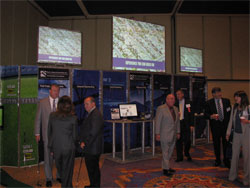 | �
�| Event exhibitors and sponsors contribute to an informative and engaging environment | �
�This year’s meeting was the best yet for the industry-leading construction defect and claims event.
�This year’s seminar concluded on May 13, 2011 with the Construction Defect Community Charitable Foundation Golf Tournament, held at Strawberry Farms Golf Course.
�The Disneyland Hotel in Anaheim, California was the place where more than 1,500 attendees convened for two days of professional development activities and seminars that included CLE workshops and panel discussions of special interest to legal and insurance professionals concerned with construction defect and claims litigation. Key events included “Challenges for Experts in Construction Defect Claims and Litigation,” “Keeping Up with Construction Defect Coverage,” and “Tips for Avoiding the ‘Perfect Storm’ in Handling of Wrap Claims.”
� �  | �
�| Supporting the golf tournament at the 15th hole | �
�This year’s Ollie award was given to George D. Calkins II, Esq. The West Coast Casualty Jerrold S. Oliver Award of Excellence was named in honor of the late Judge Jerrold S. Oliver, and recognizes an individual who is outstanding or has contributed to the betterment of the construction community.
�In addition to being the most comprehensive professional development seminar in the area of construction defects, this year’s seminar was equally valuable as a networking opportunity for members of the industry. People participated in professional development events during the day and then continued networking in the evening at numerous social events. The Lawn Party as well as the legendary Wood, Smith, Henning & Berman events were very well attended. Additional valuable networking events were hosted by a number of industry professionals at the House of Blues, and Tortilla Joe’s.
�As of this writing the 2011, West Coast Casualty's Construction Defect Seminar has applied for or has already received the following continuing education accreditation in the following areas;
�Read the full story…
�For more information about next year’s event, visit West Coast Casualty.
The Flood Insurance Reform Act May be Extended to 2016
April 7, 2011 — April 7, 2011 Beverley BevenFlorez - Construction Defect Journal
The Flood Insurance Reform Act of 2011 (H. R. 1309) has been referred to the House Committee on Financial Services—the first step in the legislative process. The bill, if passed, would extend the program to September 30, 2016. It is currently slated to be terminated September 30 of this year. The bill also contains changes to premium rates, mapping protocols, and privatization initiatives.
�H. R. 1309 has garnered the support of several Insurance organizations. Leigh Ann Pusey, president and CEO of the American Insurance Association (AIA), sent a letter of support to the Chair and Ranking member of the House Financial Services Subcommittee. “AIA has advocated for a long term reauthorization of the NFIP to protect consumers and help increase stability for real estate transactions and policyholders,” Pusey said. “AIA believes the five-year extension contained in HR 1309, will provide certainty in the flood program thereby increasing consumer and business confidence in the NFIP.”
�Jimi Grande, senior vice president of federal and political affairs for the National Association of Mutual Insurance Companies (NAMIC) spoke out in support of the bill. “For the NFIP to survive, the prices for flood insurance must reflect the actual costs of flood risk for a property,” Grande said. “HR 1309 will provide that transparency. In addition, the Technical Mapping Advisory Council will give communities a voice in the flood mapping process, fostering a better understanding of what flood maps represent and how they are made.”
�Read H. R. 1309... �
�Read the American Insurance Association statement... �
�Read the NAMIC Press Release...
No “Special Relationship” in Oregon Construction Defect Claim
July 10, 2012 — CDJ Staff
Writing on his firm’s blog, Justin Stark discusses recent changes in construction defect claims in Oregon where, as he points out, “courts in Oregon have been lowering legal hurdles that construction defect plaintiffs must overcome in bringing their cases.” He cites a case in which water damage was discovered more than six years after construction was complete. The owners claimed breach of contract and negligence. The trial court found for the contractor, who argued “that there was no ‘special relationship’ with the owners that could support the negligence claim.”
This was overturned on appeal, with the court concluding that if there was a violation of the building code, then the negligence claim could stand. This was appealed to the Oregon Supreme court which concluded that “neither a special relationship nor a statutory standard of care, such as the building code, is necessary to bring a negligence claim here.”
Stark notes that “many forms of construction contract incorporate the phrase ‘workmanlike,’ which implicates the ‘common law standard of care’ in negligence law.
Read the full story…
Death of Construction Defect Lawyer Ruled a Suicide
June 19, 2012 — CDJ Staff
The Clark County Coroner’s Office has concluded that Nancy Quon, the construction defect attorney implicated in the wide-ranging HOA scandal, died by her own hand. The cause of death was a combination of anti-anxiety and insomnia medication mixed with alcohol. Quon survived an earlier incident in which she took GHB and her apartment was set on fire. Quon denied that it was a suicide attempt.
Read the full story…
Florida Construction Defect Case Settled for $3 Million
June 19, 2012 — CDJ Staff
The Runaway Beach Club Condominium Association of Kissimmee, Florida has settled its construction defect claims against the parties involved in the construction and development of the buildings. The association claimed that defective roofs and improperly installed windows had lead to leaks and associated damages. A trial date had been set, but parties involved were able to reach this settlement instead.
Read the full story…
Kansas Man Caught for Construction Scam in Virginia
December 20, 2012 — CDJ Staff
A Virginia court sent charges of construction fraud against a Kansas man to a grand jury. Larry Foster visited homes in Bedford County, Virginia, tested the water, and told homeowners that they needed new water filtration systems. The homeowners paid, but Mr. Foster never delivered. One homeowner who testified paid him $1,690. Another paid even more, giving $3,090 to Mr. Foster. In order to dupe his victims, Foster used the address of a chiropractor as a business address, unbeknownst to the actual business there.. He is wanted for charges in other states as well.
Read the full story…
OSHA Extends Temporary Fall Protection Rules
March 1, 2012 — CDJ Staff
OSHA announced that its current rules on fall protection for residential construction will remain in place until September 15, 2012. The current measures became effective in June 2011. Under the new rules, falls must be prevented by fall protection measures unless the measures can be shown to be unfeasible or even hazardous.
�Under the extension of the temporary enforcement measures, contractors who ask for compliance assistance with OSHA are given top priority and penalties can be reduced. OSHA has conducted more than 1,000 outreach sessions on the new rules.
Read the full story…
Unit Owners Have No Standing to Sue under Condominium Association’s Policy
February 10, 2012 — Tred Eyerly, Insurance Law Hawaii
If a condominium owner suffers damage caused by a leak from another unit, may it sue the insurer for the Association of Apartment Owner (AOAO) for coverage? The federal district court for Hawaii said "no" in a decision by Judge Mollway. See Peters v. Lexington Ins. Co., 2011 U.S. Dist. LEXIS 148734 (D. Haw. December 27, 2011).
� Two cases were consolidated. In each case, Plaintiffs owned condominium units at the Watercrest Resort on Molokai. Water leaking from another unit damaged Plaintiffs’ units.
� Watercrest Resort was insured by Lexington pursuant to a policy maintained by the AOAO. Plaintiffs filed claims with Lexington. Lexington hired an adjustor.
� Unhappy with the adjustment of their claims, Plaintiffs sued Lexington and the adjustor.
Read the full story…
� Reprinted courtesy of Tred R. Eyerly, Insurance Law Hawaii. Mr. Eyerly can be contacted at te@hawaiilawyer.com