The MetroWest Daily News reports that a demolition firm was told to leave the construction site at Natick High School since their failure to have workers compensation insurance makes them unable to work on the project. The contractor, Atlantic Dismantling and Site Construction, Inc. may have been working illegally since September.
The equipment that Atlantic had rented for the job was repossessed in August. Brait Builders Corp, the general contractor for the site had rented equipment so Atlantic could continue their work.
Their lack of insurance was discovered when a worker had a minor job-related injury. The state had issued a stop-work order for the firm and they could not legally bid on public projects. The school system did not receive any notice of this, and the school’s facilities director said of the general contractor, “chances are Brait never heard of anything either.”
The Fifth Circuit Court has withdrawn its decision in Ewing Construction Company v. Amerisure Insurance Company, pending clarification from the Texas Supreme Court of its decision in Gilbert Texas Construction, L.P. v. Underwriters at Lloyd’s London. The Fifth Circuit had applied the Gilbert case in determining that a contractual liability exclusion barred coverage for faulty workmanship. The Insurance Journal reports that this decision was both applauded and criticized, with a concern noted that “an insurer would now have its pick of either the ‘your work’ exclusion or the contractual liability exclusion without the exception for subcontracted work.”
The Fifth Circuit is now asking the Texas Supreme Court two questions to clarify Gilbert, which Brian S. Martin and Suzanne M. Patrick see as a sign that the Court has realized that it overly expanded the scope of the earlier ruling. A response is expected from the Texas Supreme Court by spring 2013.
Coverage of the ongoing litigation concerning the Harmon Hotel continues to proliferate. Architectural Record and a number of other news outlets continue to provide additional details and coverage of the matter. Chief among the conditions alleged are improperly installed reinforcing steel inside link beams on 15 floors. MGM Claims that the conditions amount to hundreds of millions of dollars in damages, while Perini (the builder) indicated in a July 12th statement that the buildings problems are related to the design, and the they are “fixable.”
�There is significant speculation that MGM Resorts International isn’t interested in repairing the hotel due to a glut of hotel rooms attendant to the troubled economy. In a statement Tuesday Perini reportedly stated that “Repairing and opening the Harmon would only create a greater glut of unused hotel rooms for MGM,” “If market conditions were better and MGM found that demand existed for the Harmon hotel rooms, MGM would not be claiming that the Harmon is unstable.”
�MGM asserts that Perini failed to ”properly construct” the project. Clark County’s Department of Development Services has reportedly asked MGM to provide a plan to fix the project by August 15th.
�The Harmon is part of the $8.5 billion CityCenter project that opened in the fourth quarter of 2009 and is jointly owned by MGM Resorts and Dubai World.
�Prior reports indicated that the owner (MGM) had considered razing the entire project. The future of the project remains uncertain.
New Buildings in California Soon Must Be Greener
June 19, 2012 — CDJ Staff
The California Energy Commission has approved new energy efficiency standards for new homes and commercial buildings. The 2013 Building Energy Efficiency Standards are set to go into effect on January 1, 2014, and will require 30% more energy efficiency for non-residential construction and 25% more for homes. The standards do not affect hospitals, nursing homes, or prisons.
Buildings covered under the standard will have to have roofs that ready for the installation of solar panels. Additionally, non-residential buildings will require high-performance windows, advanced lighting controls, and cool-roof technologies. Residential requirements include insulated hot-water pipes, whole house fans, and more efficient windows.
The new standards are expected to add 3,500 new building industry jobs. One thing these construction workers won’t be building are power plants, since over the next thirty years, the standards are expected to save as much as six power plants.
Read the full story…
Construction Defects and Contractor-Owners
July 10, 2012 — CDJ Staff
On the expert advice site Avvo.com, a user asks if he can be sued for construction defects by the new owner of a building for which he served as general contractor and then owned for four years. He had construction insurance, but does not think he had construction defect insurance.
A lawyer responding to his question says that “you could be sued.” In the event of a suit, “you would have to bring claims against all of your subcontractors.”
Read the full story…
Safety Officials Investigating Death From Fall
September 9, 2011 — CDJ Staff
California safety officials are looking into the circumstances surrounding the death of a construction worker who fell from a roof in Tiburon, California. Another worker found Gabriel Vasquez unconscious at the site. Vasquez was later pronounced dead. The State Division of Occupational Safety and Health are trying to determine how Vasquez fell.
Read the full story…
Texas Windstorm Insurance Agency Under Scrutiny
April 5, 2011 — April 5, 2011 Beverley BevenFlorez - Construction Defect Journal
Representative Larry Taylor has introduced a bill in the Texas Legislature (HB 2818) that would further regulate the Texas Windstorm Insurance Agency (TWIA). According to Taylor, “In order to be adequately prepared for future hurricane seasons, it is imperative that TWIA be operating at maximum efficiency, that the Reserve Trust Fund be solvent and that the agency have adequate management measures in place to protect consumers and ensure that claims are paid in a timely manner. House Bill 2818 is an important step in the right direction toward restoring public confidence in TWIA.”
�HB 2818 includes measures that would create an expert panel that would advise the commissioner on how to evaluate loss from the storm, and a greater transparency of TWIA Board meetings and actions.
�In addition, the Texas Department of Insurance (TDI) has placed TWIA on Administrative Oversight. According to TDI, “While under Administrative Oversight, the Department may require its prior review and approval of executive decisions, certain expenditures, and other transactions. The insurer is required to fully cooperate with the Department and provide complete and timely disclosure of all information responsive to Department requests.”
�Read the full story (Rep. Taylor’s Press Release)...
�Read the full story (Texas Department of Insurance’s Press Release)...
Faulty Workmanship may be an Occurrence in Indiana CGL Policies
April 7, 2011 — April 7, 2011 Beverley BevenFlorez - Construction Defect Journal
The question of whether construction defects can be an occurrence in Commercial General Liabilities (CGL) policies continues to find mixed answers. The United States District Court in Indiana denied the Plaintiff’s Motion for Summary Judgment in the case of General Casualty Insurance v. Compton Construction Co., Inc. and Mary Ann Zubak stating that faulty workmanship can be an occurrence in CGL policies.
�Judge Theresa L. Springmann cited Sheehan Construction Co., et al. v. Continental Casualty Co., et al. for her decision, ”The Indiana Supreme Court reversed summary judgment, which had been granted in favor of the insurer in Sheehan, holding that faulty workmanship can constitute an ‘accident’ under a CGL policy, which means any damage would have been caused by an ‘occurrence’ triggering the insurance policy’s coverage provisions. The Indiana Supreme Court also held that, under identically-worded policy exclusion terms that are at issue in this case, defective subcontractor work could provide the basis for a claim under a CGL policy.”
�As we reported on April 1st, South Carolina’s legislature is currently working on bill S-431 that would change the wording of CGL policies in their state to include construction defects. Ray Farmer, Southwest region vice president of the American Insurance Association spoke out against the bill. “CGL policies were never meant to cover faulty workmanship by the contractor,” he said. “The bill’s supplementary and erroneous liability provisions will only serve to unnecessarily impact construction costs in South Carolina.”
� �Read the Opinion and order... �
�Read the court’s ruling... �
�Read the American Insurance Association statement...
Harmon Tower Construction Defects Update: Who’s To Blame?
August 17, 2011 — CDJ Staff
Reporting on the site VegasInc.com, Liz Benton notes that “nobody wants to take the fall for what happened at Harmon.” Work on the Harmon hotel building in Las Vegas’s CityCenter stopped in 2008 after 26 of the planned 49 stories were completed. Lorence Slutzky, a construction law professor at John Marshall Law School and a partner with the Chicago firm Robbins Schwartz Nicholas Lifton & Taylor told Benton that while inspectors and others are complicit, “the real responsibility rests with Perini, which has an obligation to comply with the plan specifications.” Perini’s claim is that they were given faulty design drawings. MGM disputes this.
�Perini has offered to repair the building defects, however MGM has released a statement that they have “zero confidence or trust that Perini can and will properly fix a building it has so badly constructed thus far.” One MGM spokesperson likened these requests from Perini to “the director of ‘Ishar’ demanding a sequel.” “Ishtar,’ cost Columbia Pictures $55 million dollars and earned only $4.2 million in its initial run. Perini claims that MGM halted work because of the economy.
Read the full story…
2011 West Coast Casualty Construction Defect Seminar – Recap
June 1, 2011 — CDJ Staff
� 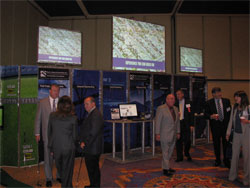 | �
�| Event exhibitors and sponsors contribute to an informative and engaging environment | �
�This year’s meeting was the best yet for the industry-leading construction defect and claims event.
�This year’s seminar concluded on May 13, 2011 with the Construction Defect Community Charitable Foundation Golf Tournament, held at Strawberry Farms Golf Course.
�The Disneyland Hotel in Anaheim, California was the place where more than 1,500 attendees convened for two days of professional development activities and seminars that included CLE workshops and panel discussions of special interest to legal and insurance professionals concerned with construction defect and claims litigation. Key events included “Challenges for Experts in Construction Defect Claims and Litigation,” “Keeping Up with Construction Defect Coverage,” and “Tips for Avoiding the ‘Perfect Storm’ in Handling of Wrap Claims.”
� �  | �
�| Supporting the golf tournament at the 15th hole | �
�This year’s Ollie award was given to George D. Calkins II, Esq. The West Coast Casualty Jerrold S. Oliver Award of Excellence was named in honor of the late Judge Jerrold S. Oliver, and recognizes an individual who is outstanding or has contributed to the betterment of the construction community.
�In addition to being the most comprehensive professional development seminar in the area of construction defects, this year’s seminar was equally valuable as a networking opportunity for members of the industry. People participated in professional development events during the day and then continued networking in the evening at numerous social events. The Lawn Party as well as the legendary Wood, Smith, Henning & Berman events were very well attended. Additional valuable networking events were hosted by a number of industry professionals at the House of Blues, and Tortilla Joe’s.
�As of this writing the 2011, West Coast Casualty's Construction Defect Seminar has applied for or has already received the following continuing education accreditation in the following areas;
�Read the full story…
�For more information about next year’s event, visit West Coast Casualty.
Builder Cannot Receive Setoff in Construction Defect Case
July 10, 2012 — CDJ Staff
The California Court of Appeals has dismissed an appeal in a San Diego construction defect case. In Smith v. Walters Group, Christopher and Maud Smith sued The Walters Group, a real estate developer, and Galen C. Pavelko, Inc, the builder of their home. Walters had bought five lots and hired Pavelko to build houses on them, selling one of these homes to the Smiths. “After moving in, the Smiths noticed a strong and obnoxious odor permeating the house.” The Smiths sued but were ordered to arbitrate instead, pursuant to a clause in the purchase contract. The Smiths were awarded $1.5 million at arbitration.
Walters requested that the arbitration remain open to determine if Walters was entitled to a setoff for settlements from defendants not involved in the arbitration. During this time, Pavelko made a settlement with the Smiths, which the court found was in good faith. At the same time, the arbitrator “reached the opposite conclusion.” The arbitrator concluded that “only settlements made ‘in good faith before verdict or judgment’ qualified for setoff.”
Walters moved that the trial court “‘correct’ the award,” but the trial court declined to do so and confirmed the award. In the appeal, Walters raised the issue of “whether Pavelko’s settlement occurred ‘before verdict or judgment.’” The appeals court dismissed the appeal, noting that “Walters would not be entitled to a $500,000 setoff if we reversed the trial court’s order determining the Smith-Pavelko settlement was made in good faith because Pavelko’s $500,000 payment was expressly conditioned on such an order.” They add that “were we to reverse the trial court’s order, Pavelko would have no obligation to pay the Smiths the $500,000.” This would then “deprive Walters of the corresponding statutory right to a setoff.”
Read the court’s decision…
Subcontractor Not Liable for Defending Contractor in Construction Defect Case
February 10, 2012 — CDJ Staff
The California Court of Appeals has ruled on January 9, 2012 in Hensel Phelps Construction Company v. Urata & Sons Cement, upholding the judgment of the lower court.
�Hensel Phelps was the general contractor for a high-rise in Sacramento. They were sued by the owners of the building after problems were discovered in the concrete slabs of the building’s parking garage. Instead of welded steel wire mesh, the slabs had been constructed with fiber mesh. Hensel Phelps filed a cross-complaint against Urata Cement, the subcontractor that had performed the cement work. Urata refused to defend Hensel Phelps. The owners’ case was subsequently dismissed due to the statute of limitations.
�Although the original case was over, Hensel Phelps continued in their claims against Urata. “Urata argued that a handwritten interlineation required Hensel Phelps to prove Urata was at fault for the injury alleged in the building owners’ complaint before Urata was obliged to defend Hensel Phelps in that action.”
�The lower court concluded that Urata would have been obligated to defend Hensel Phelps if the owners’ lawsuit had alleged that the damage was due to the subcontractor’s work or if evidence at trial established this. The lower court found neither of these true. Instead, the use of the fiber mesh was a design issue and “that decision was outside the scope of the subcontractor’s work.”
�During the trial, Hensel Phelps conceded that Urata was not at fault. The appeals court could find no reading of the contract that would cause Urata to be obligated to defend Hensel Phelps, calling Hensel Phelps’s reading of the contact as “grammatically infeasible.”
�Judges Nicholson, Raye, and Butz upheld the decision of the lower court and awarded costs on appeal to Urata.
Read the court’s decision…
Preparing for Trial on a Cause of Action for Violation of Civil Code section 895, et seq.�
May 10, 2012 — Samir R. Patel, Esq., Lorber, Greenfield, & Polito, LLP
In 2002, the California Legislature enacted the Right to Repair Act (hereinafter “SB-800”), as codified in Title VII of the Civil Code. As set forth in Civil Code section 895, et seq., SB-800 established a set of standards for residential construction, and provides a statutory protocol to address alleged violations of those standards. SB-800 applies to all new single family homes sold after January 1, 2003, and it created its own cause of action governed completely by its own terms, in that in order to state a cause of action under SB-800, a plaintiff may only allege a violation of the Act. (Civ. Code, § 938.) Under Civil Code sections 896, 897, 943, and 944, the Legislature made it clear that it intended to create a single cause of action for construction defects in homes that fall under the purview of SB-800. By passing SB-800, the Legislature eliminated multiple and often redundant or conflicting causes of action, burdens of proof, statutes of limitations, and types of damages that were common in construction defect actions prior to the enactment of the same.
�Civil Code section 895, et seq. has significantly changed the landscape of construction defect lawsuits. Yet, for years, the only attention given to the statutes focused solely on the codified pre-litigation process that requires plaintiffs and builders to meet and confer regarding defects and attempt a process to repair the alleged defects before litigation is pursued. A major impediment to the implementation of the pre-litigation procedures has often been that the statutes specifically state that the information obtained during the pre-litigation process is admissible at trial. Hence, through use of the pre-litigation process, plaintiffs’ counsel can engage in a builder funded fishing expedition and later use the information obtained to advance their litigation goals. As such, many builders have chosen to opt out of codified pre-litigation process altogether, an option which the builder can elect within their Purchase and Sale Agreements.
�Recently, counsel for builders throughout California have turned their attention to the “exclusive remedy” aspect of SB-800 by seeking, often successfully, to limit plaintiffs to a single cause of action for violation of SB-800. Civil Code section 943 makes clear that a cause of action for violation of SB-800 performance standards is a plaintiff’s sole remedy for a residential construction defect action. Civil Code section 943 states:
�Except as provided in this title, no other cause of action for a claim covered by this title or for damages recoverable under 944 is allowed. (Civ. Code, § 943.) Â
�The question remains: what is the benefit of requiring plaintiffs to trim down their complaint and eliminate their tried and true common law causes of action, and requiring them to pursue only a single cause of action for violation of SB800?
�The construction standards enumerated within SB-800 include fifty-plus functionality standards. On their face, any benefit to pursuing a construction defect action under a single cause of action for violation of SB-800 initially appears trivial at best, in light of the fact that a jury may be very confused with the complexity of the functionality standards set forth within the Civil Code. Nevertheless, Title VII of the Civil Code actually contains numerous provisions that builders can utilize to their benefit throughout the process of construction defect litigation, including during preparation for trial.
�First and foremost, counsel for builders can assert numerous affirmative defenses that will be beneficial if the matter proceeds to trial. These affirmative defenses, as codified in Civil Code section 945.5, include mitigation, in whole or in part, for damages caused by: an unforeseen act of nature; a homeowner’s failure to allow reasonable and timely access for inspections and repair under the pre-litigation procedures; the homeowner’s failure to follow the builder’s recommendations and commonly accepted homeowner maintenance obligations; ordinary wear and tear; misuse; abuse; or neglect. Builders should include these affirmative defenses within their responsive pleadings and as trial approaches, prepare appropriate motions in limine and request special jury instructions regarding the same. As frustrated builders and their attorneys are well aware, many construction defect suits result from a homeowner’s failure to properly maintain their property in a manner that is consistent with normal maintenance procedures and guidelines. Furthermore, within the ten year statute of limitations for most defects, ordinary wear and tear is often attributable to numerous deficiencies alleged by plaintiffs. The affirmative defense for a homeowner’s failure to allow inspections and repairs is also vital, as plaintiffs’ counsel may encourage a homeowner to forego the repair and seek monetary damages, allowing plaintiffs’ counsel to ultimately obtain their share of attorney’s fees. Therefore, the SB-800 statutes provide the builder with recourse and distinctive mitigation defenses that were previously and confusingly mixed into tort and contract related defenses. These affirmative defenses can also be utilized by counsel during the cross-examination of plaintiff homeowners and expert witnesses. Defense counsel should fully grasp these defenses and utilize them as defense themes throughout litigation.
�As a plaintiff is limited to a single cause of action for violation of SB-800, if defense counsel has failed to properly eliminate excessive tort and contract causes of action prior to trial, a motion for summary adjudication, or at the very least, a motion for judgment on the pleadings should be brought to limit the introduction of evidence outside of a single cause of action for violation of SB-800. Practical judges are always looking for ways to streamline and expedite trials, and they are currently ruling that SB-800 is the exclusive remedy available to plaintiffs. In fact, plaintiffs’ firms in SB-800 matters are now voluntarily limiting their complaints to this one cause of action.
�Special jury instructions can also be crafted to limit a jury’s computation of damages pursuant to Civil Codesection 944, which provides the method for computing damages within a construction defect action, as follows:
�If a claim for damages is made under this title, the homeowner is only entitled to damages for the reasonable value of repairing any violation of the standards set forth in this title, the reasonable cost of repairing any damages caused by the repair efforts, the reasonable cost of repairing and rectifying any damages resulting from the failure of the home to meet the standards, the reasonable cost of removing and replacing any improper repair by the builder, reasonable relocation and storage expenses, lost business income if the home was used as a principal place of a business licensed to be operated from the home, reasonable investigative costs for each established violation, and all other costs or fees recoverable by contract or statute. (Civ. Code, § 944.) [Emphasis added.]
�Civil Code section 944 specifically prohibits recovery for damages outside the scope of its explicit language as it states “the homeowner is only entitled to ... damages for the reasonable value of repairing any violation of the standards set forth in this title....” [Emphasis added.] The statute ultimately provides a “reasonableness” standard for the computation of damages that did not exist when computing damages on traditional common law tort and contract claims. Therefore, defense counsel should prepare special jury instructions to limit evidence of damages introduced at trial to the reasonable value of repairing any violation of the standards, and to exclude any evidence of damages beyond the reasonableness standard. Defense counsel should seize the opportunity to utilize the theme of “reasonableness” when attacking plaintiffs’ allegations and plaintiffs’ proposed repair methodology throughout the discovery process and at trial.
�Defense counsel may also prepare a motion in limine or special jury instruction regarding the limitation of evidence regarding defects that did not cause resultant damage. Civil Code section 897 states:
�Intent of Standards
�The standards set forth in this chapter are intended to address every function or component of a structure. To the extent that a function or component of a structure is not addressed by these standards, it shall be actionable if it causes damage. (Civ. Code, § 897.) [Emphasis added.]
�Defense counsel can argue that the introduction of any evidence supporting a claim for construction-related deficiencies that are not enumerated within Civil Code section 896, or for deficiencies where no damage has occurred is prohibited and must be excluded at trial. This requirement of resultant damages is familiar as the general rule was previously established in Aas v. Superior Court (2000) 24 Cal.4th 627, in which the California Supreme Court held that there is no tort recovery for construction defects that have not actually caused property damage. The legislature effectively codified this rule within Civil Code section 897.
�A motion in limine can also be crafted to limit expert testimony to the standards enumerated in Civil Code section 896, and to deficiencies that caused damage pursuant to Civil Code 897. The motion in limine can be based upon Civil Code section 943 and the fact that claims for defects in homes which were sold after January 1, 2003 may only be pursued under a single cause of action for violation of SB-800. As such, expert testimony should be controlled by the standards set forth in Civil Code section 896. Furthermore, throughout a construction defect matter, defense counsel should ensure that their experts are well versed with the standards and that they can provide testimony that utilizes the same. Defense counsel’s knowledge of the standards will also be helpful during the cross-examination of plaintiffs’ expert witnesses.
�If, despite the efforts of defense counsel, the complaint still has numerous causes of action, or if only some homes fall under the purview of SB-800 while others do not, defense counsel can utilize a motion to bifurcate trial. The motion’s basis is that a cause of action for violation of SB-800 will require the introduction of evidence regarding the violations of the fifty-plus standards, and the tort and contract-based claims would also require the introduction of a wide range of evidence to prove each cause of action. For example, in order to prove the tort causes of action, plaintiffs must prove elements such as: duty, breach, proximate and actual causation, and that the builder placed the homes into the stream of commerce. (See Richards v. Stanley (1954) 43 Cal.2d 60, 63; Kriegler v. Eichler Homes, Inc. (1969) 269 Cal.App.2d 224, 227.) On the contract causes of action, plaintiffs must prove the existence of a valid written contract for the sale of the home, including proof regarding the existence of basic contractual elements such as offer, acceptance, and consideration. (Civ. Code, § 1624 subd. (a); Roth v. Malson (1997) 67 Cal.App.4th 552, 557.) Defense counsel can argue that exposing the jury to elements that may or may not be applicable to all of the homes in the action will complicate and confuse the jury. Thus, concurrently exposing the jury to the SB-800 claims and the non-SB-800 claims will necessitate undue consumption of time, and create the substantial danger of undue prejudice of confusing the issues or misleading the jury.
�One of the most important and relevant features of the SB-800 statutes is that they include shortened statutes of limitation as to certain enumerated defects. The codified statutes of limitations apply from the date of “close of escrow,” and are much more definitive than statutes of limitations regarding tort and contract claims. Therefore, they can be utilized within a motion for summary adjudication in cases where only one or a few defects are alleged. For example, under Civil Code section 896, et seq., there is a five year limitation on paint (Civ. Code, § 896, subd. (g)(1)); a four year limitation on plumbing fixtures (Civ. Code, § 896, subd. (e)); a three year limitation on landscaping (Civ. Code § 896, subd. (g)(12)); and a one year limitation on irrigation systems and drainage (Civ. Code, § 896, subd. (g)(7)). The non-SB-800 claims are subject to a four year statute of limitation for patent defects and a ten year statute of limitation for latent defects. (See Code of Civ. Proc., §§ 337.1, 337.15.) The contrast between the statute of limitations for the SB-800 claims and non-SB-800 claims can complicate a matter at trial, further establishing the necessity to limit plaintiffs to a single cause of action for violation of SB-800. Hence, defense counsel should also utilize a motion to bifurcate the statute of limitations issues from the issue of liability if a question of fact exists. If successful on the motion to bifurcate, plaintiff’s counsel will be barred from the introducing evidence at trial regarding a defect where the statute of limitations has run.
�Defense counsel should also seek to simplify the construction standards for the jury. Ultimately, by drafting jury instructions and a special verdict form that is easy to navigate, counsel can promote an easy interpretation of the standards enumerated within the Civil Code. The best route for drafting a special verdict form is to draft it as a check-list, similar to a traditional real estate walk-through check-list. By incorporating the shortened statutes of limitations into the special verdict form, defense counsel can effectively frame the case for the jury. The special verdict form should also allow the jury to easily eliminate any claim for damages that is mitigated, in whole or in part, through the codified affirmative defenses. Defense counsel should also consider drafting a trial brief that effectively and simplistically provides the trial court judge with an understanding of the specific defects before the court, and simultaneously notes which Civil Code standards are implicated and the scope of the same. If the trial judge is not well versed in construction defect litigation, defense counsel should be all the more careful in breaking down the parameters and limitations codified within SB-800 for the court.
�The strategies outlined within this article are only a few tactics that can be utilized to defend a construction defect suit. Depending on the defect allegations within any particular case, defense counsel should become intimately familiar with Title VII of the Civil Code and use all aspects of the same to their advantage. If not, plaintiffs’ counsel will have the advantage during “court-house step” settlement discussions and at trial.
� Printed courtesy of Samir R. Patel, Esq. of Lorber, Greenfield, & Polito, LLP. Mr. Patel can be contacted at spatel@lorberlaw.com.
�
Alabama “occurrence” and subcontractor work exception to the “your completed work” exclusion
November 18, 2011 — CDCoverage.com
In Town & Country Property, LLC v. Amerisure Ins. Co., No. 1100009 (Ala. Oct. 21, 2010), property owner Town & Country contracted with insured general contractor Jones-Williams for the construction of a car dealership. All of the construction work was performed by Jones-Williams subcontractors. After completion, Town & Country sued Jones-Williams for defective construction. Jones-Williams’ CGL insurer Amerisure defended. The case was tried and a judgment was entered against Jones-Williams in favor of Town & Country. After Amerisure denied any obligation to pay the judgment, Town & Country sued Amerisure in a statutory direct action.
Read the full story…
Reprinted courtesy of CDCoverage.com.
Local Government Waives Construction Fees to Spur Jobs
June 19, 2012 — CDJ Staff
Warren Township in New Jersey has waived building and electrical permit fees, up to $5,000, for businesses that create at least five new jobs. The fee reductions are available for construction in areas zones under various designations. Buildings that have received a zoning variance are not eligible. The Echoes-Sentinel notes that other towns in Somerset County, New Jersey have adopted similar ordinances.
Read the full story…
Pictorial Construction Terminology Dictionary — A Quick and Helpful Reference
July 10, 2012 — CDJ Staff
Does it seem like contractors speak their own language? Construction defect professionals can be hampered by not knowing the terminology. The Bert L. Howe & Associates, Inc. web site has a handy Pictorial Construction Terminology Dictionary in which more than a thousand terms are not only defined, but illustrated with pictures that give a visual component to each definition.
Whether you’re wondering what a balustrade is, or you need to identify a joist girder, or hundreds of other terms, the Pictorial Construction Terminology Dictionary is there to help you. It can be found at http://www.berthowe.com/bhapedia.php.
Ensuing Loss Provision Does Not Salvage Coverage�
October 23, 2012 — Tred Eyerly, Insurance Law Hawaii
The insureds' home was built in 1989. In 2006, extensive water damage was found to the house. The insureds notified their carrier, Chubb. The insureds had coverage for all risks unless stated otherwise in the policy or if an exclusion applied.
�Chubb hired an adjustor who determined that defective construction had enabled water to enter the wall and beam systems. Chubb denied coverage under the faulty planning, construction or maintenance exclusion.
� Read the full story…
��Reprinted courtesy of Tred R. Eyerly, Insurance Law Hawaii. Mr. Eyerly can be contacted at te@hawaiilawyer.com
��
Pier Fire Started by Welders
August 2, 2012 — CDJ Staff
Welders working on Pier 29 in San Francisco were preparing the building for the America’s Cup sailing race. Instead, they accidentally caused $2.4 million in damages. Mindy Talmadge, a fire department spokesperson, attributed the fire to crews welding a latter to a wall. According to Talmadge, a spark entered a crack in the concrete wall and “the wood on the building underneath was really dry.” It took firefighters more than two hours to extinguish the blaze.
Read the full story…