Exclusion Bars Coverage for Mold, Fungus�
October 23, 2012 — Tred Eyerly, Insurance Law Hawaii
The court considered whether rain damage to a house was barred by the policy's mold exclusion. Stewart v. State Farm Fire & Cas. Co., 2012 U.S. Dist LEXIS 127804 (D. S.D. Sept. 7, 2012).
�The insureds hired DJ Construction to build a new home. Before construction was completed, it was discovered that DJ Construction and some of its subcontractors had failed to protect the partially constructed house from the elements, which allowed melting snow and rain to intrude into the house. Soon after this discovery, DJ Construction abandoned the project. The house remained incomplete and uninhabitable.
�The insureds sued DJ Construction.
� Read the full story…
��Reprinted courtesy of Tred R. Eyerly, Insurance Law Hawaii. Mr. Eyerly can be contacted at te@hawaiilawyer.com
��
Colorado “occurrence”
January 6, 2012 — CDCoverage.com
In Greystone Construction, Inc. v. National Fire & Marine Insurance Co., No. 09-1412 (10th Cir. November 1, 2011), general contractors Greystone and Branan were each sued by purchases of homes built by each alleging defective construction performed by subcontractors. CGL insurer American Family Mutual Insurance Company defended both Greystone and Brannon while co-insurer National Fire & Marine Insurance Company denied a defense. Greystone, Branan, and American Family sued National Fire for contribution towards defense costs. The federal district trial court entered summary judgment for National Fire.
Read the full story…
Reprinted courtesy of CDCoverage.com
Going Green for Lower Permit Fees
October 23, 2012 — CDJ Staff
Clay County, Kansas is offering rebates on building permits for green homes. According to the Kansas City Star, building permits in the county are typically $2,500. The county will rebate anything from half to all of the permit fee, depending on how well the builder meets green standards. The county will monitor and inspect the process to make certain that builders adhere to their promises for green construction. The county hopes this will encourage green building by offsetting the cost.
� Read the full story…
�
Washington Court Limits Lien Rights of Construction Managers
August 17, 2011 — Douglas Reiser, Builders Counsel
A newly filed, yet unpublished, court opinion opines that a construction manager cannot file a construction lien in Washington state. So, how far reaching is this opinion?
�In the case of Blue Diamond Group Inc. v. KB Seattle 1, Inc., et al, a New York construction manager filed a lien against the Westfield Southcenter Mall in Tukwila, Washington. The lien was filed after the owner of a coffee stand failed to pay Blue Diamond for consulting services used in the construction of a kiosk.
�Blue Diamond served as the owner’s agent, assisting with managing subcontractors, vendors and other tasks. The manager’s tasks also included paying invoices, managing deliveries, setting schedules and other site managerial tasks. Blue Diamond was not registered as a contractor under Washington’s RCW 18.27.
Read the full story…
�Read the court’s decision…
�Reprinted courtesy of Douglas Reiser of Reiser Legal LLC. Mr. Reiser can be contacted at info@reiserlegal.com
Injured Construction Worker Settles for Five Hundred Thousand
October 28, 2011 — CDJ Staff
An upstate New York man who was injured when an unsecured truss fell off the railings of a scissor lift has settled for $500,000. As the accident happened at the building site for a casino for the Seneca Nation, attorneys for the construction firm had argued that New York labor laws were inapplicable as the injury happened on Seneca Nation land. The state appeals court ruled that as none of the parties involved were Native Americans, it was not internal to the affairs of the Seneca Nation.
Read the full story...
Policyholder Fails to Build Adequate Record to Support Bad Faith Claim
May 19, 2011 — May 19, 2011 -
Tred R. Eyerly,
Insurance Law HawaiiThe importance of careful preparation and documentation was the take away lesson in a Texas bad faith case, C.K. Lee v. Catlin Specialty Ins. Co., 2011 U.S. Dist. LEXIS 19145 (S.D. Tex. Feb. 28, 2011).
�C.K. Lee owned a commercial shopping center in Houston. Catlin issued a commercial property policy to Lee. On September 12, 2008, Hurricane Ike hit and caused substantial property damage throughout the Texas Gulf Coast area. On September 24, 2008, Lee submitted a claim for damage to the roof of his shopping center to Catlin.
�Catlin hired Engle Martin to represent its interests in adjusting the claim. Engle Martin eventually adjusted over 200 Ike-related claims for Catlin.
�In November 2008, Engle Martin and Emergency Services Inc., retained by Lee, inspected Lee’s property. Engle Martin observed evidence of roof repairs that had apparently been made both before and after Hurricane Ike. Engle Martin decided it was necessary to use an infrared scan of the roof to help identify which damages, if any, were attributable to wind and which, if any, were attributable to sub par, prior repairs or natural deterioration.
�Engle Martin retained Project, Time & Cost (PT&C) to conduct the infrared inspection. PT&C’s inspection determined there was no wind-related damage to the roof and no breaches or openings created by wind. Instead, the roof had exceeded its life expectancy and was in need of replacement due to normal wear and weathering. Consequently, Catlin decided that the damage to Lee’s roof was not caused by winds from Hurricane Ike.
�Meanwhile, Lee’s contractor, Emergency Services, prepared a report estimating that the total cost of repairing the roof would be $871,187. Engle Martin’s estimate for repair of the roof was $22,864.
�Lee filed suit for breach of contract, breach of the duty of good faith and fair dealing, and violations of the Texas Insurance Code. Catlin moved for summary judgment on all claims but breach of contract, arguing that because there was a bona fide dispute concerning the cause of the damages and whether they were covered under the policy, there was no evidence of bad faith or violations of the Texas Insurance Code.
�Read the full story…
� �Reprinted courtesy of Tred R. Eyerly, Insurance Law Hawaii. Mr. Eyerly can be contacted at te@hawaiilawyer.com
New Washington Law Nixes Unfair Indemnification in Construction Contracts
April 25, 2012 — Douglas Reiser, Builders Cousel
Contractual fairness ? it is part of my mantra. If you read the blog, you probably know that I preach brevity, balance and clarity in contracting. The State of Washington did well to finally eliminate something that has angered me for quite some time ? unfair indemnification.
�One of my favorite construction contract revisions is mutual indemnification. Many “up the chain” contractors and owners are going to stick you with a unilateral indemnification clause that protects them for just about everything, including their own fumbling of a project. Adding mutual indemnification provides some balance, and keeps parties reliant upon each other for success on the job site.
�
Read the full story…
�Reprinted courtesy of Douglas Reiser of Reiser Legal LLC. Mr. Reiser can be contacted at info@reiserlegal.com
�
Lower Court “Eminently Reasonable” but Wrong in Construction Defect Case
July 10, 2012 — CDJ Staff
Noting that “circuit court’s orders are eminently reasonable, logical and just” the Supreme Court of Appeals of West Virginia has granted a writ to halt enforcement of these orders and to compel arbitration instead in the case of State v. Tucker. The initial case concerned claims that an HVAC system had been improperly designed, constructed, manufactured, or maintained, leading to serious problems. Glenmark Holding, the owner of the Suncrest Executive Plaza brought a lawsuit against seven defendants. Three of the defendants, Morgan Keller, Inc, York International Corporation, and Johnson Controls, Inc. argued that Glenmark was obligated to enter into arbitration.
Glenmark and the other defendants argued that the motions for arbitration should be denied “so all the claims and cross-claims of the parties could be litigated in one forum, in one proceeding.” The circuit court noted that arbitration is preferred over litigation because of its supposed “expeditious, economic resolution of issues,” but that in this case, “the petitioners would expend additional, not fewer resources responding to the parties’ claims and cross-claims.” As “compulsory arbitration would be insufficient and inequitable” the court denied the request, finding the arbitration clauses “unconscionable and, therefore, unenforceable.”
Morgan Keller, York, and Johson argued that “the interpretation of arbitration clauses is governed exclusively by the Federal Arbitration Act.” The appeals court found that “the circuit court was within its authority to consider Glenmark’s claim that the arbitration clauses were unenforceable.” However, the appeals court rejected the circuit court’s conclusion about the “piecemeal” resolution of the conflict, as it contradicts a Supreme Court ruling. The Supreme Court stated in 1983 that the FAA “requires piecemeal resolution when necessary to give effect to an arbitration agreement.” In a 1985 decision, the Court held that a court could “not substitute [its] own views of economy and efficiency.”
Nor could the court find the arbitration clause to be unconscionable or unenforceable. The court noted that the contract was a standard AIA form, and was amended by the parties involved, whom the court characterized as “commercially sophisticated.” The court found that the agreement limited the rights of all parties and was not one-sided.
As the arbitration clause was neither unconscionable nor unenforceable, and Supreme Court rulings preclude a court from substituting its own procedures, even when these are “eminently reasonable, logical and just,” the appeals court halted the order of the circuit court, sending the matter to arbitration.
Read the court’s decision…
Celebrities Lose Case in Construction Defect Arbitration
May 26, 2011 — CDJ Staff
An arbitration panel has ruled that problems with the Idaho home of actors Tom Hanks and Rita Wilson were not due to construction defects but rather to “poor design and bad architectural advice.” The couple had settled with the architectural firm, Lake Flato of San Antonio, Texas for $900,000 and was subsequently seeking $3 million from Storey Construction of Ketchum, Idaho.
Problems with the couple’s home “included leaking roofs, inadequate drainage, fireplaces that did not vent properly and an inadequate air-conditioning system. In 2003, sliding snow from the roof damaged kitchen windows and roof components.”
The arbitration panel, according to the report in the Idaho Mountain Express and Guide, noted that “Hanks and Wilson were responsible for the full $167,623 cost of arbitration, but further denied a Storey Construction counterclaim that alleged Hanks and Wilson filed their claim out of malice.”
Read the full story…
2011 West Coast Casualty Construction Defect Seminar – Recap
June 1, 2011 — CDJ Staff
� 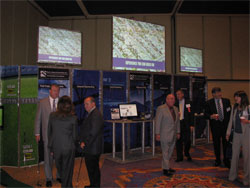 | �
�| Event exhibitors and sponsors contribute to an informative and engaging environment | �
�This year’s meeting was the best yet for the industry-leading construction defect and claims event.
�This year’s seminar concluded on May 13, 2011 with the Construction Defect Community Charitable Foundation Golf Tournament, held at Strawberry Farms Golf Course.
�The Disneyland Hotel in Anaheim, California was the place where more than 1,500 attendees convened for two days of professional development activities and seminars that included CLE workshops and panel discussions of special interest to legal and insurance professionals concerned with construction defect and claims litigation. Key events included “Challenges for Experts in Construction Defect Claims and Litigation,” “Keeping Up with Construction Defect Coverage,” and “Tips for Avoiding the ‘Perfect Storm’ in Handling of Wrap Claims.”
� �  | �
�| Supporting the golf tournament at the 15th hole | �
�This year’s Ollie award was given to George D. Calkins II, Esq. The West Coast Casualty Jerrold S. Oliver Award of Excellence was named in honor of the late Judge Jerrold S. Oliver, and recognizes an individual who is outstanding or has contributed to the betterment of the construction community.
�In addition to being the most comprehensive professional development seminar in the area of construction defects, this year’s seminar was equally valuable as a networking opportunity for members of the industry. People participated in professional development events during the day and then continued networking in the evening at numerous social events. The Lawn Party as well as the legendary Wood, Smith, Henning & Berman events were very well attended. Additional valuable networking events were hosted by a number of industry professionals at the House of Blues, and Tortilla Joe’s.
�As of this writing the 2011, West Coast Casualty's Construction Defect Seminar has applied for or has already received the following continuing education accreditation in the following areas;
�Read the full story…
�For more information about next year’s event, visit West Coast Casualty.
Window Manufacturer Weathers Recession by Diversifying
October 28, 2011 — CDJ Staff
American Openings, a Tuscon-based window manufacturer, has responded to the loss of its sales of windows for new home construction by moving into new markets. The Arizona Daily Star reports that American Openings used to see providing windows for new homes as half their business. Now, Tom Regina, the founder and president says “single family is just dead.”
Their products are insulated windows, designed to comply with Energy Star standards. Without new homes being built, now the company is focusing on homeowners and building owners looking for more energy efficient windows. As the windows have two or three panes and special coatings, homeowners using them are eligible for tax credits.
One of their newer products combines their energy-saving coatings with “break resistant” glass. The article notes that the windows repel “all but the most determined burglars.” However, the company is still awaiting special equipment to cut the glass.
Read the full story...
Insurer Must Defend Claims for Diminution in Value of Damaged Property
June 19, 2012 — Tred Eyerly, Insurance Law Hawaii
The insurer’s duty to defend a developer sued by purchasers of homes for damages for diminution in value of homes was at issue in Mid-Continent Cas. Co. v. Academy Dev., Inc., 2012 WL 1382459 (5th Cir. April 20, 2012).
In the underlying action, plaintiffs alleged the developer knew when it sold the homes that the lake walls were falling and that water was leaking from the lakes onto adjacent home sites. They sought damages for diminution in the value of their homes resulting from the defective lakes. The action was tried in 2008, and the jury returned a verdict for the developer.
Mid-Continent initially defended under a reservation of rights.
Reprinted courtesy of Tred R. Eyerly, Insurance Law Hawaii. Mr. Eyerly can be contacted at te@hawaiilawyer.com
Read the full story…
Contractor Sues License Board
June 30, 2011 — CDJ Staff
Judge Kendall J. Newman of the US District Court handed down a decision on June 24 on the case of Kent v California Department of Consumer Affairs. Mr. Kent, appearing as his own counsel, had brought the suit against the California Department of Consumer Affairs and the Contractors State Licensing Board after he was arrested in a sting operation and, as the plaintiff put it, “was absurdly arrested and uncooperatively detained for a time longer than necessary or allowed by law under the false pretense of contracting with out a license.” Mr. Kent’s alleged that Rick Lopez, one of the defendants, formed him to read allow from the California Business and Professions Code. He said he was later handcuffed and placed in an uncomfortable chair, “enduring physical pain and emotional agony.”
�Although Kent was given a Notice to Appear, he alleged that a further defendant, Stuart Rind, “closed the plaintiff’s case marked citation A7773 without giving written notice to anyone.” As a result, the Placer County District Attorney’s Office had no record of his Notice to Appear.
�Kent alleged that subsequently his firm was essentially shut down for two years and that he was prevented from “legally contracting or selling services for any other contractor or qualifying for any other licensed capacity governed by the CSLB.” After this, the CSLB suspended the license for his firm, DSI Construction. He was assessed a $1,500 fine, after which he claims he sent a letter to the CSLB demanding money damages. The judge noted that the letter was not included in the plaintiff’s Ninth Amended Complaint.
�Judge Kendall recommended that the plaintiff’s Complaints be dismissed, although he did allow that sixth, and perhaps the eighth and ninth, could be amended with a tenth amended complaint.
� Read the court’s decision…
Another Colorado District Court Refuses to Apply HB 10-1394 Retroactively
October 28, 2011 — David M. McLain, Colorado Construction Litigation
In Martinez v. Mike Wells Construction Company, 09CV227, Teller County District Court Judge Edward S. Colt refused to apply C.R.S. § 13-20-808 retroactively to provide coverage for the underlying construction defect allegations. According to the recitation of facts in Judge Colt’s March 2011 order, Martinez contracted with Mike Wells Construction to serve as the general contractor for the construction of a home. At that time, Mike Wells Construction was insured through ProBuilders Specialty Insurance Company, RRG. Disputes arose between Martinez and Mike Wells Construction, resulting in Martinez ordering it off of the project in mid-November 2007 and terminating its right to work there by letter dated November 28, 2007.
Mike Wells, the owner of the corporation, subsequently died. Martinez sued Mike Wells Construction in July 2009 for breach of contract and various claims relating to alleged defecting workmanship. Martinez provided notice of the suit to the special administrator of the probate estate. No answer having been filed, the court entered a default judgment against Mike Wells Construction and Martinez sought to garnish Mike Wells Construction’s ProBuilders insurance policy.
Read the full story...
Reprinted courtesy of Higgins, Hopkins, McLain & Roswell, LLC. Mr. McClain can be contacted at mclain@hhmrlaw.com
Texas Law Bars Coverage under Homeowner’s Policy for Mold Damage
July 13, 2011 — Tred R. Eyerly, Insurance Law Hawaii
Although the insurer paid for some of the mold damage at the insured’s home, the Fifth Circuit eventually determined the homeowner’s policy did not cover such damage. Rooters v. State Farm Lloyds, 2011 U.S. App. LEXIS 12306 (5th Cir. June 15, 2011).
�The policy excluded loss caused by hail to personal property unless the direct force of wind or hail made an opening in the roof allowing rain to enter. Further, the policy excluded loss caused by mold or other fungi.
�In 1999, hail and rain caused water damage to the roof and interior of the residence. State Farm paid $19,000 to repair the roof. Another $1,800 was paid for repairs to the interior of the building. In 2002, the insured noticed black mold. State Farm issued an additional check for $4,402 for mold abatement.
� Read the full story…
�Reprinted courtesy of Tred R. Eyerly, Insurance Law Hawaii. Mr. Eyerly can be contacted at te@hawaiilawyer.com
Pipes May Be Defective, But Owners Lack Standing
September 13, 2012 — CDJ Staff
The United States District Court in Minnesota has determined that Steven and Cecilia Thundander cannot make a class-action claim against Uponor, Inc. over the plumbing in their home, as they do not have Article III standing. In this situation, the alleged defect is that Uponor made fraudulent claims that the pipes met National Sanitation Foundation (NSF) standards for use in potable water systems. Uponor submitted samples of other pipes, and their substitution was discovered when the NSF made an inspection of the manufacturing facility. The court noted that “the Thunanders contend that Uponor failed to inform homeowners, plumbers and consumers that it had been selling pipe that failed to meet NSF toxicity requirements at the time of sale and installation.”
�The Court noted that the Thunanders have not tested their piping to determine if they “demonstrate toxicity or lack of compliance with the NSF 61 standards,” noting also that the Complaint seeks to require Uponor to instruct the plaintiffs on “how to test the piping and water to determine the level of risk.” Lacking testing, the Court could not find that the Thundanders have defective pipes. The Court found that the “Plaintiffs have failed to adequately plead an injury in fact sufficient to confer standing as to their product liability claims.”
�The Court also concluded that it could not determine if the Plaintiff’s warranty actions could not be applied, as they “have failed to allege a plausible defect.” Even in the presence of a defect, the Court noted that more than eight years had passed before the filing of the suit, when the warranties under both Indiana and Minnesota law have a four-year statute of limitations. The Court also rejected the Thunanders tort claims, once again because “Plaintiffs have not tested their pipes,” noting that “a tort requires the existence of an injury.”
�In conclusion, Judge Nelson rejected the entirety of the complaint, granting the motions to dismiss by the defendants. However, despite the problems with the Thunanders’ claims, she found that they were not “patently frivolous or groundless.” Therefore, she denied attorney fees requested by one of the defendants.
Read the court’s decision…
Consulting Firm Indicted and Charged with Falsifying Concrete Reports
August 17, 2011 — CDJ Staff
The New York Times reports that a company paid to inspect concrete at major public works projects in New York has been charged with falsifying results. They had been hired by the city three years ago after their predecessor was found to have falsified results.
�According to the Times, investigators found nothing legitimate in nearly three thousand reports. The owner and five employees of American Standard Testing and Consulting Laboratories have been indicted on twenty-nine counts, including charges under New York’s racketeering law. Prison terms could be up to twenty-five years.
�Prior to the city’s contract with American Standard, the city employed a firm called Testwell. Testwell was found in 2008 to have falsified its test results.
Read the full story…
OSHA Extends Temporary Fall Protection Rules
March 1, 2012 — CDJ Staff
OSHA announced that its current rules on fall protection for residential construction will remain in place until September 15, 2012. The current measures became effective in June 2011. Under the new rules, falls must be prevented by fall protection measures unless the measures can be shown to be unfeasible or even hazardous.
�Under the extension of the temporary enforcement measures, contractors who ask for compliance assistance with OSHA are given top priority and penalties can be reduced. OSHA has conducted more than 1,000 outreach sessions on the new rules.
Read the full story…