Minnesota Starts Wide-Ranging Registration of Contractors
July 10, 2012 — CDJ Staff
Minnesota has replaced its Independent Contractor Exemption Certificate program with the Contractor Registration Pilot Project, according to an article in the Martindale-Hubble Legal Library by Michael B. Lapicola. Mr. Lapicola notes that “it will be a violation of the law to contract with or perform construction services for another person without first being registered with the Pilot Project, or to contract with or pay another person to perform construction services if the other person is not registered with the Pilot Project. There are, however, quite a few exceptions, including those who are currently registered with the earlier program. Additionally, independent contractors who do not register can avoid the fine (up to $2,000) by registering within thirty days of fines being levied. Individuals and firms that do not perform building construction or improvements are exempt from the hiring aspects of the statute.
Minnesota’s goal is to “assist state agencies to investigate employee misclassification in the building industry.” Employees of construction firms do not individually register. Rather, the intent of the of law is to stop those who would “require any individual through coercion, misrepresentation or fraudulent means to adopt independent contractor status” or to “knowingly misrepresent or misclassify an individual as an independent contractor.”
Read the full story…
Amerisure Case to be Heard by Texas Supreme Court
August 16, 2012 — CDJ Staff
The Fifth Circuit Court of Appeals has withdrawn its decision in Ewing Construction Company Inc. v. Amerisure Insurance Company, according to Insurance Developments. The Fifth Circuit had concluded that “a contractor’s obligation to perform its contact in a workmanlike manner constituted an ‘assumption of liability.’” Two questions have now been certified to the Texas Supreme Court. The dissent in the case argued the majority had misread Texas Supreme Court precedent. The court will now have the opportunity to clarify this matter.
Read the full story…
After Breaching its Duty to Defend, Insurer Must Indemnify
August 11, 2011 — Tred Eyerly, Insurance Law Hawaii
In a brief decision analyzing Oregon law, the Ninth Circuit determined that once an insurer breaches its duty to defend, it must indemnify. See Desrosiers v. Hudson Speciality Ins. Co., 2011 U.S. App. LEXIS 12591 (9th CIr. June 21, 2011).
�The victim secured a judgment against the insured after he was beaten by another patron outside the insured's bar. Hudson Speciality Insurance refused to defend the insured, claiming the injury arose from an assault and battery, which excluded coverage.
Read the full story…
�Reprinted courtesy of Tred R. Eyerly, Insurance Law Hawaii. Mr. Eyerly can be contacted at te@hawaiilawyer.com
Safety Officials Investigating Death From Fall
September 9, 2011 — CDJ Staff
California safety officials are looking into the circumstances surrounding the death of a construction worker who fell from a roof in Tiburon, California. Another worker found Gabriel Vasquez unconscious at the site. Vasquez was later pronounced dead. The State Division of Occupational Safety and Health are trying to determine how Vasquez fell.
Read the full story…
“Other Insurance” and Indemnity Provisions Determine Which Insurer Must Cover
September 1, 2011 — Tred Eyerley, Insurance Law Hawaii
A policy’s “other insurance” clause and a contractual indemnity provision were at the root for determining which of two insurers had to cover for injuries at a construction site. Valley Forge Ins. Co. v. Zurich Am. Ins. Co., 2011 U.S.Dist. LEXIS 76061 (N.D. Calif. July 14, 2011).
Hathaway was the general contractor at a demolition and construction project. Hathaway was insured by Zurich. Reinhardt Roofing was the roofing subcontractor. Reinhardt was insured by Valley Forge under a policy which named Hathaway as an additional insured. The subcontract also required Reinhardt to indemnify Hathaway for acts or omissions arising from Reinhardt’s work unless Hathaway was solely negligent.
Four of Reinhardt’s workers were injured when a canopy roof on which they were working collapsed. At the time of the accident, Hathaway’s on-site supervisor was inspecting a gap in the canopy roof, but did not order Reinhardt’s workers to stop working.
Read the full story…
Reprinted courtesy of Tred R. Eyerly, Insurance Law Hawaii. Mr. Eyerly can be contacted at te@hawaiilawyer.com
Cabinetmaker Exceeds Expectations as Conditions Improve�
October 23, 2012 — CDJ Staff
American Woodmark, the manufacturer of several national brands of cabinets and vanities, saw greater than anticipated earnings in its most recent quarter. Their revenue was $148.3 million, an increase of 13% over the same quarter a year prior. They saw a 40% increase in sales. As a result, their per-share earnings were 7 cents, instead of the projected loss of 3 cents per share. Forbes reports that the share price for American Woodmark has been rising in August 2012.
� Read the full story…
�
2011 West Coast Casualty Construction Defect Seminar – Recap
June 1, 2011 — CDJ Staff
� 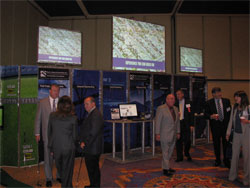 | �
�| Event exhibitors and sponsors contribute to an informative and engaging environment | �
�This year’s meeting was the best yet for the industry-leading construction defect and claims event.
�This year’s seminar concluded on May 13, 2011 with the Construction Defect Community Charitable Foundation Golf Tournament, held at Strawberry Farms Golf Course.
�The Disneyland Hotel in Anaheim, California was the place where more than 1,500 attendees convened for two days of professional development activities and seminars that included CLE workshops and panel discussions of special interest to legal and insurance professionals concerned with construction defect and claims litigation. Key events included “Challenges for Experts in Construction Defect Claims and Litigation,” “Keeping Up with Construction Defect Coverage,” and “Tips for Avoiding the ‘Perfect Storm’ in Handling of Wrap Claims.”
� �  | �
�| Supporting the golf tournament at the 15th hole | �
�This year’s Ollie award was given to George D. Calkins II, Esq. The West Coast Casualty Jerrold S. Oliver Award of Excellence was named in honor of the late Judge Jerrold S. Oliver, and recognizes an individual who is outstanding or has contributed to the betterment of the construction community.
�In addition to being the most comprehensive professional development seminar in the area of construction defects, this year’s seminar was equally valuable as a networking opportunity for members of the industry. People participated in professional development events during the day and then continued networking in the evening at numerous social events. The Lawn Party as well as the legendary Wood, Smith, Henning & Berman events were very well attended. Additional valuable networking events were hosted by a number of industry professionals at the House of Blues, and Tortilla Joe’s.
�As of this writing the 2011, West Coast Casualty's Construction Defect Seminar has applied for or has already received the following continuing education accreditation in the following areas;
�Read the full story…
�For more information about next year’s event, visit West Coast Casualty.
Court Grants Summary Judgment to Insurer in HVAC Defect Case
August 4, 2011 — CDJ Staff
The US District Court in Colorado has determined in the case of RK Mechanical, Inc. v. Travelers Property Casualty Company of America that Travelers did not breach its insurance contract when it refused to cover RK Mechanical.
�RK Mechanical performed an HVAC installation for a residential project for which J.E. Dunn Rocky Mountain was the general contractor. As part of the work, RK “installed approximately one hundred seventy-one CPVC flanges, which were manufactured by Charlotte Pipe and Foundry Company.” Two of these flanges failed in June, 2009 leading to water damage. RK replaced the cracked flanges and engaged in water remediation. “Travelers paid Dunn and RK for the costs associated with the water damage associated with the Flange Failure.” The court notes that Travelers did not pay for the cracked flanges, however.
�Subsequently, RK examined the remaining flanges, finding many cracked ones. These were replaced with new ones. Later, all the Charlotte flanges were replaced with ones from another manufacturer. RK applied for coverage.
�All sides brought in their experts: “Microbac Laboratories, Inc. prepared a report on behalf of RK concluding that the Flange Failure was due, in part, to an assembly or workmanship defect in addition to manufacturing defects in the flanges. Higgins & Associates prepared a report on behalf of Travelers concluding that the flanges failed due to improper installation. Plastic Failure Labs prepared a report on behalf of the flange manufacturer concluding that the flanges failed due to improper installation by RK.”
�At this point, Travelers denied coverage. RK sued alleging that the coverage for flange failure and water damage implicitly includes mitigation costs. The court rejected this claim, noting it would do so even if Travelers had paid for the replacement of the first two flanges. Nor did the court find that replacement of the faulty flanges is not "a covered cause of loss." RK also argued that as it was required to mitigate, Travelers was obligated to cover costs. However, the court found that “the mitigation costs expended by RK were not incurred in an effort to avoid damages from a potential breach of contract by Travelers.” The court additionally noted that despite RK’s claims, the Colorado courts have not found a common law duty to mitigate. Finally, the court found that the exclusions in the policy were not in violation of public policy.
� Read the court’s decision…
Contractual Liability Exclusion Bars Coverage
August 2, 2012 — Tred Eyerly, Insurance Law Hawaii
The Fifth Circuit Court of Appeals considered whether coverage existed for a defectively built tennis court in light of a contractual liability exclusion. Ewing Construction Company, Inc. v. Amerisure Ins. Co., 2012 U.S. App. LEXIS 12154 (5th Cir. June 15, 2012).
Ewing Construction Company entered a contract with the School District to construct tennis courts at a school. After completion, the School District complained that the courts were cracking and flaking, rendering them unfit for playing tennis. The School District filed suit, seeking damages for defective construction. It alleged that Ewing breached its contract and performed negligently.
Ewing tendered the underlying lawsuit to Amerisure. Amerisure denied coverage and Ewing filed suit.
Read the full story…
Reprinted courtesy of Tred R. Eyerly, Insurance Law Hawaii. Mr. Eyerly can be contacted at te@hawaiilawyer.com
Insurance for Defective Construction Now in Third Edition
November 7, 2012 — CDJ Staff
Available both in print and online, the International Risk Management Institute, Inc has brought out a third edition of Insurance for Defective Construction. The work is written by Patrick J. Wielinski of Cokinos, Bosien & Young, a Dallas-Fort Worth law firm. Mr. Wielinski practice focuses on insurance coverage. Insurance for Defective Construction is described as “a must read for anyone who buys, sell, or underwrites construction insurance or who becomes involved in construction claims.”
Read the full story…
Preventing Costly Litigation Through Your Construction Contract
August 17, 2011 — Douglas Reiser, Builders Counsel
It’s Tuesday, which means it ’s the middle of your work week. Tuesday is a great time to take an hour to look over your contracts, while the crews are pushing through their scheduled work. Today’s food for thought: How do you use your contract to reduce your litigation burden?
�Your contract should do many things. It should discuss the scope of work, scheduling of work, quality of work, coverage for liabilities and conditions and timeliness for payment. But often overlooked is how your contract can lend to dispute resolution.
�Commonly, you will see a simple provision that covers governing law, venue for disputes and the awarding of attorneys’ fees. But you can do better. Remember, a contract is enforced to the maximum extent possible in Washington state.
Read the full story…
�Reprinted courtesy of Douglas Reiser of Reiser Legal LLC. Mr. Reiser can be contacted at info@reiserlegal.com
Hovnanian Increases Construction Defect Reserves for 2012
January 6, 2012 — CDJ Staff
In their fourth quarter earnings call, executives of Hovnanian Enterprises made some projections for investors, covering the company’s plans for 2012. During the call, Ara K. Hovnanian, the firm’s CEO, discussed their reserves to meet construction defect claims. The firm does an annual actuarial study of their construction defect reserves.
Mr. Hovnanian noted that there have been no changes for the past several years, but this year they are increasing their reserves by about $6.3 million. Additionally, the firm has added $2.5 million to their legal reserves. Mr. Hovnanian stated “we do not anticipate that changes of this magnitude will be recurring as we look forward to 2012.”
Read the full story…
Wisconsin “property damage” caused by an “occurrence.”
April 4, 2011 — April 4, 2011 in CDCoverage.com
In American Family Mut. Ins. Co. v. American Girl, Inc., 673 N.W.2d 65 (Wis. 2004), the insured general contractor was hired by the owner to design and build a warehouse on the owner s property. The general contractor hired a soil engineer to do a soil analysis and make site preparation recommendations. The soil engineer determined that the soil conditions were poor and recommended a compression process which the general contractor followed. After the warehouse was completed and the owner took possession, excessive soil settlement caused the foundation to sink which in turn caused structural damage to the warehouse. The warehouse had to be torn down.
�Read the full story...
�Reprinted courtesy of CDCoverage.com
Oregon agreement to procure insurance, anti-indemnity statute, and self-insured retention
March 5, 2011 — By
CDCoverage.com, March 5, 2011
In Continental Casualty Ins. Co. v. Zurich American Ins. Co., No. 09-35484 (9th Cir. Oct. 28, 2010), general contractor TCR was sued by an employee of subcontractor Safeway for bodily injuries suffered while working on the project. In the subcontract, Safeway agreed to procure primary insurance providing coverage for TCR for liability arising out of Safeway’s negligence. Safeway’s CGL policy included a self-insured retention that had to be satisfied before the insurer had a duty to defend. TCR filed suit against Safeway alleging that
�Read the full story...�Reprinted courtesy of CDCoverage.com
Architect Not Responsible for Injuries to Guests
September 1, 2011 — CDJ Staff
The Texas Court of Appeals has ruled, with one dissent, that the architectural firm that designed a home was not responsible to the injuries caused to guests when a balcony collapsed. Judge David Puryear wrote the majority opinion in Black + Vernooy Architects v. Smith.
Black + Vernooy designed a vacation home for Robert and Kathy Maxfield in 2000. The Maxfields hired a general contractor to build the home. The general contractor hired a subcontractor to build a balcony; however, the subcontractor did not follow the architect’s design in building the balcony.
A year after the house was completed; the Maxfields were visited by Lou Ann Smith and Karen Gravely. The balcony collapsed under the two women. Ms. Gravely suffered a broken finger, a crushed toe, and bruises. Ms. Smith was rendered a paraplegic as a result of the fall. They sued the Maxfields, the general contractor, and the architects for negligence. The Maxfields and the general contractor settled. A jury found that the architects held 10% of the responsibility. The architects appealed the judgment of the district court.
The Appeals Court reversed this judgment, noting that “there has been no allegation that the Architects negligently designed the balcony or that the Architects actually created the defects at issue.” Further, “the Smiths allege that the defect was caused by the construction practices of the contractor and subcontractor when the balcony was not built in accordance with the design plans of the Architects.”
The court found that even though the architects had a duty “to endeavor to guard against defects and deficiencies in the construction of the home and to generally ascertain whether the home was being built in compliance with the construction plans,” this duty did not extend to third parties.
Read the court’s decision…
Are Construction Defects Covered by Your General Liability Policy?
July 10, 2012 — CDJ Staff
Construction firms are finding that their insurers are denying construction defect claims and the courts are siding with the insurers, according to Kelly M. Gindele, writing in the Martindale-Hubble Legal Library. Ms. Gindele notes that when construction defect claims are not covered, firms can end up with “multi-million dollar claims” that it has to pay “out of its own pocket.” She notes that in Kentucky and Ohio, if “the insured’s work causes an unforeseen and unintended event to occur?Ķthere is not occurrence under the policy.” Further, if there is an occurrence, the court will “look for an exception to coverage.”
She also notes that contractors may not hold sufficient coverage, either by limiting the amounts or the time. She notes that while “insurers generally try to limit coverage for defect claims to one year,” that “construction defects may not be found in a year’s time.”
Ms. Ginele recommends that contractors “hire an insurance company with extensive experience in this field” and “independent legal counsel with insurance knowledge,” to avoid finding themselves “with limited or even no coverage when it needs it most.”
Read the full story…
Construction Defects and Contractor-Owners
July 10, 2012 — CDJ Staff
On the expert advice site Avvo.com, a user asks if he can be sued for construction defects by the new owner of a building for which he served as general contractor and then owned for four years. He had construction insurance, but does not think he had construction defect insurance.
A lawyer responding to his question says that “you could be sued.” In the event of a suit, “you would have to bring claims against all of your subcontractors.”
Read the full story…
Fifth Circuit Reverses Insurers’ Summary Judgment Award Based on "Your Work" Exclusion
November 18, 2011 — Tred Eyerley, Insurance Law Hawaii
Application of the facts to the "your work" exclusion was the key to resolving coverage issued in Am. Home Assurance Co. v. Cat Tech L.L.C., 2011 U.S. App. LEXIS 21076 (5th Cir. Oct. 5, 2011).
Ergon Refining, Inc. hired Cat Tech L.L.C. to service a hydrotreating reactor. In January 2005, Cat Tech replaced certain parts in the reactor. After Cat Tech finished the job and left, Ergon noticed a high pressure drop in the reactor, forcing it to be shut down. Cat Tech returned in February 2005, removed, repaired and replaced the damaged parts, and loaded new parts. After completion, a second large pressure drop occurred during the reactor’s start-up process. The reactor was shut down until October 2005, when Ergon hired a different contractor to perform the repair work. Additional damage to the reactor was found.
Read the full story…
Reprinted courtesy of Tred R. Eyerly, Insurance Law Hawaii. Mr. Eyerly can be contacted at te@hawaiilawyer.com