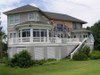
Contractor’s Home Not Covered for Construction Defects
September 13, 2012 — CDJ Staff
The US District Court in Seattle has rejected most of the claims made by a Des Moines man over insurance coverage for water damage to his home. Judge John C. Coughenour granted summary judgment to Liberty Northwest in Ayar v. Liberty Northwest Insurance Corporation.
�Sayad Ayar was the general contractor for the construction of his house. As a homeowner held a $1.5 million insurance policy from Liberty Northwest (LNW) that excluded “faulty, inadequate, or defective construction.”
�In 2008, less than three years after his house was constructed, Mr. Ayar filed a claim after water leaked through his living room ceiling. LNW hired an engineering firm to investigate the damage. The engineering firm, CASE Forensics, concluded that the water intrusion was due to “the failure to install an adequate and continuous waterproof membrane, flashing, and drainage system within the balcony at the time of construction.” Ayar’s expert attributed the leakage to “damage done to the weather deck waterproofing during a storm event with high winds,” which would be covered under the policy. CASE Forensics reviewed these conclusions and rejected them. LNW denied coverage.
�Further problems lead to further investigations, and in each case, LNW attributed the problems to construction defects. During this process, LNW “authorized Ayar to cut into the ceiling’s drywall in order to assist in determining the source of the water intrusion.” Mr. Ayar moved his family to a rental home. He requested that LNW cover the rental and other other costs.
�LNW’s adjuster concluded that no coverage was available, but recommended paying Mr. Ayar $19,648.68 to reinstall drywall and repair the hole in the ceiling. The insurance company paid $2,000 to cover the cost of cutting into the ceiling. The also claimed the amount of drywall he removed was “excessive” and would not cover his relocation as “his home had been livable and because the loss was not covered.”
�Ayar made four claims to the court in support of the argument that LNW misrepresented “pertinent facts or insurance policy provisions.” The court rejected three of these, noting that as all water damage was excluded, LNW’s citation of other sources of water intrusion was not a misrepresentation. “LNW did not rely on this provision as the reason for denying coverage.” Nor was LNW’s reference to “fungi, wet or dry rot” a misrepresentation. As for their reference to construction defects, it “was clearly appropriate given that the construction defect exclusion was the principal basis or denying the claim.” However, the court found that regarding the removal of drywall, “a triable issue of the facts exists.”
�Ayar also claimed that LNW did not conduct a reasonable investigation, but the court found no evidence to support this conclusion. “This is not a case where the insurer failed to investigate or did so only half-heartedly.” Although the thoroughness of the investigation could not questioned, the court concluded that its timing could. Ayar claimed that LNW engaged in unreasonable delays. LNW counters that the delays were due to “Ayar’s own obstructive behavior and failure to cooperate with LNW’s investigation.”
�The court dismissed all of Ayar’s claims, with the exception of whether LNW should have informed him that they would not pay for drywall repair unless there was damage, and whether LNW’s investigation failed to conclude its investigation within a thirty-day time line.
Read the court’s decision…
Fifth Circuit Reverses Insurers’ Summary Judgment Award Based on "Your Work" Exclusion
November 18, 2011 — Tred Eyerley, Insurance Law Hawaii
Application of the facts to the "your work" exclusion was the key to resolving coverage issued in Am. Home Assurance Co. v. Cat Tech L.L.C., 2011 U.S. App. LEXIS 21076 (5th Cir. Oct. 5, 2011).
Ergon Refining, Inc. hired Cat Tech L.L.C. to service a hydrotreating reactor. In January 2005, Cat Tech replaced certain parts in the reactor. After Cat Tech finished the job and left, Ergon noticed a high pressure drop in the reactor, forcing it to be shut down. Cat Tech returned in February 2005, removed, repaired and replaced the damaged parts, and loaded new parts. After completion, a second large pressure drop occurred during the reactor’s start-up process. The reactor was shut down until October 2005, when Ergon hired a different contractor to perform the repair work. Additional damage to the reactor was found.
Read the full story…
Reprinted courtesy of Tred R. Eyerly, Insurance Law Hawaii. Mr. Eyerly can be contacted at te@hawaiilawyer.com
Contractors with Ties to Trustees Reaped Benefits from LA Community College Modernization Program
March 3, 2011 — Original reporting by Gale Holland, Michael Finnegan and Doug Smith, Los Angeles Times
In the latest installment of the “Billions To Spend” series of investigative reports focused on construction defects, management, and cost issues relevant to LACC’s Community College Modernization Projects, the LA Times examines the costs associated with the various layers of construction management and benefits that accrued to contractors with ties to LACC trustees.
�The reporting by the Times is seemingly critical of the project’s utilization of “body shops” an industry term for companies that function as employers of record. The article segment published today cites a number of circumstances wherein their utilization appears to have escalated costs substantially.
�“To gauge the cost of the staffing system, The Times reviewed thousands of pages of financial records from April 2007, when URS began managing the program, to July 2010. Reporters identified two dozen contractors serving as conduits for pay and benefits for employees they did not supervise.
�At least 230 people were employed in this manner, at a total cost of about $40 million, the records show.
�Approximately $18 million of the total was paid to the employees, according to the Times analysis. The remaining $22 million went to profit and overhead for contractors, the records indicate.
�For employees on its own payroll, the district says that medical and other benefits increase compensation costs 40% above base salaries. So if the district had employed its construction staff directly, the total cost for the period studied would have been $25 million instead of $40 million, a savings of $15 million, The Times calculated.”
�Read Full Story...
California Lawyer Gives How-To on Pursuing a Construction Defect Claim
September 13, 2012 — CDJ Staff
On his recently started blog, Harry Kaladjian writes about construction defect litigation in California. He notes that after taking possession, homeowners sometimes notices problems such as “slab cracks in the garage, water leaking through the ceiling, warped floors, improper framing, cracking stucco, etc.” He goes on to note that once that happens, there are series of things homeowners must do.
�The first is to be concerned about the statute of limitations. Then, “once it has been established that defects exist, the homeowner must refer to the ‘Right to Repair Act’ and ‘Calderon Procedures.’” These, he notes set out the “pre-litigation procedures prior to filing a lawsuit.”
Read the full story…
Guilty Pleas Draw Renewed Interest In Nevada’s Construction Defect Laws
December 9, 2011 — CDJ Staff
A report this week by David McGrath Schwarz of the Las Vegas Sun suggests that Nevada’s construction defect laws will be a point of much contention in upcoming legislative sessions. The report cites renewed interest in the state’s construction defect laws due to ongoing federal investigations of construction defect attorney Nancy Quon and construction company owner Leon Benzer. Guilty pleas have been entered by at least ten individuals including an attorney, property managers, straw purchasers, and former HOA board members.
The article suggests that Nevada’s Chapter 40 laws are easily manipulated to the detriment of Nevada’s homebuilding industry. Construction industry lobbyists have tried unsuccessfully to change the laws in past legislative sessions.
The Sun’s article speculates that the building industry might be able to gain legislative concessions due to the volume of guilty pleas and what it refers to as examples of Chapter 40 abuses. ”With federal authorities collecting guilty pleas, the construction industry has prime examples of the system being abused, and how lucrative it can be for attorneys.”
Read the full story…
Florida: No Implied Warranties for Neighborhood Improvements
July 10, 2012 — CDJ Staff
A new law in Florida ends suits from homeowners associations from suing over damages from off-site improvements on the basis of implied warranties. Rob Samouch, writing for the Naples Daily News quotes House Biill 1013: “There is no cause of action in law or equity available to a purchaser of a home or to a homeowners’ association based upon the doctrine or theory of implied warranty of fitness and merchantability or habitability for damages to off-site improvements." The off-site improvements are defined as: "The street, road, driveway, sidewalk, drainage, utilities, or any other improvement or structure that is not located on or under the lot on which a new home is constructed.”
Mr. Samouch notes that “there are no statutory warrant rights in homeowner associations of fitness and merchantability or habitability like there is for condominium associations.” He predicts that the Florida legislature will have to address this issue “once new homeowners start screaming and yelling to them about their shoddy infrastructure for which they have no legal remedy.”
The bill took effect on July 1, 2012 and applies to “all cases accruing before, pending on, or filed after July 1, 2012.”
Read the full story…
Judge Rejects Extrapolation, Harmon Tower to Remain Standing
November 7, 2012 — CDJ Staff
CityCenter has filed an emergency motion asking the Nevada Supreme Court to intervene in Judge Elizabeth Gonzalez’ order that the building’s defects cannot be extrapolated from those tested. CityCenter’s structural engineering expert “evaluated 397 of the Harmon’s critical structural elements and found all but one defective,” according to the article on Vegas.Inc. Judge Gonzalez would not permit this to be extrapolated to the untested 1,072, as the locations tested were not random.
Judge Gonzalez also ruled that if CityCenter does additional testing, they may not appeal her order that ruled the extrapolation inadmissible. CityCenter argued to the Nevada Supreme Court that “the notion that CityCenter should be forced to incur additional millions of dollars in testing costs and sanctions ?Äì on the condition that it waive its right to appeal this ruling ?Äì just to be permitted to present its own damages evidence, shocks the conscience.”
Gonzalez gave the okay to CityCenter to demolish the building, but its demolition would make any further testing impossible. Under Gonzalez’ ruling, the untested structural elements cannot b assumed to be defective.
Read the full story…
Bar to Raise on Green Standard
November 7, 2012 — CDJ Staff
Next June, members of the U.S. Green Building Council will be voting on changes to the LEED green building standard. “The bar is getting raised,” said Navad Malin of BuildingGreen, a consulting and publishing firm, in an article in USA Today. Under the proposed guidelines, builders would have to project energy and water use for five years as part of the certification process. However, if the occupants aren’t as green as the builders anticipated, the buildings will not lose their certification.
The new rules will include higher energy standards, award points for avoiding potentially hazardous materials, and even determine what kind of plumbing items can be used.
Read the full story…
Construction Defects Lead to Demolition
May 26, 2011 — CDJ Staff
Ten years after it was built, demolition of Seattle’s McGuire Building has begun, as Jeanne Lang Jones reports in the Puget Sound Business Journal. Construction defects had rendered the 25-story apartment building uninhabitable. The major problem was corroded steel cabling. According to the report, “the building’s owners reached an undisclosed settlement last year with St. Louis-based contractor McCarthy Building Companies.”
�Read the full story…
Housing Prices Up through Most of Country
December 20, 2012 — CDJ Staff
Home prices in October were up more than six percent compared with prices in October 2011. The LA Times noted that some of the strongest gains were in California and Arizona. The Phoenix metropolitan area saw a 24.5% rise in home prices. In California, Riverside and Los Angeles were just above the national average, at 7.3% and 6.4%, contributing to the state’s overall nine percent increase.
The news wasn’t good throughout the entire country, as five states did not see any price increases. Mark Fleming, the chief economist at CoreLogic, a research firm in Irvine, California said that “the housing recovery that started earlier in 2012 continues to gain momentum.
Read the full story…
JDi Data Introduces Mobile App for Litigation Cost Allocation
October 23, 2012 — CDJ Staff
JDi Data of Fort Lauderdale, Florida has announced that they are about to release a mobile app for their Vendor Cost Control service. Their mobile app is a web app, and so can be used by customers on the iOS, Android, or Blackberry platforms. It provides a secure link to their database with no risk of releasing proprietary information. JDi Data notes that their product will allow users to “track their full subscribed case listings,” give them “easy access to carrier allocations, payments, and outstanding balances reports,” and to “call or email case managers directly from their mobile application.
�James DeRosa, the founder of JDi Data says that “pushing the boundaries of technology has enabled us to further our goal of providing credible reporting and cost allocation expertise to insured, carriers and the legal community.”
� Read the full story…
�
Preventing Costly Litigation Through Your Construction Contract
August 17, 2011 — Douglas Reiser, Builders Counsel
It’s Tuesday, which means it ’s the middle of your work week. Tuesday is a great time to take an hour to look over your contracts, while the crews are pushing through their scheduled work. Today’s food for thought: How do you use your contract to reduce your litigation burden?
�Your contract should do many things. It should discuss the scope of work, scheduling of work, quality of work, coverage for liabilities and conditions and timeliness for payment. But often overlooked is how your contract can lend to dispute resolution.
�Commonly, you will see a simple provision that covers governing law, venue for disputes and the awarding of attorneys’ fees. But you can do better. Remember, a contract is enforced to the maximum extent possible in Washington state.
Read the full story…
�Reprinted courtesy of Douglas Reiser of Reiser Legal LLC. Mr. Reiser can be contacted at info@reiserlegal.com
Contractor’s Coverage For Additional Insured Established by Unilateral Contract
November 18, 2011 — Tred Eyerley, Insurance Law Hawaii
The contractor was covered as an additional insured under the subcontractor’s policy even though the parties had never actually signed an agreement to add the contractor to the policy. Evanston Ins. Co. v. Westchester Surplus Lines Ins. Co., 2011 U.S. App. LEXIS 20081 (9th Cir. Oct. 3, 2011).
The policies held by Bellevue Master, the general contractor, required it to be an additional insured under any subcontractor’s liability policy. Northwest Tower Crane Services was a subcontractor. Bellevue Master LLC, faxed a message that Northwest could continue to be a subcontractor on the project if it complied with Bellevue Master’s insurance requirements. Northwest contacted its insurance broker and requested an insurance certificate be issued to Bellevue Master so that it would be an additional insured under Northwest’s policy.
Read the full story…
Reprinted courtesy of Tred R. Eyerly, Insurance Law Hawaii. Mr. Eyerly can be contacted at te@hawaiilawyer.com
Unlicensed Contractors Nabbed in Sting Operation
September 9, 2011 — CDJ Staff
The California State License Board charged sixteen people in the Fresno area with accepting contracting jobs without licenses. The Statewide Investigative Fraud Team of the CSLB set up a sting operation at a home in Clovis, California seeking bids on tree service, painting, and general contracting services. Those who bid for jobs at more than $500 are required under California law to be licensed. Unlicensed contractors can only work on jobs with a cost to the homeowner of less than $500 and must inform the homeowner that they are not licensed.
In addition to citing contractors for not possessing appropriate licenses, the CSLB also cited contractors for failure to carry workers compensation insurance and illegal advertising. Further, California law limits down payments to the lesser of ten percent or $1,000. Two contractors were cited for requesting excessive down payments.
One contractor, an unlicensed tree service contractor, had been cited previously in a sting operation. He failed to show up for his court date.
Read the full story…
Insurer Not Liable for Construction Defect Revealed by Woodpecker
September 13, 2012 — CDJ Staff
The Eighth Circuit Court of Appeals has ruled that an insurance provision that excluded construction defects must stand in Friedberg v. Chubb, granting a summary judgment to the insurance firm.
�The Friedbergs discovered extensive water damage to their home after a woodpecker drilled a hole in a vertical support. They sought insurance coverage under their Chubb “Masterpiece” policy. The decision quotes the policy as covering “all risk of physical loss” “unless stated otherwise or an exclusion applies.” These exclusions included “gradual or sudden loss,” “structural movement,” and “faulty planning, construction or maintenance,” but the policy covered “ensuing covered loss unless another exclusion applies.”
�Chubb’s expert determined that the Friedbergs’ home had defective construction, and “attributed the damage to the beams and walls below the beam to a failure to install control joints.” After Chubb denied coverage, the Friedbergs sued, although the court ruled that “even under the Friedbergs’ theory, the water damage was a loss caused by faulty construction and therefore excluded under the policy.”
�On appeal, the Friedbergs argued that “the loss resulted from the combination of both faulty construction and the presence of water” and that Minnesota’s “concurrent causation” doctrine must apply, which according to the decision, “when a loss results from both a covered peril and an excluded peril, coverage exists unless the excluded peril is the ‘overriding cause’ of the loss.” The court rejected this reasoning, noting that “once the house was plagued with faulty construction, it was a foreseeable and natural consequence that water would enter.”
�The Friedbergs also contended that “the damage caused by the intrusion of water into their home is an ‘ensuing covered loss’ for which they are due coverage.” The court also rejected this claim, noting that Minnesota law excludes defective construction from the ensuing loss provision. The court said that “the Friedbergs’ reading of their ensuing-loss clause, by contrast, would dramatically limit their policy’s faulty-construction exclusion, because almost ‘any loss cause by’ faulty construction could also be characterized as an ensuing loss under an all-risk policy.”
Read the court’ decision…
Court Consolidates Cases and Fees in Soil Construction Defect Case
August 16, 2012 — CDJ Staff
The California Court of Appeals has ruled in Burrow v. JTL Development. JTL Development had appealed a judgement in a construction defect case in which JTL Development and Highland Development were found liable for damage due to homes built on unstable and improperly compacted soil. The two companies were sued by the two sets of homeowners, the Burrows and the Balls, and their cases were consolidated at trial. Each family was awarded $700,000 in damages. This judgement had also been appealed and affirmed by the appeals court. In the current case, an additional $235,800 in cost-of-proof sanctions had been awarded to the two families.
Before the trial, Dale Burrows, Charles Ball, and Laurie Ball “asked JTL and Highland to admit that they ‘approved grading plans’ for the Burrows’ and Balls’ properties; ‘had knowledge that the [properties] contained improperly compacted fill’; ‘had knowledge that the [properties were’ not properly prepared for structures’; and ‘did not provide Plaintiffs with a complete soils report’ prepared by Gorian & Associates.” These were requests 14, 19, 20, and 22. JTL and Highland denied all of these.
At trial, the Burrows and Balls proved that all these were true. JTL and Highland’s geotechnical subcontractor, Gorian & Associates, had “recommended that Highland remove and re-compact the entire tract to a depth of 25 feet.” JTL and Highland did not follow this recommendation, “in order to avoid expense.”
After judgment, the Burrows and Balls moved for $582,587.45 for “attorneys’ fees and costs incurred proving the truth of requests for admission.” JTL and Highland claimed that only Dale Burrows could recover fees, but that also the fees were not recoverable. Joe Lynch of Highland “declared that he always believed the soils under the Burrows and Balls homes were properly compacted.” The Burrows and Balls responded with six identical sets of requests for admissions and the court awarded each of them twenty-five percent of $235,800, with JTL and Highland each responsible for fifty percent.
The appeals court noted that JTL and Highland filed a timely appeal and goes on to notes the four circumstances under which a responding party does not have to pay costs and fees. The court concluded that none of these were met. Instead of waiving the request, JTL and Highland denied the request, stating “without in any manner waiving the foregoing objection, responding party denies the request for admission.”
Nor was the admission “of no substantial importance,” instead the court said that the matters were of “substantial importance,” and the “trial would have been shortened by their admission. Highland and JTL “relied on Gorian when it denied the request,” but the trial court “discredited Lynch’s assertions,” finding that “Highland knew the soil was improperly compacted.”
As all plaintiffs had identical discovery requests, the court rejected the claim that only Dale Burrows was entitled to an award.
Read the court’s decision…
OSHA Cites Construction Firm for Safety Violations
August 16, 2012 — CDJ Staff
S.J. Louis Construction of Texas Ltd. has been cited by OHSH for one serious and one repeat safety violation, according to a report in Insurance Journal. OSHA officials saw S.J. Louis employees working in an unshored trench along a highway service road. The company had cited for this violation previously. Without shoring of trenches deeper than five feet there is a risk of serious injury or death.
Read the full story…
Ohio Court Finds No Coverage for Construction Defect Claims
March 1, 2012 — Tred Eyerly, Insurance Law Hawaii
Charles and Valerie Myers hired Perry Miller to build their home. Myers v. United Ohio Ins. Co., 2012 Ohio App. LEXIS 287 (Ohio Ct. App. Jan. 26, 2012). After completion of the home, Miller was again hired to construct an addition which included a full basement, staircases, bathroom, bedroom, hallway and garage.
�After the addition was completed, one of the basement walls began to crack and bow. Miller began to make repairs, but eventually stopped working on the project. Other contractors were hired to make repairs, but further problems developed. A second basement wall began to bow and crack, allowing water into the basement. The wall eventually had to be replaced. Subsequently, the roof over the addition began to leak in five or six places before the drywall could be painted. The leaks caused water stains on the drywall and cause it to separate and tear. It was discovered the roof needed to be replaced.
�The Myers sued Miller and his insurer, United Ohio Insurance Company. The trial court ruled that the policy did not provide coverage for faulty workmanship, but did provide coverage for consequential damages caused by repeated exposure to the elements. United Ohio conceded liability in the amount of $2,000 to repair water damage to the drywall. United Ohio was also found liable for $51,576, which included $31,000 to repair the roof and ceiling and $18,576 to replace the basement wall.
Read the full story…
���Reprinted courtesy of Tred R. Eyerly, Insurance Law Hawaii. Mr. Eyerly can be contacted at te@hawaiilawyer.com
�