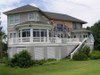
West Hollywood Building: Historic Building May Be Defective
August 16, 2012 — CDJ Staff
The Sunset Lanai apartment building in West Hollywood, California has its fans, it also has its detractors. Designed by Edward H. Flickett and built in 1952 by George Alexander, the building isn’t wearing its years lightly. Its owner has opposed a move by the West Hollywood Preservation Commission that the building is a “local cultural resource.” Instead, Edwin Silver, the building’s owner says the group has overstated the building’s significance. His lawyer points to “design and construction flaws,” and says the building is prone to flooding and leaks. Repairs to the building have an estimated cost of $2.3 million, according to the L.A. Times.
The West Hollywood City Council decided to table the question of a historical designation as that might impede repairs. However, they did decide that if Silver seeks to demolish the building, they will grant the protection.
Read the full story…
California Supreme Court Finds Associations Bound by Member Arbitration Clauses
September 13, 2012 — CDJ Staff
In a decision with great implications for construction defect suits in California, the California Supreme Court has ruled in Pinnacle Museum Tower Association v. Pinnacle Market Development that arbitration clauses binding on the members of the association are also binding on the association itself. They concluded this, even though “the association did not exist as an entity independent of the developer when the declaration was drafted and recorded.” The opinion, written by Justice Baxter, was joined by four additional justices, with two separate concurrences and a dissenting opinion by Justice Kennard.
�The Pinnacle homeowners sought to bring suit over construction defect claims. In response, the developer filed a motion to compel arbitration. The association argued that the arbitration clause signed by its individual members was not binding on it. The Appeals Court invalidated the arbitration agreement “finding it marked by slight substantive unconscionability and high degree of procedural unconscionability. The Appeals Court determined that “for all intents and purposes, Pinnacle was the only party to the ‘agreement,’ and there was no independent homeowners association when Pinnacle recorded the CC&R’s.” However, the California Supreme Court said that this was “not persuasive in light of the statutory and contract principles in play.”
�The opinion notes that “the Project CC&R’s provides that Pinnacle and, by accepting a deed to any portion of the Project property, the Association and each individual condominium owner agree to submit any construction dispute to binding arbitration in accordance with the FAA.” The Court noted that “settled principles of condominium law establish that an owners association, like its constituent members, must act in conformity with the terms of a recorded declaration,” which, as the Court notes, includes the CC&Rs.
�After finding that the terms were binding on the Association, the Court then questioned whether the terms were “unenforceable as unconscionable,” noting that “the party resisting arbitration bears the burden of proving unconscionability.” But the Court found that “the arbitration provisions of article XVIII are not substantively unconscionable.” Additionally, they found “no support for the Association’s claims of unfairness and absence of mutuality.”
Read the court’s decision…
Builder Waits too Long to Dispute Contract in Construction Defect Claim�
May 10, 2012 — CDJ Staff
The Louisiana Court of Appeals has affirmed the lower court’s judgment in the case of Richard v. Alleman. The Richards initiated this lawsuit under Louisiana’s New Home Warranty Act, claiming that they had entered into a construction contract with Mr. Alleman and that they quickly found that his materials and methods had been substandard. They sued for the cost of repairing the home and filing the lawsuit. Mr. Alleman countersued, claiming the Richards failed to pay for labor, materials, and services. By his claim, they owed him $12,838.80.
�The trial court split the issues of liability and damages. In the first trial, the court concluded that there was a contact between Alleman and the Richards and that the New Home Warranty Act applied. Mr. Alleman did not appeal this trial.
�The second trial was on the issue of damages. Under the New Home Warranty Act, the Richards were found to be entitled to $36,977.11 in damages. In a second judgment, the couple was awarded $18,355.59 in attorney’s fees. Mr. Alleman appealed both judgments.
�In his appeal, Alleman contended that the trial court erred in determining that the Home Warranty Act applied. This was, however, not the subject of the trial, having been determined at the earlier trial. Nor did the court accept Alleman’s claim that the Richards failed to comply with the Act. The trial record made clear that the Richards provided Alleman with a list of problems with their home by certified mail.
�The court did not establish whether the Richards told Alleman to never return to their home, or if Alleman said he would never return to the home, but one thing was clear: Alleman did not complete the repairs in the list.
�A further repair was added after the original list. The Richards claimed that with a loud noise, a large crack appeared in their tile flooring. Mr. Alleman stated that he was not liable for this as he was not given a chance to repair the damage, the Richards hired the flooring subcontractors, and that the trial court rejected the claim that the slab was defective. The appeals court found no problem with the award. Alleman had already “refused to make any of the repairs.”
�Finally Alleman made a claim on a retainage held by the Richards. Since Alleman did not bring forth proof at trial, the appeals court upheld the trial courts refusal to award a credit to Alleman.
� Read the court’s decision…
�
Landmark San Diego Hotel Settles Defects Suit for $6.4 Million
March 4, 2011 — April 4, 2011 Beverley BevenFlorez - Construction Defect Journal
After five years of legal battles, the condo owners of the El Cortez Hotel building in downtown San Diego settled for $6.4 million, as reported by The San Diego Union-Tribune on March 28, 2011. The Homeowners Association will net just over $3 million from the settlement.
�The litigation may have had an adverse effect on the value of the condos within the El Cortez Hotel building. According to an article by Kelly Bennett of Voice of San Diego, “Many condos in the building originally sold for more than $600,000. Currently, the three units on the market are asking for just more than $200,000, the U-T said.”
�Andrew Berman, the owners’ attorney, told The San Diego Union-Tribune that the five years of litigation included six lawsuits, 200 depositions, and multiple construction tests.
�Read the full story... (San Diego Union Tribune)
�Read the full story... (Voice of San Diego)
Construction Company Head Pleads Guilty to Insurance and Tax Fraud
December 20, 2012 — CDJ Staff
The former head of Orients Construction Company and of Melrose Construciton Company, Herlindo Garcia-Merlos, has entered a guilty plea to charges that the gave false informoation to his insurer, New Jersey Manufacturers Insurance Group, for more than three years in order to lower his workers compensation payments. Mr. Garcia-Merlos was able to underpay by more than $315,000 as a result of this deception.
Mr. Garcia-Merlos additionally failed to file tax returns for his companies and underreported his wages on his own tax returns. The State of New Jersey is seeking an eight-year prison term and restitution of more than $400,000.
Read the full story…
Construction Defects Not Occurrences under Ohio Law
November 7, 2012 — CDJ Staff
Concluding the “claims of defective construction or workmanship brought by a property owners are not claims for ‘property damage’ caused by an ‘occurrence’ under a commercial general liability policy,” the Supreme Court of Ohio has ruled in Westfield Insurance Co. v. Custom Agri Systems, Inc. In the underlying case, Custom Agri Systems, Inc. built a grain bin as a subcontractor to Younglove Construction, LLC. Younglove had been contracted by PSD Development, which withheld payment, claiming it had suffered damages due to defects in Custom Agri System’s work. Younglove filed a complaint against Custom Agri, which filed complaints against its subcontractors. Custom Agri also requested that its insurer, Westfield Insurance Company, defend and indemnify it. Westfield claimed that it had no such duty. The Ohio Supreme Court concurred.
The decision notes that “Custom was being sued under two general theories: defective construction and consequential damages resulting from the defective construction.” Westfield argued that none of the claims were “for ‘property damage’ caused by an ‘occurrence” and therefore none of the claims were covered under the CGL policy.” Further, Westfield argued that “even if the claims were for property damage caused by an occurrence, they were removed from coverage by an exclusion in the policy.”
The case was filed in the US District Court which issued a summary judgment for Westfield. The plaintiff appealed and Sixth Circuit Court of Appeals certified the questions to the Supreme Court of Ohio.
The court noted that “all of the claims against which Westfield is being asked to defect and indemnify Custom relate to Custom’s work itself.” And so, the court concluded that they “must decide whether Custom’s alleged defective construction of and workmanship on the steel grain bin constitute property damage caused by an ‘occurrence.’” However, the court noted that under the terms of the insurance contract, an occurrence is defined as “an accident, including continuous or repeated exposure to substantially the same general harmful conditions,” and the court noted that the “natural and commonly accepted meaning” of “accident” is something “unexpected, as well as unintended.”
The Ohio Supreme Court also looked at court decisions in other places, and found that in many similar cases, courts have concluded that construction defects are not occurrences.
In a dissenting opinion, Justice Pfeifer argues that “if the defective construction is accidental, it constitutes an ‘occurrence’ under a CGL policy.” Justice Pfeifer characterized the majority’s definition of “accidental” as “broad, covering unexpected, unintentional happenings.”
Read the court’s decision…
Wisconsin “property damage” caused by an “occurrence.”
April 4, 2011 — April 4, 2011 in CDCoverage.com
In American Family Mut. Ins. Co. v. American Girl, Inc., 673 N.W.2d 65 (Wis. 2004), the insured general contractor was hired by the owner to design and build a warehouse on the owner s property. The general contractor hired a soil engineer to do a soil analysis and make site preparation recommendations. The soil engineer determined that the soil conditions were poor and recommended a compression process which the general contractor followed. After the warehouse was completed and the owner took possession, excessive soil settlement caused the foundation to sink which in turn caused structural damage to the warehouse. The warehouse had to be torn down.
�Read the full story...
�Reprinted courtesy of CDCoverage.com
Cabinetmaker Exceeds Expectations as Conditions Improve�
October 23, 2012 — CDJ Staff
American Woodmark, the manufacturer of several national brands of cabinets and vanities, saw greater than anticipated earnings in its most recent quarter. Their revenue was $148.3 million, an increase of 13% over the same quarter a year prior. They saw a 40% increase in sales. As a result, their per-share earnings were 7 cents, instead of the projected loss of 3 cents per share. Forbes reports that the share price for American Woodmark has been rising in August 2012.
� Read the full story…
�
Good and Bad News on Construction Employment
February 10, 2012 — CDJ Staff
The construction industry hit a two-year high in January, with 21,000 jobs added that month. The mild winter is assumed to have helped. According to the General Contractors of America, the construction industry currently employs about 5.57 million people. This is a 21 percent gain over January 2010. Ken Simonson, the chief economist of GCA, noted that “the unemployment rate in construction is still double that of the overall economy.” He said it was not currently clear if “the recent job growth reflects a sustained pickup or merely acceleration of homebuilding and highway projects that normally halt when the ground freezes in December and January.”
� Stephen Sandherr, the chief executive officer of the GCA, said that the federal government had to make infrastructure funding a top priority. “Without adequate long-term funding for infrastructure, competitive tax rates and fewer costly regulatory hurdles, the construction industry may lose some of the jobs it gained in the last year.”
Read the full story…
HOA Has No Claim to Extend Statute of Limitations in Construction Defect Case
October 28, 2011 — CDJ Staff
The California Court of Appeals ruled on September 20, 2011 in the case of Arundel Homeowners Association v. Arundel Green Partners, a construction defect case involving a condominium conversion in San Francisco. Eight years after the Notice of Completion was filed, the homeowners association filed a lawsuit alleging a number of construction defects, including “defective cabinets, waterproofing membranes, wall-cladding, plumbing, electrical wiring, roofing (including slope, drainage and flashings), fire-rated ceilings, and chimney flues.” Three years of settlement negotiations followed.
Negotiations ended in the eleventh year with the homeowners association filing a lawsuit. Arundel Green argued that the suit should be thrown out as California’s ten-year statute of limitations had passed. The court granted judgment to Arundel Green.
The homeowners then filed for a new trial and to amend its complaint, arguing that the statute of limitations should not apply due to the doctrine of equitable estoppel as Arundel Green’s actions had lead them to believe the issues could be solved without a lawsuit. “The HOA claimed that it was not until after the statute of limitations ran that the HOA realized Arundel Green would not keep its promises; and after this realization, the HOA promptly brought its lawsuit.” The trial court denied the homeowners association’s motions, which the homeowners association appealed.
In reviewing the case, the Appeals Court compared Arundel to an earlier California Supreme Court case, Lantzy. (The homeowners also cited Lantzy as the basis of their appeal.) In Lantzy, the California Supreme Court set up a four-part test as to whether estoppel could be applied. The court applied these tests and found, as was the case in Lantzy, that there were no grounds for estoppel.
In Arundel, the court noted that “there are simply no allegations that Arundel Green made any affirmative statement or promise that would lull the HOA into a reasonable belief that its claims would be resolved without filing a lawsuit.” The court also cited Lesko v. Superior Court which included a recommendation that the plaintiffs “send a stipulation?Ķextending time.” This did not happen and the court upheld the dismissal.
Read the court’s decision…
Pennsylvania Court Extends Construction Defect Protections to Subsequent Buyers
December 20, 2012 — CDJ Staff
The Pennsylvania courts have long held that there is an implied warranty of habitability for the initial purchaser of a home. Now, as some defects may not immediately show up, the court has extended that implied warranty to second and subsequent purchasers. As Marc D. Brookman, David I. Haas, and Christopher Bender of Duane Morris note, “this judicially created doctrine shifts the risk of a latent defect in the construction of a new home from the purchaser to the builder-vendor.”
The Pennsylvania Supreme Court concluded that a contractual relationship is not needed for an implied warranty of habitability. The court’s concern was inequalities would result when a home was sold while other homes were protected by being within the statute of repose.
Read the full story…
Seller Cannot Compel Arbitration for Its Role in Construction Defect Case<
March 1, 2012 — CDJ Staff
The buyer of a leaky home in Venice, California cannot be compelled to arbitration with the seller in a construction defect lawsuit, according to a decision in Lindemann v. Hume, which was heard in the California Court of Appeals. Lindemann was the trustee of the Schlei Trust which bought the home and then sued the seller and the builder for construction defects.
�The initial owner was the Hancock Park Trust, a real estate trust for Nicholas Cage. Richard Hume was the trustee. In 2002, Cage agreed to buy the home which was being built by the Lee Group. Cage transferred the agreement to the Hancock Park Trust. Hancock had Richard Nazarin, a general contractor, conduct a pre-closing walk through. They also engaged an inspector. Before escrow closed, the Lee Group agreed to provide a ten-year warranty “to remedy and repair any and all damage resulting from water infiltration, intrusion, or flooding due to the fact that the door on the second and third floors of the residence at the Property were not originally installed at least one-half inch (1/2”) to one inch (1”) above the adjacent outside patio tile/floor on each of the second and third floors.”
�Cage moved in and experienced water intrusion and flooding. The Lee Group was unable to fix the problems. Hume listed the home for sale. The Kamienowiczs went as far as escrow before backing out of the purchase over concerns about water, after the seller’s agent disclosed “a problem with the drainage system that is currently being addressed by the Lee Group.”
�The house was subsequently bought by the Schlei Trust. The purchase agreement included an arbitration clause which included an agreement that “any dispute or claim in Law or equity arising between them out of this Agreement or any resulting transaction, which is not settled through mediation, shall be decided by neutral, binding arbitration.” The warranty the Lee Group had given to Hancock was transferred to the Schlei trust and Mr. Schlei moved into the home in May 2003.
�Lindemann enquired as to whether the work done would prevent future flooding. Nazarin sent Schlei a letter that said that measures had been taken “to prevent that situation from recurring.” In February, 2004, there was flooding and water intrusion. Lindemann filed a lawsuit against the Lee Group and then added the Hancock Park defendants.
�The Hancock Park defendants invoked the arbitration clause, arguing that Lindemann’s claims “were only tangentially related to her construction defect causes of action against the Lee Group.” On June 9, 2010, the trial court rejected this claim, ruling that there was a possibility of conflicting rulings on common issues of law. “With respect to both the developer defendants and the seller defendants, the threshold issue is whether there was a problem with the construction of the property in the first instance. If there was no problem with the construction of the property, then there was nothing to fail to disclose.” Later in the ruling, the trial court noted that “the jury could find there was no construction defect on the property, while the arbitration finds there was a construction defect, the sellers knew about it, and the sellers failed to disclose it.” The appeals court noted that while Hancock Park had disclosed the drainage problems to the Kamienowiczs, no such disclosure was made to Sclei.
�The appeals court described Hancock Park’s argument that there is no risk of inconsistent rulings as “without merit.” The appeals court said that the issue “is not whether inconsistent rulings are inevitable but whether they are possible if arbitration is ordered.” Further, the court noted that “the Hancock Park defendants and the Lee Group have filed cross-complaints for indemnification against each other, further increasing the risk of inconsistent rulings.”
�The court found for Lindemann, awarding her costs.
Read the court’s decision…
Homebuilding on the Rise in Nation’s Capitol
November 7, 2012 — CDJ Staff
Is the homebuilding crunch over in DC? The Washington Post has reported that while new home construction is up throughout the country, in the DC area, construction has reached levels last seen in 2006. From January to August 2012, there were more than 19,000 building permits issued in the area, nearly doubling the number issued by that point in 2011.
While building is on a quicker pace, what’s being built has changed. As compared to 2006, there are more townhomes, condos, and smaller homes being built. The article notes that 11 percent of new construction is condos, while in 2006, it was only 5 percent.
Read the full story…
After Breaching its Duty to Defend, Insurer Must Indemnify
August 11, 2011 — Tred Eyerly, Insurance Law Hawaii
In a brief decision analyzing Oregon law, the Ninth Circuit determined that once an insurer breaches its duty to defend, it must indemnify. See Desrosiers v. Hudson Speciality Ins. Co., 2011 U.S. App. LEXIS 12591 (9th CIr. June 21, 2011).
�The victim secured a judgment against the insured after he was beaten by another patron outside the insured's bar. Hudson Speciality Insurance refused to defend the insured, claiming the injury arose from an assault and battery, which excluded coverage.
Read the full story…
�Reprinted courtesy of Tred R. Eyerly, Insurance Law Hawaii. Mr. Eyerly can be contacted at te@hawaiilawyer.com
Conspirators Bilked Homeowners in Nevada Construction Defect Claims
March 28, 2012 — CDJ Staff
Courthouse News has a summary of the current lawsuit over a Nevada conspiracy to defraud homeowners by taking control of homeowner boards and then providing inadequate repairs. Homeowners in eight Las Vegas area communities are involved in the suit, which claims that the conspirators purchased units in the communities and then transferred fractional interests to others to allow them to run for HOA board elections. The suit claims that David Amesbury and his firm helped manipulate the elections.
�Once homeowner boards were controlled by the conspirators, Nancy Quon, the construction defect attorney whose recent death appears to be by suicide, handled the litigation against homebuilders. She would settle out of court, engaging Silver Lining Construction to “do very minor and superficial repairs” to the homes. The remainder of the money was split by the conspirators. The suit also notes that the construction defect claims were “frivolous,” and?in addition to the negative publicity?caused the homes to lose at least 5% of their value.
Read the full story…
The Hidden Dangers of Construction Defect Litigation
March 28, 2012 — David M. McLain, Colorado Construction Litigation
David M. McLain, writing at Colorado Construction Litigation, has an interesting blog post republishing his article in Common Interests magazine, the monthly periodical of the Rocky Mountain Chapter of the Community Associations Institute. In his article, he touches on a number of pitfalls in construction defect litigation, including the potential conflicts of interests facing HOAs. He also considers the problems homeowners can face, including both “strong-arm tactics” taken by attorneys to compel homeowners to join the lawsuit, or situations in which the interests of the HOA do not match those of the homeowners. He writes:
�There is also a conflict of interest with individual owners who attempt to opt out of the case. This can lead to shocking strong-arm tactics on the part of plaintiffs’ attorneys. In one instance, a plaintiffs’ attorney sent a letter to an individual homeowner that stated that as a 1/58th owner of the common elements, if he refused to go along with the suit, and there was ultimately a finding in favor of the HOA which was in any way limited by his refusal to participate, he would be personally liable for 1/58th of the HOA’s total damages. In another instance, a different plaintiffs’ attorney sent a letter to a homeowner who wanted the builder to perform warranty repairs, informing the owner that if he let the builder perform any repairs, the attorney would bill the HOA according to the fee agreement entered by the HOA board (without knowledge or consent of non-board members) and that the HOA would assess the homeowner for that expense. These are just two examples of conflicts which may arise between the HOA board and individual homeowners when the HOA pursues CD cases.
�Another example of a conflict which will arise as a result of CD litigation occurs post-settlement. When an HOA settles for less than 100% of the amount necessary to fund all repairs outlined by its experts, plus attorneys’ fees and litigation costs, there will obviously be a shortfall in the amount necessary to fix the development. The HOA board must then choose to impose a special assessment to cover the shortfall or to make some, but not all, of the repairs outlined by its experts. In choosing the latter, the conflict arises with respect to which homes get fixed and which do not. In this situation, the HOA board has acted as the attorney-in-fact for the individual owners by bringing claims on their behalf, and has compromised those claims without their knowledge or consent.
Read the full story…
�Reprinted courtesy of David M. McLain of Higgins, Hopkins, McClain & Roswell, LLC. Mr. McClain can be contacted at mclain@hhmrlaw.com.
Florida: No Implied Warranties for Neighborhood Improvements
July 10, 2012 — CDJ Staff
A new law in Florida ends suits from homeowners associations from suing over damages from off-site improvements on the basis of implied warranties. Rob Samouch, writing for the Naples Daily News quotes House Biill 1013: “There is no cause of action in law or equity available to a purchaser of a home or to a homeowners’ association based upon the doctrine or theory of implied warranty of fitness and merchantability or habitability for damages to off-site improvements." The off-site improvements are defined as: "The street, road, driveway, sidewalk, drainage, utilities, or any other improvement or structure that is not located on or under the lot on which a new home is constructed.”
Mr. Samouch notes that “there are no statutory warrant rights in homeowner associations of fitness and merchantability or habitability like there is for condominium associations.” He predicts that the Florida legislature will have to address this issue “once new homeowners start screaming and yelling to them about their shoddy infrastructure for which they have no legal remedy.”
The bill took effect on July 1, 2012 and applies to “all cases accruing before, pending on, or filed after July 1, 2012.”
Read the full story…
Contract Not So Clear in South Carolina Construction Defect Case
November 7, 2012 — CDJ Staff
The South Carolina Court of Appeals has reversed a partial summary judgment issued by one of the lower courts in the case of The Retreat at Edisto Co-Owners Association v. The Retreat at Edisto. The underlying issues of the case deal with a construction defect complaint.
The lower court had concluded “Developer’s ‘First Amendment’ to the Master Deed required the Developer to satisfy the provision in the paragraph labeled ‘Master Deed Amendment or Phase II’ as a condition precedent to its election to proceed with the development of Phase II.”
The appeals court found that “the language of the First Amendment to the Master Deed is susceptible to more than one interpretation.” The court additionally concluded that the “Developer presented the requisite scintilla of evidence on the question of its intent in order to establish a genuine issue of material fact. As the material facts were in dispute, the appeals court reversed the summary judgment and remanded the case to the circuit court for further proceedings.
Read the court’s decision…