Insurer Unable to Declare its Coverage Excess In Construction Defect Case
January 6, 2012 — CDJ Staff
The Ninth Circuit Court of Appeals has upheld a summary judgment in the case of American Family Mutual Insurance Co. v. National Fire & Marine Insurance Co. Several other insurance companies were party to this case. In the earlier case, the US District Court of Appeals for Arizona had granted a summary judgment to Ohio Casualty Group and National Fire & Marine Insurance Company. At the heart of it, is a dispute over construction defect coverage.
The general contractor for Astragal Luxury Villas, GFTDC, contracted with American Family to provide it with a commercial liability policy. Coverage was issued to various subcontractors by Ohio Casualty and National Fire. These policies included blanket additional insured endorsements that provided coverage to GFTDC. The subcontractor policies had provisions making their coverage excess over other policies available to GFTDC.
The need for insurance was triggered when the Astragal Condominium Unit Owners Association filed a construction defect claim in the Arizona Superior Court. CFTDC filed a third-party claim against several subcontractors. The case was settled with American Family paying the settlement, after which it filed seeking reimbursement from the subcontractor’s insurers. The court instead granted summary judgment in favor of Ohio Casualty and National Fire.
American Family appealed to the Ninth Circuit for a review of the summary judgment, arguing that the “other insurance” clauses were “mutually repugnant and unenforceable.” The Ninth Circuit cited a case from the Arizona Court of Appeals that held that “where two policies cover the same occurrence and both contain ‘other insurance’ clauses, the excess insurance provisions are mutually repugnant and must be disregarded. Each insurer is then liable for a pro rate share of the settlement or judgment.”
The court noted that unlike other “other insurance” cases, the American Family policy “states that it provides primary CGL coverage for CFTDC and is rendered excess only if there is ‘any other primary insurance’ available to GFTDC as an additional insured.” They note that “the American Family policy purports to convert from primary to excess coverage only if CFTDC has access to other primary insurance as an additional insured.”
In comparison, the court noted that “the ‘other insurance’ language in Ohio Casualty’s additional insured endorsement cannot reasonably be read to contradict, or otherwise be inconsistent with, the ‘other primary insurance’ provision in the American Family policy.” They find other reasons why National Fire’s coverage did not supersede American Family’s. In this case, the policy is “written explicitly to apply in excess.”
Finally, the Astragal settlement did not exhaust American Family’s coverage, so they were obligated to pay out the full amount. The court upheld the summary dismissal of American Family’s claims.
Read the court’s decision…
New OSHA Fall Rules to Start Early in Minnesota
June 14, 2011 — CDJ Staff
Minnesota has elected to implement the new OSHA rules concerning fall prevention in residential construction on June 20, well before OSHA’s September 15 deadline. Brian Johnson, reporting in Finance and Commerce, quotes Pam Perri, the executive vice president of the Builders Association of Minnesota, “this is the worst time to implement a new rule.” Ms. Perri notes “In Minnesota, education time for the residential construction industry is between November and March 1, not in the middle of the construction season.”
�Mike Swanson of Rottlund Homes estimated that the new regulations would add between $200 to $500 to the cost of a house and that he felt the current safety regulations were adequate. OSHA officials are quoted that there continues “to be a high number of fall-related deaths in construction.”
�Read the fully story…
Contractor Sues Supplier over Defective Products
June 28, 2011 — CDJ Staff
Fast Track Specialties has sued RJF International after needing to remove wall protection units at Methodist West Houston Hospital, according to an article in the Houston Chronicle. Fast Track claims that contractors had to disconnect gas, water, and electric from the area to facilitate removal of corner guards, handrails, and crash guards from the hospital. This cost the contractor more than $135,000.
�Fast Track is claiming that RJD International has committed breach of contract, breach of warranty, and negligent representation.
Read the full story…
Seller Cannot Compel Arbitration for Its Role in Construction Defect Case<
March 1, 2012 — CDJ Staff
The buyer of a leaky home in Venice, California cannot be compelled to arbitration with the seller in a construction defect lawsuit, according to a decision in Lindemann v. Hume, which was heard in the California Court of Appeals. Lindemann was the trustee of the Schlei Trust which bought the home and then sued the seller and the builder for construction defects.
�The initial owner was the Hancock Park Trust, a real estate trust for Nicholas Cage. Richard Hume was the trustee. In 2002, Cage agreed to buy the home which was being built by the Lee Group. Cage transferred the agreement to the Hancock Park Trust. Hancock had Richard Nazarin, a general contractor, conduct a pre-closing walk through. They also engaged an inspector. Before escrow closed, the Lee Group agreed to provide a ten-year warranty “to remedy and repair any and all damage resulting from water infiltration, intrusion, or flooding due to the fact that the door on the second and third floors of the residence at the Property were not originally installed at least one-half inch (1/2”) to one inch (1”) above the adjacent outside patio tile/floor on each of the second and third floors.”
�Cage moved in and experienced water intrusion and flooding. The Lee Group was unable to fix the problems. Hume listed the home for sale. The Kamienowiczs went as far as escrow before backing out of the purchase over concerns about water, after the seller’s agent disclosed “a problem with the drainage system that is currently being addressed by the Lee Group.”
�The house was subsequently bought by the Schlei Trust. The purchase agreement included an arbitration clause which included an agreement that “any dispute or claim in Law or equity arising between them out of this Agreement or any resulting transaction, which is not settled through mediation, shall be decided by neutral, binding arbitration.” The warranty the Lee Group had given to Hancock was transferred to the Schlei trust and Mr. Schlei moved into the home in May 2003.
�Lindemann enquired as to whether the work done would prevent future flooding. Nazarin sent Schlei a letter that said that measures had been taken “to prevent that situation from recurring.” In February, 2004, there was flooding and water intrusion. Lindemann filed a lawsuit against the Lee Group and then added the Hancock Park defendants.
�The Hancock Park defendants invoked the arbitration clause, arguing that Lindemann’s claims “were only tangentially related to her construction defect causes of action against the Lee Group.” On June 9, 2010, the trial court rejected this claim, ruling that there was a possibility of conflicting rulings on common issues of law. “With respect to both the developer defendants and the seller defendants, the threshold issue is whether there was a problem with the construction of the property in the first instance. If there was no problem with the construction of the property, then there was nothing to fail to disclose.” Later in the ruling, the trial court noted that “the jury could find there was no construction defect on the property, while the arbitration finds there was a construction defect, the sellers knew about it, and the sellers failed to disclose it.” The appeals court noted that while Hancock Park had disclosed the drainage problems to the Kamienowiczs, no such disclosure was made to Sclei.
�The appeals court described Hancock Park’s argument that there is no risk of inconsistent rulings as “without merit.” The appeals court said that the issue “is not whether inconsistent rulings are inevitable but whether they are possible if arbitration is ordered.” Further, the court noted that “the Hancock Park defendants and the Lee Group have filed cross-complaints for indemnification against each other, further increasing the risk of inconsistent rulings.”
�The court found for Lindemann, awarding her costs.
Read the court’s decision…
No Choice between Homeowner Protection and Bankrupt Developers?
February 10, 2012 — CDJ Staff
Donna DiMaggio Berger, writing in the Sun Sentinel argues those may be the only current choices in Florida. A recent court case, Lakeview Reserve HOA v. Maronda Homes has caused a swift response from the legislators. Ms. Berger notes that the construction defect bill, HB 1013, “would take away a homeowner’s rights to pursue a developer for defects to the driveways, roads, sidewalks, utilities, drainage areas and other so-called ‘off-site’ improvements.” The alternative? She notes that applying the Maronda decision would “bankrupt developers who don’t build defect-free roads and sidewalks.”
Read the full story…
Mortar Insufficient to Insure Summary Judgment in Construction Defect Case
January 6, 2012 — CDJ Staff
The US District Court of Nevada issued a summary judgment in the case of R&O Construction Company V. Rox Pro International Group, Ltd. on December 19, 2011. The case involved the installation of stone veneer at a Home Depot location (Home Depot was not involved in the case). R&O’s subcontractor, New Creation Masonry, purchased the stone veneer from Arizona Stone. Judge Larry Hicks noted that “the stone veneer failed and R&O was forced to make substantial structural repairs to the Home Depot store.”
Rox Pro asked the court for a summary judgment, which the court granted only in part. The court looked at two issues in the case, whether the installation instructions constituted a breach of implied warranty of merchantability, and whether there was a breach of an implied warranty of fitness for a particular purpose.
Judge Hicks found that there was a breach of implied warranty of merchantability. The instructions drafted by Real Stone and distributed by Arizona Stone were not sufficient for affixing the supplied stones, according to R&O’s expert, a claim the plaintiffs dispute. “Because there is an issue of material fact concerning the installation guidelines, the court shall deny Arizona Stone’s motion for a summary judgment on this issue.”
On the other hand, the judge did not find that the instructions had any bearing as to whether R&O bought the stone, since the stone was selected by the shopping center developer. This issue was, in the view of the judge, appropriately dismissed.
Read the court’s decision…
SB800 Cases Approach the Courts
July 10, 2012 — CDJ Staff
California’s Right to Repair Law turns ten this year and cases under the statute are finally coming to trial, as John V. O’Meara of Bremer Whyte Brown & O’Meara writes for the Martindale-Hubble Legal Library. Mr. O’Meara notes that SB800 eliminated “the traditional definitions of construction defect,” replacing them with “functionality standards.” He argues that these standards are not uniform: “some standards require damage and others do not.” He also wonders what terms like “significant cracks,” “intended water” and “materially comply” mean in a court.
Mr. O’Meara states that “defendants in construction defect cases have a right to know the standards that apply to a case, the definitions that will be presented to the jury, and the burden of proof that attaches.”
Read the full story…
Construction Defect Journal Seeks Article Submissions Regarding SB800 and Other Builders Right to Repair Laws
October 28, 2011 — CDJ Staff
As we approach the tenth anniversary of the passage and signing of SB800, California’s right-to-repair law, we’d like to hear your reactions to the law, your experiences with it, and your thoughts on it and right-to-repair laws in other states.
We invite you to submit articles either reacting to SB800 or on other matters relevant to construction defect and claims issues. You can promote your firm’s capabilities and get valuable exposure through the publication of your articles. Construction Defect Journal is widely read by our highly targeted audience of decision makers, construction attorneys, builders, owners, and claims professionals.
Articles may contain relevant images, your firm’s name, and links to your corporate website or third parties and can be submitted through e-mail to submitstory@constructiondefectjournal.com. Please remember to include your contact information if you would like it to be published with your content. If you are submitting photos or PDF documents with your article, please send them as e-mail attachments. Items submitted are assumed to be cleared for publishing upon receipt by CDJ.
Normally articles are published in full, although we reserve the right to edit content for space purposes. All articles submitted are considered for publication. For additional questions please contact editor@constructiondefectjournal.com.
Condo Owners Allege Construction Defects
July 6, 2011 — CDJ Staff
Last November, mold problems were discovered at the Siena Condominiums in Montclair, New Jersey, which had been described by their developers as “an enclave of luxury in an urban village setting.” The owners have filed a lawsuit against Pinnacle Companies, Kohl Parnters, and Herod Development, seeking “compensatory damages, interest, reasonable attorney’s fee and costs, and for such other, further, and different relief as the Court may deem just and proper.”
�According to the article on Baristanet.com, an engineering report commissioned by the condominium association revealed many problems, including improperly installed windows and siding. The developers commissioned two engineering reports themselves and found evidence of water pounding on the roof. Despite these reports and repeated promises, no repairs have been made.
Read the full story…
Insurer Has Duty to Defend in Water Intrusion Case
July 10, 2012 — CDJ Staff
The Seventh Circuit Court of Appeals has upheld a summary judgment against an insurance company in a construction defect suit. Lagestee-Mulder, Incorporated (LMI) was hired by Crown Centre to construct a multi-story office building in Franfort, Illinois. LMI hired Frontrunner Glass & Metal to supply and install windows and doors. Frontrunner purchased an insurance policy from Consolidated which named LMI as an additional insured. The project experienced water intrusion and other construction defects and Crown sued LMI. Consolidated denied coverage. LMI sued Consolidated and the US District Court granted a summary judgment against Consolidated.
The appeals court reviewed the grounds for summary judgment and determined that under Illinois law, Consolidated had a duty to defend. The court cited an earlier opinion that “if the underlying compliant alleges facts within or potentially within policy coverage, an insurer is obligated to defend its insured even if the allegations are groundless, false, or fraudulent.”
Read the court’s decision…
Williams v. Athletic Field: Hugely Important Lien Case Argued Before Supreme Court
June 17, 2011 — Douglas Reiser, Builders Counsel
Well, it finally made it. The most important Washington lien case of recent memory was argued in front of the Washington Supreme Court on Tuesday, June 14, 2011. So, what should we all expect?
As I was reading through my RSS feeds this afternoon ? I was stopped dead in my tracks. Williams v . Athletic Field, the Division II case that has been a frequent topic here on Builders Counsel, has finally been argued before the Supreme Court. All of you who have been anxiously awaiting this day, you can check out the Supreme Court submissions by following this link.
The Williams case has been the center of attention for construction lawyers and construction organizations over the past year. Some have called for complete lien law reform, others have tried to patch a hole in the law. Now, we can expect a ruling from the highest court in the state. That ruling will have a major impact on whether the Legislature feels compelled to change lien law.
Read the full story…
Reprinted courtesy of Douglas Reiser of Reiser Legal LLC. Mr. Reiser can be contacted at info@reiserlegal.com
Subcontractor Not Liable for Defending Contractor in Construction Defect Case
February 10, 2012 — CDJ Staff
The California Court of Appeals has ruled on January 9, 2012 in Hensel Phelps Construction Company v. Urata & Sons Cement, upholding the judgment of the lower court.
�Hensel Phelps was the general contractor for a high-rise in Sacramento. They were sued by the owners of the building after problems were discovered in the concrete slabs of the building’s parking garage. Instead of welded steel wire mesh, the slabs had been constructed with fiber mesh. Hensel Phelps filed a cross-complaint against Urata Cement, the subcontractor that had performed the cement work. Urata refused to defend Hensel Phelps. The owners’ case was subsequently dismissed due to the statute of limitations.
�Although the original case was over, Hensel Phelps continued in their claims against Urata. “Urata argued that a handwritten interlineation required Hensel Phelps to prove Urata was at fault for the injury alleged in the building owners’ complaint before Urata was obliged to defend Hensel Phelps in that action.”
�The lower court concluded that Urata would have been obligated to defend Hensel Phelps if the owners’ lawsuit had alleged that the damage was due to the subcontractor’s work or if evidence at trial established this. The lower court found neither of these true. Instead, the use of the fiber mesh was a design issue and “that decision was outside the scope of the subcontractor’s work.”
�During the trial, Hensel Phelps conceded that Urata was not at fault. The appeals court could find no reading of the contract that would cause Urata to be obligated to defend Hensel Phelps, calling Hensel Phelps’s reading of the contact as “grammatically infeasible.”
�Judges Nicholson, Raye, and Butz upheld the decision of the lower court and awarded costs on appeal to Urata.
Read the court’s decision…
Delays in Filing Lead to Dismissal in Moisture Intrusion Lawsuit
September 9, 2011 — CDJ Staff
The Alabama Court of Civil Appeals has upheld a summary judgment in the case of Franklin v. Mitchell. Walter Mitchell, doing business as Southern Classic Construction built a new home for the Franklins. The Franklins moved into the home in October 2001. In April 2006 they discovered sagging floors in both the bathroom and kitchen. They contacted Mitchell who suggested the flooring might be defective. The Franklins spent eight months attempting to contact the flooring manufacturer.
In March 2007, the Franklins had the home inspected. The sagging was determined to be due to a loss of strength in the decking because of condensation from the air conditioning system. Air returns were not properly sealed and drawing moisture into the structure. There was mold on the decking and floor joints.
When Mitchell was contacted by the Franklins, he told them his one-year warranty had expired but had the HVAC subcontractor, Southern Mechanical Heating & Air (owned by Mitchell’s father, Jim Mitchell), look at the situation. SMHA replaced and braced subfloors. Later, they entered the crawl space to tape ducts, seal the air return, and insulate the air vent housing. The Franklins were not satisfied with the repairs, as not all the ducts were taped, nor were the air vent housings insulated.
Franklin complained to Walter Mitchell who again cited his one-year warranty. Jim Mitchell said he would not report complaints to his insurer, stating that the repairs were unnecessary, that the work had been done correctly in the first place, and it was only done at the request of Walter Mitchell.
In February 2009, the Franklins sued Walker Mitchell. Mitchell denied the claims, citing in part the statute of limitations. Mitchell also filed complaints against three subcontractors, including his father’s firm. Mitchell received a summary judgment as the case started after Alabama’s six-year statute of limitations.
The appeals court rejected the Franklin’s argument that the claim of damage did not start until they were aware it was due to a construction defect. The court noted that as Walter Mitchell was licensed as a “residential home builder, the statute the Franklins cite did not apply, as it concerns architects, engineers, and licensed general contactors.”
Nor did they feel that Mitchells’ claim that his warranty had expired were sufficient to override the statute of limitations, quoting an earlier case, “Vague assurances do not amount to an affirmative inducement to delay filing suit.” Their claim of subsequent negligent repairs was rejected because Mitchell did not direct the specific actions taken by his father’s firm.
Read the court’s decision…
Court Voids Settlement Agreement in Construction Defect Case
September 1, 2011 — CDJ Staff
A U.S. District Court Judge in Florida has ruled in favor of a company that sought to void a settlement agreement. The case, Water v. HDR Engineering, involved claims of construction defects at Florida’s C.W. Bill Young Regional Reservoir. The Tampa Bay Water Authority attributed these to both HDR Engineering’s design and Bernard Construction Company which had built the embankment. Bernard Construction filed a complaint against their subcontractor, McDonald.
Tampa Bay Water settled with Bernard Construction and McDonald, in an agreement that set a minimum and maximum settlement, but also would “prohibit Barnard and McDonald from presenting any evidence on several claims and positions of TBW, to require Barnard to call certain witnesses at trial, to preclude Barnard and McDonald from calling other witnesses, and to restrict the filing of trial and post-trial motions.” HDR Engineering moved to void the agreement as collusive.
The judge that the agreement¬? contained “133 paragraphs of ‘Agreed Facts’ that the parties stipulated would survive any order declaring the Settlement Agreement void or unenforceable.” He characterized these as stipulating “that Barnard neither caused nor contributed to TBW’s damages.” HDR motioned that a summary judgment be given to Barnard Engineering.
The court found that “the evidence identified by TBW is patently insufficient to survive summary judgment.” Further, TBW’s expert initially held Barnard responsible for “lenses, pockets, streaks and layers within the embankment,” but then later withdrew this assigning the responsibility to HDR. Further, the court notes that, “TBW’s arguments that lenses, pockets, streaks, and layers in the soil wedge caused or contributed to its damages and that Barnard is liable for those damages have been foreclosed by the Agreed Facts.”
As TBW failed to provide sufficient evidence to withstand summary judgment, the court granted summary judgment, mooted the claim against McDonald, and terminated the agreement between TBW and the other parties.
Read the court’s decision…
2011 West Coast Casualty Construction Defect Seminar – Recap
June 1, 2011 — CDJ Staff
� 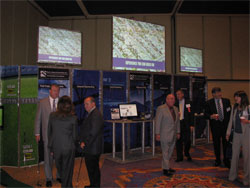 | �
�| Event exhibitors and sponsors contribute to an informative and engaging environment | �
�This year’s meeting was the best yet for the industry-leading construction defect and claims event.
�This year’s seminar concluded on May 13, 2011 with the Construction Defect Community Charitable Foundation Golf Tournament, held at Strawberry Farms Golf Course.
�The Disneyland Hotel in Anaheim, California was the place where more than 1,500 attendees convened for two days of professional development activities and seminars that included CLE workshops and panel discussions of special interest to legal and insurance professionals concerned with construction defect and claims litigation. Key events included “Challenges for Experts in Construction Defect Claims and Litigation,” “Keeping Up with Construction Defect Coverage,” and “Tips for Avoiding the ‘Perfect Storm’ in Handling of Wrap Claims.”
� �  | �
�| Supporting the golf tournament at the 15th hole | �
�This year’s Ollie award was given to George D. Calkins II, Esq. The West Coast Casualty Jerrold S. Oliver Award of Excellence was named in honor of the late Judge Jerrold S. Oliver, and recognizes an individual who is outstanding or has contributed to the betterment of the construction community.
�In addition to being the most comprehensive professional development seminar in the area of construction defects, this year’s seminar was equally valuable as a networking opportunity for members of the industry. People participated in professional development events during the day and then continued networking in the evening at numerous social events. The Lawn Party as well as the legendary Wood, Smith, Henning & Berman events were very well attended. Additional valuable networking events were hosted by a number of industry professionals at the House of Blues, and Tortilla Joe’s.
�As of this writing the 2011, West Coast Casualty's Construction Defect Seminar has applied for or has already received the following continuing education accreditation in the following areas;
�Read the full story…
�For more information about next year’s event, visit West Coast Casualty.
Insurer Has Duty to Disclose Insured's Interest In Obtaining Written Explanation of Arbitration Award�
October 23, 2012 — Tred Eyerly, Insurance Law Hawaii
The issue faced by the Minnesota Supreme Court was whether the insurer had a duty to disclose the insured's interest in obtaining a written explanation of an arbitration award that identified the claims of recovery and the portions of the award attributable to each. Remodeling Dimensions, Inc. v. Integrity Mut. Ins. Co., 2012 LEXIS Minn. 404 (Minn. Sup. Ct., Aug. 22, 2012).
�Remodeling Dimensions, Inc. ("RDI") built an addition for the homeowners and installed windows in the original part of the house. After construction began, the homeowners also asked RDI to fix the master bedroom window in the original part of the house.
�After completion of the project, the house sustained storm damage.
� Read the full story…
��Reprinted courtesy of Tred R. Eyerly, Insurance Law Hawaii. Mr. Eyerly can be contacted at te@hawaiilawyer.com
��
Background Owner of Property Cannot Be Compelled to Arbitrate Construction Defects
November 7, 2012 — CDJ Staff
In Truppi v. Pasco Engineering, John Quattro sued Property Management Contractors, Inc. over construction defects in William Truppi’s home. All parties are named in the suit. The California Court of Appeals ruled that Property Management Contractors, Inc. (PMCI) could not compel Mr. Quattro to arbitration.
The background of the case involves two houses built in Encinitas, California by PCMI: one for Mr. Truppi at 560 Neptune, and one for Mr. Quattro at 566 Neptune. Both contracts contained an arbitration provision. Mr. Quattro signed the contract for his residence and Mr. Truppi signed the other. Mr. Quattro then sued PCMI and its principal, William Gregory. Mr. Quattro claimed to be the true contracting party for the 560 Neptune residence and a third party beneficiary of the contract Mr. Truppi signed, and stated that PCMI was aware of this.
PCMI in a demurrer stated that Quattro “had only a ‘prospective beneficial interest in the property upon its eventual sale or lease.’” Mr. Quattro amended his complaint to account for the issues raised by PCMI. The court rejected PCMI’s demurrer to the amended complaint.
Finally, PCMI and Gregory asserted that Quattro was “not the real party in interest” and could not sue. PCMI continues to assert that Quattro lacks standing, but their attorney sent Quattro an e-mail stating, “While my client disputes that you are a party, and that you lack standing to assert the claim, to the extent you do so I believe you are obligated to proceed by way of arbitration.”
The court did not cover the issue of Quattro’s standing in the case, only if he could be compelled to arbitration. The court affirmed the lower court’s finding that Quattro could not be compelled to arbitrate the construction defect claim as neither he nor Gregory signed the contract in an individual capacity. Further, the court noted that PCMI and Gregory “denied the existence of an agreement between themselves and Quattro on the 560 contract,” and cannot compel arbitration on a non-existent agreement. And while non-signatories can, in some situations be compelled to arbitrate, the court found that “these cases are inapplicable because here they seek to have the alleged third party beneficiary (Quattro) compelled by a nonsignatory (Gregory).” The arbitration clause in question “expressly limited its application to persons or entities that signed the 560 contract.”
As Mr. Quattro was not a signatory to that agreement, the court found that he could not be held to its arbitration provision.
Read the court’s decision…
Continuous Trigger of Coverage Adopted for Loss Under First Party Policy
August 2, 2012 — Tred Eyerly, Insurance Law Hawaii
The Seventh Circuit predicted that the Wisconsin Supreme Court would adopt the continuous injury trigger for first party property loss that extends over several policy periods. Miller v. Safeco Ins. Co. of Am., 2012 U.S. App. LEXIS 12940 (7th Cir. June 25, 2012).
A home inspection report performed before the Millers purchased their home showed a soft spot on the roof. The stucco's finish color was also uneven and stained. Further, some water damage was found in the study and skylights above the kitchen sink. But the report advised that the exterior walls, chimney, grass roof, flashings, floor joists/beams and columns, garage walls and floor appeared serviceable. A roof specialist determined the soft spot was not significant and could be repaired for $1,500.
The Millers purchased a homeowner's policy from Safeco on June 30, 2005. The policy went into effect the next day when the Millers closed on the property. But the Millers did not see the policy's terms until Safeco mailed them a copy of the policy at the end of July.
Before receiving the policy, the Millers discovered severe inner wall water leaks and significant water infiltration on three of the home's exterior walls.
Read the full story…
Reprinted courtesy of Tred R. Eyerly, Insurance Law Hawaii. Mr. Eyerly can be contacted at te@hawaiilawyer.com