Vegas Hi-Rise Not Earthquake Safe
July 12, 2011 — CDJ Staff
If an earthquake hit Las Vegas, the Harmon Tower would not withstand it. A report from Weidlinger Associates told MGM Resorts that “in a code-level earthquake, using either the permitted or current code specified loads, it is likely that critical structural members in the tower will fail and become incapable of supporting gravity loads, leading to a partial or complete collapse of the tower.” The inspection came at the request of county officials, according to the article in Forbes.
�According to Ronald Lynn, directory of the building division in the county’s development services division, “these deficiencies, in their current state, make the building uninhabitable.” The county is concerned about risks to adjacent buildings.
�MGM Resorts is currently in litigation, separate from the stability issues, with Perini Corp., the builders of Harmon Tower.
� Read the full story…
Condominium Communities Must Complete Construction Defect Repairs, Says FHA
July 10, 2012 — CDJ Staff
Laura K. Sanchez of HindmanSanchez writes that the FHA “will not approve or recertify” any condominium community “where there are any pending or incomplete repairs within the community which are a result of a construction defect claim, regardless of whether the litigation has been resolved and regardless of whether there are funds in the bank paid by the developer to pay for the repairs.” The FHA notes that failure to complete or fund repairs could “put FHA insured loans at risk.” Communities must disclose all maintenance and repair issues to the FHA. Sanchez notes that the FHA has stated that incomplete repairs could put FHA-insured loans at risk.
Read the full story…
Construction Law Client Alert: California Is One Step Closer to Prohibiting Type I Indemnity Agreements In Private Commercial Projects
June 15, 2011 — Haight Brown & Bonesteel, LLP
On June 1, 2011 by majority vote, the California Senate passed Senate Bill 474, which would amend Civil Code section 2782, and add Civil Code section 2782.05. The passage of this new law is a critical development for real estate developers, general contractors and subcontractors because it will affect how these projects are insured and how disputes are resolved.
�Civil Code section 2782 was amended in 2007 to prohibit Type I indemnity agreements for residential projects only. Since 2007, various trade associations and labor unions have lobbied to expand those very same restrictions to other projects. These new provisions apply to contracts, entered into after January 1, 2013, that are not for residential projects, and that are not executed by a public entity. The revisions provide that any provision in a contract purporting to indemnify, hold harmless, and defend another for their negligence or other fault is against public policy and void. These provisions cannot be waived.
�A provision in a contract requiring additional insured coverage is also void and unenforceable to the extent it would be prohibited under the new law. Moreover, the new law does not apply to wrap-up insurance policies or programs, or a cause of action for breach of contract or warranty that exists independently of the indemnity obligation.
�The practical impact of this new law is that greater participation in wrap-up insurance programs will likely result. While many wrap-up programs suffer from problems such as insufficient limits, and disputes about funding the self-insured retention, the incentive for the developer or general contractor to utilize wrap-up insurance will be greater than ever before because they will no longer be able to spread the risk of the litigation to the trades and the trade carriers.
�Read the full story…
�Reprinted courtesy of Steve Cvitanovic of Haight Brown & Bonesteel, LLP.
A Loud Boom, But No Serious Injuries in World Trade Center Accident
March 1, 2012 — CDJ Staff
The Wall Street Journal reports that nearly twenty tons of steel fell forty stories at the World Trade Center site on February 16. One person was checked by medical personnel. One person who works in the Financial District said it was “almost like thunder.” Frank Pensabene, one of the ironworkers on the site said that after “loud boom,” “all hell broke loose.” The steel beams and cables fell onto a flatbed truck, which was not occupied at the time.
Read the full story…
Is Construction Heading Off the Fiscal Cliff?
December 20, 2012 — CDJ Staff
After a period of growth, the construction industry lost 20,000 jobs in November, based on the federal jobs data. Damon Scott of New Mexico Business Weekly suggests that contractors may have laid off employees in anticipation of the “fiscal cliff.” Ken Simpson, the chief economist of the National Association of Home Builders said in a press release that “it is discouraging that construction employment is still struggling after three years of expansion in the overall economy.”
Read the full story…
Delays in Filing Lead to Dismissal in Moisture Intrusion Lawsuit
September 9, 2011 — CDJ Staff
The Alabama Court of Civil Appeals has upheld a summary judgment in the case of Franklin v. Mitchell. Walter Mitchell, doing business as Southern Classic Construction built a new home for the Franklins. The Franklins moved into the home in October 2001. In April 2006 they discovered sagging floors in both the bathroom and kitchen. They contacted Mitchell who suggested the flooring might be defective. The Franklins spent eight months attempting to contact the flooring manufacturer.
In March 2007, the Franklins had the home inspected. The sagging was determined to be due to a loss of strength in the decking because of condensation from the air conditioning system. Air returns were not properly sealed and drawing moisture into the structure. There was mold on the decking and floor joints.
When Mitchell was contacted by the Franklins, he told them his one-year warranty had expired but had the HVAC subcontractor, Southern Mechanical Heating & Air (owned by Mitchell’s father, Jim Mitchell), look at the situation. SMHA replaced and braced subfloors. Later, they entered the crawl space to tape ducts, seal the air return, and insulate the air vent housing. The Franklins were not satisfied with the repairs, as not all the ducts were taped, nor were the air vent housings insulated.
Franklin complained to Walter Mitchell who again cited his one-year warranty. Jim Mitchell said he would not report complaints to his insurer, stating that the repairs were unnecessary, that the work had been done correctly in the first place, and it was only done at the request of Walter Mitchell.
In February 2009, the Franklins sued Walker Mitchell. Mitchell denied the claims, citing in part the statute of limitations. Mitchell also filed complaints against three subcontractors, including his father’s firm. Mitchell received a summary judgment as the case started after Alabama’s six-year statute of limitations.
The appeals court rejected the Franklin’s argument that the claim of damage did not start until they were aware it was due to a construction defect. The court noted that as Walter Mitchell was licensed as a “residential home builder, the statute the Franklins cite did not apply, as it concerns architects, engineers, and licensed general contactors.”
Nor did they feel that Mitchells’ claim that his warranty had expired were sufficient to override the statute of limitations, quoting an earlier case, “Vague assurances do not amount to an affirmative inducement to delay filing suit.” Their claim of subsequent negligent repairs was rejected because Mitchell did not direct the specific actions taken by his father’s firm.
Read the court’s decision…
The Montrose Language Interpreted: How Many Policies Are Implicated By A Construction Defect That Later Causes a Flood?
March 17, 2011 — By Shaun McParland Baldwin, March 17, 2011
The Court of Appeals of Indiana recently addressed the “Montrose” language added to the CGL ISO form in 2001 in the context of a construction defect claim where a fractured storm drain caused significant flooding a year after the drain was damaged. The insuring agreement requires that “bodily injury or “property damage” be caused by an occurrence and that the “bodily injury or “property damage” occur during the policy period. The Montrose language adds that the insurance applies only if, prior to the policy period, no insured knew that the “bodily injury or “property damage” had occurred in whole or in part. Significantly, it also states that any “bodily injury” or “property damage” which occurs during the policy period and was not, prior to the policy period known to have occurred, includes a continuation, change or resumption of that “bodily injury” or “property damage” after the end of the policy period.
�In Grange Mutual Cas. Co. v. West Bend Mut. Ins. Co., No. 29D04-0706-PL-1112 (Ct. App. IN March 15, 2011), http://www.ai.org/judiciary/opinions/pdf/03151109ehf.pdf, Sullivan was the General Contractor for a school construction project. Its subcontractor, McCurdy, installed the storm drain pipes. One of the storm pipes was fractured in 2005 while McCurdy was doing its installation work. More than a year later, the school experienced significant water damage due to flooding. It was later discovered that the flooding was due to the fractured storm drain. Sullivanrsquo;s insurer paid $146,403 for the water damage. That insurer brought a subrogation claim against McCurdy and its two insurers: West Bend and Grange. West Bend had issued CGL coverage to McCurdy while the construction was ongoing, including the date in which the storm pipe was fractured. Grange issued CGL coverage to McCurdy at the time of the flooding. Those two carriers jointly settled the subrogation claim and then litigated which insurer actually owed coverage for the loss. Significantly, the loss that was paid included only damages from the flooding, not any damages for the cost of repairing the pipe.
�Read the full story...
�Reprinted courtesy of Shaun McParland Baldwin of Tressler LLP. Ms Baldwin can be contacted at sbaldwin@tresslerllp.com
Construction Jobs Expected to Rise in Post-Hurricane Rebuilding
November 7, 2012 — CDJ Staff
Businessweek reports that construction jobs and materials will see increased demand as property owners in New York and New Jersey rebuild after hurricane Sandy. Tom Jeffery, of Irvine, California-based CoreLogic, a real estate information service, noted that “a high percent of damaged properties are going to be repaired.” Experts estimate property damage to total anywhere from $7 billion to $40 billion.
It is also estimated that about 739,000 properties in the area are underwater in the way that has nothing to do with flooding, with negative equity of 25 percent or more. Many of these homeowners are likely to walk away from their mortgages.
Ken Simonson, chief economist of the Associated General Contractors of America, expects “localized spikes in construction employment throughout November and the winter.” Martin Connor, the chief financial officer of Toll Brothers, expects to see more a rise in labor costs than in materials.
Read the full story…
Gilroy Homeowners Sue over Leaky Homes
February 10, 2012 — CDJ Staff
Two years into a lawsuit against Shapell Homes, the builder of a subdivision called Eagle Ridge in Gilroy, California, homeowners have joined or left the lawsuit. About fifty homeowners are still in the suit, which contends that construction defects have lead to water intrusion in their homes. The lawyer for the homeowners contends that more than a hundred homes have construction defects.
�One homeowner said that soon after he joined the suit, Sharpell sent workers to his home who repaired problems to his satisfaction. “They came in within two weeks and fixed everything,” said Frank Lowry. Another homeowner, Wilson Haddow, said that he was “quite happy” after Shapell repaired problems.
�Others weren’t quite so happy. Greg Yancey said that problems had “been a nightmare” and that “it just doesn’t feel like home.” He said that his “house is possessed,” with problems that include walls that bow out and a balcony that drips rainwater to the front door. His home is currently worth far less than the $700,000 he paid in 2007.
Read the full story…
Harsh New Time Limits on Construction Defect Claims
April 26, 2011 — April 26, 2011 by Scott F. Sullan, Esq., Mari K. Perczak, Esq., and Leslie A. Tuft, Esq. of
Sullan2, Sandgrund, Smith & Perczak, P.C. in the
HindemanSanchez blogA recent Colorado Supreme Court decision, Smith v. Executive Custom Homes, Inc., 230 P.3d 1186 (Colo. 2010), considerably shortens the time limit for bringing many construction defect lawsuits. Homeowners and homeowner associations risk losing the right to seek reimbursement from builders, developers and other construction professionals unless they carefully and quickly act upon discovery of evidence of any potential construction defect.
�The Statute of Limitations for Construction Defect Claims
�Colorado’s construction defect statute of limitations limits the time for homeowners and homeowners associations to bring lawsuits for construction defects against “construction professionals,” including developers, general contractors, builders, engineers, architects, other design professionals, inspectors and subcontractors. The statute requires homeowners and associations to file suit within two years “after the claim for relief arises.” A claim for relief “arises” when a homeowner or association discovers or reasonably should have discovered the physical manifestation of a construction defect.
�The two-year time limitation applies to each construction defect separately, and will begin to run upon the appearance of a “manifestation” of a construction defect (which may include, for example, a condition as simple as a roof leak or drywall cracks), even if the homeowner or association does not know the cause of the apparent problem.
�The Smith Opinion and its Effect on the Statute of Limitations
�In Smith v. Executive Custom Homes, Inc., the plaintiff homeowner, Mrs. Smith, slipped on ice that had accumulated on her sidewalk because of a leaking gutter and suffered injury. When she first noticed the leak, she reported it to her property manager, who reported it to the builder. The builder attempted to repair the gutter, unbeknownst to Mrs. Smith, and she did not notice further problems until approximately one year after she first observed the leak, when she fell and suffered serious injury. She sued the builder within two years of her injury, but nearly three years after she first learned of the leak.
�The Colorado Supreme Court dismissed Mrs. Smith’s claims as untimely and held that under the construction defect statute of limitations, the two-year period for suing for injuries due to construction defects begins when the homeowner first observes the physical manifestation of the defect, even if the resulting injury has not yet occurred. The court acknowledged that this ruling could result in “unfair results,” especially if a serious and unforeseeable injury occurs more than two years after the first time the homeowner noticed the problem, and as a result the victim is unable to seek redress from those responsible for the defect.
�Read the full story…
�Reprinted courtesy of Scott F. Sullan, Esq., Mari K. Perczak, Esq., and Leslie A. Tuft, Esq. of Sullan2, Sandgrund, Smith & Perczak, P.C., and they can be contacted through their web site.
Can Negligent Contractors Shift Blame in South Carolina?
July 10, 2012 — CDJ Staff
Clay Olson looks back to a 1991 Carolina case, Nelson v. Concrete Supply Company. The court concluded in that case that “a plaintiff in South Carolina may recover only if his/her negligence does not exceed that of the defendant’s and amount of plaintiff’s recovery shall be reduced in proportion to amount of his or her negligence; if there is more than one defendant, plaintiff’s negligence shall be compared to combined negligence of all defendants.” In 2005, he reports, as part of tort reform in South Carolina, the legislature further addressed this.
He then suggests a possible outcome of this is that negligent contractors may be able to shift some of the blame (and cost of the settlement) to other defendants who may not be to blame. He offers a scenario in which a contractor is sued for construction defects and a jury has to allocate responsibility for indivisible damage. “A jury need only find the two subcontractors to have each contributed 15% of the indivisible damage.” He adds in another 15% for claims against the architect. Minor blame is given to the manufacturers, and suddenly the negligent contractor is paying less than 50% of the total settlement.
He notes that the previous system in place also had its problems, but notes that this one may not be “fair and equitable.”
Read the full story…
Connecticut Gets Medieval All Over Construction Defects
February 10, 2012 — CDJ Staff
The Hartford Courant reports that Connecticut is trying a very old tactic in a construction defect suit. The law library building at the University of Connecticut suffered from leaks which have now been repaired. The state waited twelve years after was complete to file lawsuit, despite that Connecticut has a six-year statute of limitations on construction defect claims. Connecticut claims that the statute of limitations does apply to the state.
� The state is arguing that a legal principle from the thirteenth century allows it to go along with its suit. As befits a medieval part of common law, the principle is called “nullum tempus occurrit regi,” or “time does not run against the king.” In 1874, the American Law Register said that nullum tempus occurrit reipublicae “has been adopted in every one of the United States” and “is now firmly established law.”
� In the case of Connecticut, Connecticut Solicitor General Gregory D’Auria said that “the statute of limitations does not apply to the state.” He also noted that “the state did not ‘wait’ to file the lawsuit. The lawsuit was filed only after all other options and remedies were exhausted.”
� Connecticut also argued that “nullus tempus occurrit regi” applied in another construction defect case at the York Correctional Institution. The judge in that case ruled in December 2008 to let the case proceed. But in the library case, Judge William T. Cremins ruled in February 2009 that the statute of limitations should apply to the state as well. Both cases have been appealed, with the library case moving more quickly toward the Connecticut Supreme Court.
Read the full story…
No Duty to Indemnify When Discovery Shows Faulty Workmanship Damages Insured’s Own Work
November 7, 2012 — Tred Eyerly, Insurance Law Hawaii
Our post last week addressed the duty to defend when alleged faulty workmanship caused loss to property adjacent to where the insured was working. See Pamerin Rentals II, LLC v. R.G. Hendricks & Sons Constr., Inc., 2012 Wis. App. LEXIS 698 (Wis. Ct. App. Sept. 5, 2012) [post here]. Today, we report on recent developments in the same case where the court determined, despite earlier finding the insurer owed a defense, it had no duty to indemnify. Pamperin Rentals II, LLC v. R.G. Hendricks & Sons Constr., Inc., 2012 Wisc. App. LEXIS 793 (Wis. Ct. App. Oct. 10, 2012).
Hendricks contracted to “prepare the site and supply and install concrete, tamped concrete, and colored concrete” at several service stations. The owner sued Hendricks, alleging the concrete “was defective and/or the work performed was not done in a workman-like manner and resulted in damages, and will require replacement.”
Pekin Insurance Company agreed to defend Hendricks subject to a reservation of rights.
Read the full story…
Reprinted courtesy of Tred R. Eyerly, Insurance Law Hawaii. Mr. Eyerly can be contacted at te@hawaiilawyer.com
Granting Stay, Federal Court Reviews Construction Defect Coverage in Hawaii
January 6, 2012 — Tred Eyerly, Insurance Law Hawaii
The federal district court ultimately stayed a construction defect case, but offered comments on the current status of coverage disputes for such defects in Hawaii. See National Union Fire Ins. Co. of Pittsburgh, Pa. v. Simpson Mfg. Co., 2011 U.S. Dist. LEXIS 128481(D. Haw. Nov. 7, 2011).
National Union filed a complaint for declaratory relief to establish it had no duty to defend or to indemnify Simpson Manufacturing Company in four actions pending in the Hawaii state courts. The state court actions concerned allegedly defective hurricane strap tie hold downs that were manufactured and sold by Simpson. The hurricane ties allegedly began to prematurely corrode and rust, causing cracking, spalling and other damage to homes.
National Union contended the underlying allegations did not constitute "property damage" caused by an "occurrence," as defined in the policies.
Read the full story…
Reprinted courtesy of Tred R. Eyerly, Insurance Law Hawaii. Mr. Eyerly can be contacted at te@hawaiilawyer.com
Contractor Burns Down Home, Insurer Refuses Coverage�
May 10, 2012 — CDJ Staff
InsuranceStep reports that a Connecticut insurance company has rejected a claim over a fire in a remodeling project that killed five people. Utica First Insurance states that the coverage was invalid as the insured, Tiberias Construction, had misrepresented information about the company and the work performed in applying for insurance. During a remodel, the contractor allegedly placed fireplace ashes near trash. The trash ignited, leading to the house fire.
� Read the full story…
�
No “Special Relationship” in Oregon Construction Defect Claim
July 10, 2012 — CDJ Staff
Writing on his firm’s blog, Justin Stark discusses recent changes in construction defect claims in Oregon where, as he points out, “courts in Oregon have been lowering legal hurdles that construction defect plaintiffs must overcome in bringing their cases.” He cites a case in which water damage was discovered more than six years after construction was complete. The owners claimed breach of contract and negligence. The trial court found for the contractor, who argued “that there was no ‘special relationship’ with the owners that could support the negligence claim.”
This was overturned on appeal, with the court concluding that if there was a violation of the building code, then the negligence claim could stand. This was appealed to the Oregon Supreme court which concluded that “neither a special relationship nor a statutory standard of care, such as the building code, is necessary to bring a negligence claim here.”
Stark notes that “many forms of construction contract incorporate the phrase ‘workmanlike,’ which implicates the ‘common law standard of care’ in negligence law.
Read the full story…
2011 West Coast Casualty Construction Defect Seminar – Recap
June 1, 2011 — CDJ Staff
� 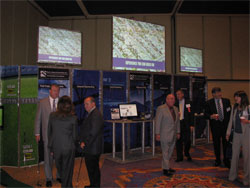 | �
�| Event exhibitors and sponsors contribute to an informative and engaging environment | �
�This year’s meeting was the best yet for the industry-leading construction defect and claims event.
�This year’s seminar concluded on May 13, 2011 with the Construction Defect Community Charitable Foundation Golf Tournament, held at Strawberry Farms Golf Course.
�The Disneyland Hotel in Anaheim, California was the place where more than 1,500 attendees convened for two days of professional development activities and seminars that included CLE workshops and panel discussions of special interest to legal and insurance professionals concerned with construction defect and claims litigation. Key events included “Challenges for Experts in Construction Defect Claims and Litigation,” “Keeping Up with Construction Defect Coverage,” and “Tips for Avoiding the ‘Perfect Storm’ in Handling of Wrap Claims.”
� �  | �
�| Supporting the golf tournament at the 15th hole | �
�This year’s Ollie award was given to George D. Calkins II, Esq. The West Coast Casualty Jerrold S. Oliver Award of Excellence was named in honor of the late Judge Jerrold S. Oliver, and recognizes an individual who is outstanding or has contributed to the betterment of the construction community.
�In addition to being the most comprehensive professional development seminar in the area of construction defects, this year’s seminar was equally valuable as a networking opportunity for members of the industry. People participated in professional development events during the day and then continued networking in the evening at numerous social events. The Lawn Party as well as the legendary Wood, Smith, Henning & Berman events were very well attended. Additional valuable networking events were hosted by a number of industry professionals at the House of Blues, and Tortilla Joe’s.
�As of this writing the 2011, West Coast Casualty's Construction Defect Seminar has applied for or has already received the following continuing education accreditation in the following areas;
�Read the full story…
�For more information about next year’s event, visit West Coast Casualty.
Construction Demand Unsteady, Gains in Some Regions
June 29, 2011 — CDJ Staff
The Associated General Contractors of America reported Tuesday, June 28 that construction employment increased in 120 of the 337 metropolitan areas surveyed between May 2010 and May 2011.
�‘While construction employment has stopped plunging, any sign of a recovery remains spotty at best,” said Ken Simonson, the association’s chief economist. ‘The close to even split between areas adding and losing jobs is a reminder that for every market doing well, there is another market that is still hurting.”
�The largest number of jobs created was in the Dallas, Texas region, with 5,600 new jobs, a five percent increase. The northern Massachusetts/southern New Hampshire region near Haverhill saw the greatest percentage increase, although that twenty-two percent increase represents only 800 new jobs. The Chicago, Illiinois area added 4,600 jobs, a four percent increase.
�Other regions were not so lucky. The Atlanta, Georgia area saw a loss of 7,400 jobs, an eight percent loss. Las Vegas also lost 7,400 jobs, which there represented a sixteen percent decline. The New York City area lost 6,700 jobs, a six percent reduction. The Riverside, California area lost 5,300 jobs, a nine percent loss.
�Stephen E. Sandherr, the association’s chief executive officer, blamed a combination of regulation and budget squeezes. "Some in Washington never met a regulation they didn’t like and others never found a penny they didn’t want to pinch. Together that makes for a bad way to boost employment and a great way to stifle the private sector and neglect critical economic infrastructure.”
� Read the full story…