General Contractor/Developer May Not Rely on the Homeowner Protection Act to Avoid a Waiver of Consequential Damages in an AIA Contract
August 4, 2011 — Higgins, Hopkins, McLain & Roswell, LLC
Recently, in Caribou Ridge Homes, LLC v. Zero Energy, LLC, et al., Case No. 10CV1094, Boulder County District Court Judge Ingrid S. Bakke entered a ruling and order on the Plaintiff’s Motion for Determination of Question of Law Pursuant to C.R.C.P. 56(h) on Issue of Damages. The Order found that the Plaintiff was not a homeowner intended to be protected by the Homeowner Protection Act (the “HPA”) and thus could not pursue its claims for consequential damages against Defendant.
�By way of background, on June 18, 2008, Plaintiff Caribou Ridge Homes, LLC (“Caribou”) entered into a Standard Form Agreement Between Owner and Contractor AIA Document A114-2001 (the “Contract”) with Defendant Zero Energy, LLC (“Zero Energy”). Plaintiff hired Zero Energy to serve as a general contractor for the construction of a single-family home in the Caribou Ridge subdivision in Nederland, Colorado. A provision in the contract contained a mutual waiver of consequential damages (“Waiver”).
Read the full story…
�Reprinted courtesy Higgins, Hopkins, McLain & Roswell, LLC
Nevada District Court Dismisses Case in Construction Defect Coverage Suit
August 16, 2012 — CDJ Staff
The United States District Court of Nevada has dismissed a case filed by Maryland Casualty Company against National Fire & Marine Insurance Company. This case follows a case in which National was sued over “200 causes of action arising out of 193 separate insurance coverage disputes related to 75 different insureds and 163 unrelated construction defect or Chapter 40 proceedings across seven states.” The judge in this initial case severed the plaintiffs, as he found that allowing joinder “would make this case impossible to manage.” In this particular instance, National seeks to have the claims made by Maryland Casualty dismissed.
Maryland Casualty alleged that for insurance policies issued to 38 companies, National was obligated to defend the insured. National was, according to the plaintiff, named as defendants in 72 unrelated lawsuits to which National disclaimed coverage. However, the court found that Maryland Casualty failed “to provide enough detail regarding the relevant property damage, policies, claims, and time periods.” The court found that Maryland failed to “state a claim upoin which relief can be granted.
The court also found that “the Complaint lacks any well-pled allegations from which the Court could conclude the Plaintiff has standing since the Complaint is devoid of information about the specific policies at issue.
The court did allow Maryland Casualty up to September 3, 2012 in which to file an amended complaint.
Read the court’s decision…
Tucson Officials to Discuss Construction Defect Claim
July 10, 2012 — CDJ Staff
The mayor of Tucson, Arizona and the city council scheduled a meeting on June 26, 2012 in order to consult with the city’s attorneys concerning possible construction defect litigation involving the Martin Luther King, Jr. apartment building in that city. The memorandum was authored by Richard Miranda, the Tucson city manager.
Read the full story…
Florida Appeals Court Rules in Favor of Homeowners Unaware of Construction Defects and Lack of Permits
December 9, 2011 — CDJ Staff
The Florida Court of Appeals has ruled that a homeowner is not liable for defects in unpermitted alterations, reversing a lower court’s decision in Jensen v. Bailey. The Jensens sold their house to the Baileys. During the sale, the Jensens filled out a property disclosure statement, checking “no” to a question about “any improvement or additions to the property, whether by your or by others that have been constructed in violation of building codes or without necessary permits.”
After moving in, the Baileys discovered several problems with the home. One involved a defective sewer connection leading to repeated backups. The Baileys also found problems with remodeling the Jensens had done in the kitchen, master bath, and bedroom. The remodeling work was not done with required permits nor was it up to code.
The court noted that an earlier case, Johnson v. Davis, established four criteria: “the seller of a home must have knowledge of a defect in the property; the defect must materially affect the value of the property; the defect must not be readily observable and must be unknown to the buyer; and the buyer must establish that the seller failed to disclose the defect to the buyer.” The court found that the first of these criteria was crucial to determining the case.
In the Johnson ruling, the then Chief Justice dissented, fearing that the courts “would ultimately construe Johnson’s requirement of actual knowledge to permit a finding of liability based on constructive knowledge,” quoting Justice Boyd, “a rule of constructive knowledge will develop based on the reasoning that if the seller did not know of the defect, he should have known about it before attempting to sell the property.” The Appeals Court concluded that the lower court hit this point in ruling on Jensen v. Bailey.
Citing other Florida cases, the court noted that the Johnson rule does require “proof of the seller’s actual knowledge of the defect.” The court cited a case in which it was concluded that the seller “should have known” that there was circumstantial evidence was that the seller did know about the defects, as the seller had been involved in the construction of the home.
In the case of the Jensens, the lower court concluded that they did not know that the work was defective, nor did they know that they were obligated to obtain permits for it. The Appeals Court found this one fact sufficient to reverse the decision and remand the case to the lower court for a final judgment in favor of the Jensens.
Read the court’s decision…
Construction Defects in Home a Breach of Contract
September 9, 2011 — CDJ Staff
The Supreme Court of North Dakota has ruled in Leno v. K & L Homes, affirming the verdict of the lower court. K & L Homes argued that district court had erred in several ways, including by refusing to instruct the jury on comparative fault, denying a request for inspection, and not allowing a defendant to testify on his observations during jury viewing.
The Lenos purchased a home constructed by K & L Homes, after which they alleged they found cracks, unevenness, and shifting, which they attributed to improper construction. They claimed negligence on the part of K & L Homes. K & L Homes responded that the Lenos were responsible for damage to the home. The Lenos dropped their negligence claim, arguing breach of contract and implied warranties.
Before the trial, after the discovery period had passed, K & L Homes requested to inspect the home. This was rejected by the court. Kelly Moldenhauer, the owner of K & L Homes sought to testify about his observations during the jury’s viewing of the house. The court denied this too. The jury found that K & L was in breach of contract and awarded damages to the Lenos.
The North Dakota Supreme Court noted that K & L Homes gave “warranties that the home had been built according to local building codes and laws, and that the house was fit for its particular purpose as a residence.” The court found that a defective home breached this warranty. Further, the home violated an implied warranty of fitness.
The district court had denied K & L’s request to inspect the home, as the discovery period had ended and it would not give the Lenos time to do further discovery of their own. At the time of the request, there was only twenty-two days before the trial. The Supreme Court ruled that this was not an abuse of discretion of the part of the district court.
The Lenos had requested that Moldenhauer’s testimony not be permitted, as it would “have the same effect as if the court had granted K & L Homes’ pretrial request for inspection.” K & L Homes agreed to this in court, replying, “okay.”
The decision affirms the judgment of the district court and the damages awarded to the Lenos by the jury.
Read the court’s decision…
Hovnanian Increases Construction Defect Reserves for 2012
January 6, 2012 — CDJ Staff
In their fourth quarter earnings call, executives of Hovnanian Enterprises made some projections for investors, covering the company’s plans for 2012. During the call, Ara K. Hovnanian, the firm’s CEO, discussed their reserves to meet construction defect claims. The firm does an annual actuarial study of their construction defect reserves.
Mr. Hovnanian noted that there have been no changes for the past several years, but this year they are increasing their reserves by about $6.3 million. Additionally, the firm has added $2.5 million to their legal reserves. Mr. Hovnanian stated “we do not anticipate that changes of this magnitude will be recurring as we look forward to 2012.”
Read the full story…
Contractors with Ties to Trustees Reaped Benefits from LA Community College Modernization Program
March 3, 2011 — Original reporting by Gale Holland, Michael Finnegan and Doug Smith, Los Angeles Times
In the latest installment of the “Billions To Spend” series of investigative reports focused on construction defects, management, and cost issues relevant to LACC’s Community College Modernization Projects, the LA Times examines the costs associated with the various layers of construction management and benefits that accrued to contractors with ties to LACC trustees.
�The reporting by the Times is seemingly critical of the project’s utilization of “body shops” an industry term for companies that function as employers of record. The article segment published today cites a number of circumstances wherein their utilization appears to have escalated costs substantially.
�“To gauge the cost of the staffing system, The Times reviewed thousands of pages of financial records from April 2007, when URS began managing the program, to July 2010. Reporters identified two dozen contractors serving as conduits for pay and benefits for employees they did not supervise.
�At least 230 people were employed in this manner, at a total cost of about $40 million, the records show.
�Approximately $18 million of the total was paid to the employees, according to the Times analysis. The remaining $22 million went to profit and overhead for contractors, the records indicate.
�For employees on its own payroll, the district says that medical and other benefits increase compensation costs 40% above base salaries. So if the district had employed its construction staff directly, the total cost for the period studied would have been $25 million instead of $40 million, a savings of $15 million, The Times calculated.”
�Read Full Story...
Residential Construction: Shrinking Now, Growing Later?
August 17, 2011 — CDJ Staff
Jim Haugey, the Chief Economist for Reed Construction Data noted that new residential construction spending fell 0.2% in June and a slightly larger drop of 0.5% in residential remodeling. While economic growth is still low, Haugey states that homebuilders have “record low inventories.” He forecasts a shrinkage of 1.5% in 2011, followed by about 20% growth in 2012.
Read the full story…
Water Damage Covered Under Efficient Proximate Cause Doctrine
August 2, 2012 — Tred Eyerly, Insurance Law Hawaii
A U.S. District Court in Washington found coverage in what it described as a text book study of the efficient proximate cause rule. Hiller v. Allstate Pro. & Cas. Ins. Co., 2012 U.S. Dist. LEXIS 84862 (E.D. Wash. June 19, 2012).
The Hillers purchased a newly constructed home in December 2006. They also purchased an all-risk homeowner's policy from Allstate.
In July 2010, the Hillers discovered that the carpet in the basement of the residence was saturated with water. Allstate was immediately notified. Hiller began an investigation to attempt to determine the source of the water. He poured water into a downspout drain at the northwest corner of the residence. This caused water to leak into the northwest corner of the home's basement.
An area was excavated around the northwest downspout drain. The end of the drain pipe was partially blocked by rocks and had been wrapped with fabric landscaping material. Further, a “T” pipe installed at the foot of the drain was directing water toward the house's concrete foundation. Hiller notified Allstate that the problems with the drain was due to construction defects and the system was designed to fail.
Allstate denied the claim. Based upon Hiller's information, coverage was excluded under the policy's surface water, subsurface water, inherent vice, and latent defect exclusions.
Read the full story…
Reprinted courtesy of Tred R. Eyerly, Insurance Law Hawaii. Mr. Eyerly can be contacted at te@hawaiilawyer.com
North Carolina Exclusion j(6) “That Particular Part”
February 10, 2012 — CDCoverage.com
In Alliance Mutual Insurance Co. v. Dove, 714 S.E.2d 782 (N.C. Ct. App. 2011), claimant Murphy-Brown hired insured Dove to repair a broken elevator belt in a grain elevator in Murphy-Brown’s feed mill. The elevator was inside a metal duct and, to access the broken belt, Dove had to cut out a section of the duct. After replacing the belt, Dove welded the metal section back to the duct. Immediately after Dove completed the welding, dust inside the duct ignited, causing an explosion in the elevator, resulting in property damage to the elevator and other property. Murphy-Brown sued Dove for negligence seeking damages for the repair and replacement of the elevator, repair and replacement of the other property, increased grain handling costs during the repairs, and loss of use.
Read the full story…
� Reprinted courtesy of CDCoverage.com
�
Underpowered AC Not a Construction Defect
November 7, 2012 — CDJ Staff
After buying a home in Louisiana, Mike Gines determined that the home’s air conditioning unit was insufficient to maintain an appropriate temperature. He contacted the home builder, D.R. Horton, Inc., which worked with the air conditioning installer, Reliant Heating & Air Conditioning, in order to repair the system. When the problems persisted, Gines filed a class action petition against Horton and Reliant in state court. Horton and Reliant moved the case to the federal courts, whereupon Gines asserted the defendants were in violation of the Louisiana New Home Warranty Act (NHWA). Horton stated that the claim under the NHWA was invalid, because Gines had not alleged actual physical damage to his home.
The district court granted Horton’s motion to dismiss. Gines sought a reversal from the Fifth Circuit Court of Appeals and sought to have two questions of state law addressed by the Louisiana Supreme Court.
The district court ruled that the NHWA was the “sole remedy under Louisiana law for a purchaser of a new home with construction defects. Gines argued that court erred in this, but also conceded that this was the conclusion of the Louisiana Supreme Court.
Further, Gines argued that a provision in the NHWA that allows the inclusion of construction defects that do not cause damage was satisfied by paragraph 6 of the contract. The court noted that Gines did not attach a copy of the contract to either the original or amended complaint, and so the court does not need to address these claims. However, the court cautioned that if a copy had been included, they still would have rejected the claim, as “the cited language does not indicate a waiver of the physical damage requirement.” They also note that “paragraph 13 of the contract shows that Gines was aware to the absence of any such waiver in the contract.”
The court concludes that “the moral of this story is that in order to avoid the harsh result that has obtained here, the buyer of a newly constructed home in Louisiana should seek to obtain in the contract of sale an express waiver of the actual damage requirement of the NHWA.” The appeals court affirmed the decision of the circuit court and denied the application to certify questions to the Louisiana Supreme Court.
Read the court’s decision…
Federal Court Denies Summary Judgment in Leaky Condo Conversion
August 4, 2011 — CDJ Staff
In the US District Court for Illinois, Judge William Hibber has rejected the request for summary judgment sought by the developers of a condominium building in the case of Nautilus Ins. Co. v. 1735 W. Diversey, LLC (the insureds). The insureds renovated a building at 1735 W. Diversey, Chicago, converting it into condominiums. After the project was completed and all units sold, and a condominium association form, one of the owners found that unit suffered leaks during rainstorms. The condo board hired a firm, CRI, to investigate the cause of the leakage. CRI found “water infiltration through the exterior brick masonry walls, build-up of efflorescence on the interior surfaces of the masonry, and periodic spalling of portions of the brick masonry.”
�The redevelopment firm had purchased coverage from Nautilus. “Shortly after the Board filed its first complaint, the Insureds tendered the mater to Nautilus and requested that it indemnify and defend them from the Board's underlying claims. Nautilus, however, rejected the Insureds’ tender and denied coverage under both insurance policies.” Nautilus stated that the water leakage did not constitute an occurrence under the policies. The court cited these policies in which an occurrence is defined as “an accident, including continuous or repeated exposure to substantially the same general harmful conditions.” The Illinois courts have determined that construction defects are not accidents.
�The court concluded that the insured did not bring forth claims within the coverage of the policies and denied the motion for summary judgment.
� Read the court’s decision…
Homebuilding on the Rise in Nation’s Capitol
November 7, 2012 — CDJ Staff
Is the homebuilding crunch over in DC? The Washington Post has reported that while new home construction is up throughout the country, in the DC area, construction has reached levels last seen in 2006. From January to August 2012, there were more than 19,000 building permits issued in the area, nearly doubling the number issued by that point in 2011.
While building is on a quicker pace, what’s being built has changed. As compared to 2006, there are more townhomes, condos, and smaller homes being built. The article notes that 11 percent of new construction is condos, while in 2006, it was only 5 percent.
Read the full story…
Who Is To Blame For Defective — And Still LEED Certified — Courthouse Square?
September 1, 2011 — Douglas Reiser, Builders Counsel
Remember Courthouse Square? I sure do. We have talked about the closed and evacuated LEED certified building a couple of times here on Builders Counsel. Well, it’s back in the news. This time building professionals are pointing fingers — but there is some talk about a fix. Still, its LEED certification remains.
If you read my past articles about Courthouse Square, you can get caught up on this mess. The short of it is that Salem, Oregon had the five-story government building and bus mall completed in 2000 for $34 Million. It was awarded LEED certification during the USGBC’s infancy. Last year, it became public that the building had significantly defective concrete and design. The Salem-Keizer Transit District worked with the City of Salem to shut the building down, and it has not been occupied since.
Last fall, Courthouse Square failed thorough forensic testing leading to a lengthy bout with a number of insurers. The contractors and designers had been hauled into court, but the Transit District was able to settle with the architect and contractors. The only remaining party involved in the lawsuit appears to be the engineering firm, Century West Engineering. Most expert reports have pinned the responsibility for the poor design and materials on Century West’s shoulders.
Read the full story…
Reprinted courtesy of Douglas Reiser of Reiser Legal LLC. Mr. Reiser can be contacted at info@reiserlegal.com
2011 West Coast Casualty Construction Defect Seminar – Recap
June 1, 2011 — CDJ Staff
� 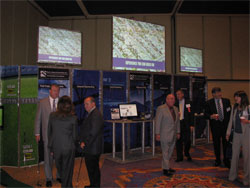 | �
�| Event exhibitors and sponsors contribute to an informative and engaging environment | �
�This year’s meeting was the best yet for the industry-leading construction defect and claims event.
�This year’s seminar concluded on May 13, 2011 with the Construction Defect Community Charitable Foundation Golf Tournament, held at Strawberry Farms Golf Course.
�The Disneyland Hotel in Anaheim, California was the place where more than 1,500 attendees convened for two days of professional development activities and seminars that included CLE workshops and panel discussions of special interest to legal and insurance professionals concerned with construction defect and claims litigation. Key events included “Challenges for Experts in Construction Defect Claims and Litigation,” “Keeping Up with Construction Defect Coverage,” and “Tips for Avoiding the ‘Perfect Storm’ in Handling of Wrap Claims.”
� �  | �
�| Supporting the golf tournament at the 15th hole | �
�This year’s Ollie award was given to George D. Calkins II, Esq. The West Coast Casualty Jerrold S. Oliver Award of Excellence was named in honor of the late Judge Jerrold S. Oliver, and recognizes an individual who is outstanding or has contributed to the betterment of the construction community.
�In addition to being the most comprehensive professional development seminar in the area of construction defects, this year’s seminar was equally valuable as a networking opportunity for members of the industry. People participated in professional development events during the day and then continued networking in the evening at numerous social events. The Lawn Party as well as the legendary Wood, Smith, Henning & Berman events were very well attended. Additional valuable networking events were hosted by a number of industry professionals at the House of Blues, and Tortilla Joe’s.
�As of this writing the 2011, West Coast Casualty's Construction Defect Seminar has applied for or has already received the following continuing education accreditation in the following areas;
�Read the full story…
�For more information about next year’s event, visit West Coast Casualty.
Differing Rulings On Construction Defect Claims Leave Unanswered Questions For Builders, and Construction Practice Groups. Impact to CGL Carriers, General Contractors, Builders Remains Unclear
March 7, 2011 — March 7, 2011 Construction Defect Journal Staff
In the past year a number of state and federal courts have rendered a number of conflicting decisions that promise to alter or perhaps shift entirely the paradigm, of how builders manage risk.
�According to a report today by Dave Lenckus in Property Casualty 360 “Nine state and federal courts and one state legislature over the past year have addressed whether a construction defect a defective product or faulty workmanship is fortuitous and therefore an occurrence under the commercial general liability insurance policy. Four jurisdictions determined it is; three said no; two ruled that a construction defect that causes consequential damage to property other than the work product is an occurrence; and one federal court contributed its conflicting case law that has developed in Oregon since its high court ruled in 2000 that a construction defect is not an occurrence”.
�The article strongly suggests that in the absence of a clear consensus over what the recent rulings mean for builders and contractors coverage disputes will intensify and continue to proliferate.
� Doing this on a state-by-state basis has caused a lot of confusion among buyers and sellers, said Jeffrey A. Segall, a Tampa-based senior vice president and the Florida Construction Practice leader at Willis of Florida, a unit of Willis Group Holdings.
�Read Full Story...
Construction Defects Are Occurrences, Says Georgia Supreme Court
July 10, 2012 — CDJ Staff
Michael Bradford writes about the implications of a March decision of the Georgia Supreme Court in which the court found that “negligent construction resulting in damage to surrounding property constitutes an occurrence under a commercial general liability policy. The contractor in the case, American Empire Surplus Lines Insurance Co. Inc. vs. Hathaway Development Co. Inc, argued that a damage caused by a plumbing subcontractor’s work was covered. American Empire was the insurer for the plumbing subcontractor.
Bradford notes that this follows similar decisions in other courts. The George court ruled that “an occurrence can arise where faulty workmanship causes unforeseen or unexpected damage to other property.”
Read the full story…
Read Her Lips: “No New Buildings”
November 18, 2011 — CDJ Staff
Martha Johnson, the head of the General Services Administration, has said that her agency will not be building any new buildings in the near future. Among other duties, the GSA is responsible for the building, renovating, and leasing of federal office space. The White House had proposed $840 million in new construction, the Senate only $56 million. The House did not appropriate any money for the agency to use for new construction.
In addition to cutbacks on new buildings, Congress is suggesting only $280 million in repairs of existing government buildings. In order to cut back, the GSA has dropped plans to renovate their own offices in favor of renovations at the Department of Homeland Security and the Food and Drug Administration.
Read the full story…