The Year 2010 In Review: Design And Construction Defects Litigation
February 25, 2011 — Candace Matson, Harold Hamersmith, and Helen Lauderdale -
Construction & Infrastructure Law Blog - February 25, 2011
This article is the first in a series summarizing construction law developments for 2010
�1. Centex Homes v. Financial Pacific Life Insurance Co., 2010 U.S. Dist. LEXIS 1995 (E.D. Cal. 2010)
�After settling numerous homeowners’ construction defect claims — and more than ten years after the homes were substantially completed — a home developer brought suit against one of the concrete fabrication subcontractors for the development seeking indemnity for amounts paid to the homeowners, as well as for damages for breach of the subcontractor’s duties to procure specific insurance and to defend the developer against the homeowners’ claims. The subcontractor brought a motion for summary adjudication on the ground the developer’s claims were barred by the ten year statute of repose contained in Code of Civil Procedure Section 337.15.
The District Court agreed the developer’s claim for indemnity was barred by Section 337.15. And it held that because the damages recoverable for breach of the subcontractor’s duty to purchase insurance are identical to the damages recoverable through the developer’s indemnity claim, the breach of duty to procure insurance claim also was time-barred. The District Court, however, allowed the claim for breach of the duty to defend to proceed. The categories of losses associated with such a claim (attorneys’ fees and other defense costs) are distinct from the damages recoverable through claims governed by Section 337.15 (latent deficiency in the design and construction of the homes and injury to property arising out of the latent deficiencies).
� �2. UDC — Universal Development v. CH2M Hill, 181 Cal. App. 4th 10 (6th Dist. Jan. 2010)
��Indemnification clauses in construction agreements often state that one party to the agreement — the “indemnitor” — will defend and indemnify the other party from particular types of claims. Of course, having a contract right to a defense is not the same as actually receiving a defense. Any indemnitor attempting to avoid paying for defense costs can simply deny the tender of defense with the hope that when the underlying claim is resolved the defense obligations will be forgotten. In the past, when parties entitled to a defense — the “indemnitees” — had long memories and pressed to recover defense costs, indemnitors attempted to justify denying the tender by claiming their defense obligations coincided with their indemnity obligations and neither arose until a final determination was made that the underlying claim was one for which indemnity was owed.
��Read the full story...
�Reprinted courtesy of Candace Matson, Harold Hamersmith, and Helen Lauderdale, Sheppard Mullin Richter & Hampton LLP. Ms. Matson can be contacted at cmatson@sheppardmullin.com, Mr. Hamersmith can be contacted at hhamersmith@sheppardmullin.com, and Ms. Lauderdale can be contacted at hlauderdale@sheppardmullin.com.
New Web Site Tracks Settled Construction Defect Claims
June 19, 2012 — CDJ Staff
Peter Lissner, a former Nevada homebuilder, has created a new site to help track homes that have been involved in construction defect litigation. His site, housefaxreview.com, collections documentation about homes where claims of construction defects have been made. He told The Builders Magazine concerns about “the number of homes that have been served notices, received compensation, yet the homes weren’t repaired.” On the site, the creator is identified as “a family owned builder.” According to the site, “the builder had no claims until the neighborhood reached the statutory claims limit 10 years.”
Lissner also claims that in many cases, after settling construction defect lawsuits, the homeowners sell to subsequent buyers without disclosing the lawsuit or their failure to repair. “Who is going to let the new homeowner know about the issue?” he asks.
Documents on the site are priced according to their relevance. Lissner notes that those who provide documents to the site will receive free access.
Read the full story…
Texas exclusions j(5) and j(6).
April 27, 2011 — April 27, 2011, by CDCoverage.com
In Evanston Ins. Co. v. D&L Masonry of Lubbock, Inc., No. 07-10-00358-CV (Tex. Ct. App. April 18, 2011), insured masonry subcontractor D&L sued its CGL insurer Evanston to recover costs incurred by D&L for the replacement of window frames damaged by D&L while performing masonry work adjacent to the window frames. The trial court granted summary judgment for D&L.
�Read the full story…
�Reprinted courtesy of CDCoverage.com
2011 West Coast Casualty Construction Defect Seminar – Recap
June 1, 2011 — CDJ Staff
� 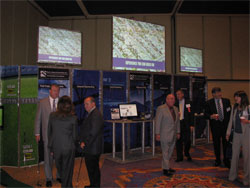 | �
�| Event exhibitors and sponsors contribute to an informative and engaging environment | �
�This year’s meeting was the best yet for the industry-leading construction defect and claims event.
�This year’s seminar concluded on May 13, 2011 with the Construction Defect Community Charitable Foundation Golf Tournament, held at Strawberry Farms Golf Course.
�The Disneyland Hotel in Anaheim, California was the place where more than 1,500 attendees convened for two days of professional development activities and seminars that included CLE workshops and panel discussions of special interest to legal and insurance professionals concerned with construction defect and claims litigation. Key events included “Challenges for Experts in Construction Defect Claims and Litigation,” “Keeping Up with Construction Defect Coverage,” and “Tips for Avoiding the ‘Perfect Storm’ in Handling of Wrap Claims.”
� �  | �
�| Supporting the golf tournament at the 15th hole | �
�This year’s Ollie award was given to George D. Calkins II, Esq. The West Coast Casualty Jerrold S. Oliver Award of Excellence was named in honor of the late Judge Jerrold S. Oliver, and recognizes an individual who is outstanding or has contributed to the betterment of the construction community.
�In addition to being the most comprehensive professional development seminar in the area of construction defects, this year’s seminar was equally valuable as a networking opportunity for members of the industry. People participated in professional development events during the day and then continued networking in the evening at numerous social events. The Lawn Party as well as the legendary Wood, Smith, Henning & Berman events were very well attended. Additional valuable networking events were hosted by a number of industry professionals at the House of Blues, and Tortilla Joe’s.
�As of this writing the 2011, West Coast Casualty's Construction Defect Seminar has applied for or has already received the following continuing education accreditation in the following areas;
�Read the full story…
�For more information about next year’s event, visit West Coast Casualty.
Joinder vs. Misjoinder in Colorado Construction Claims: Roche Constructors v. One Beacon
July 10, 2012 — David McLain, Higgins, Hopkins, McLain & Roswell, LLC
Often, those practicing in the construction defect field have faced questions concerning the joinder of a party. Recently, the U.S. District Court for the District of Colorado weighed in on the requirements for joinder under the Colorado Rules of Civil Procedure. See Roche Constructors, Inc. v. One Beacon America Ins. Co., 2012 WL 1060000 (D. Colo. 2012). Roche secured a construction contract to build a detention facility for the Lincoln County Sheriff’s Office in Lincoln County, Nebraska. In turn, Roche entered into a subcontract with Dobberstein Roofing Company, Inc. in October 2009 to install the roofing system and other related work at the detention facility. The subcontract agreement required Dobberstein to maintain adequate commercial general liability insurance and to add Roche as an additional insured under the policy. Roche maintained a builder’s risk policy issued by OneBeacon America Insurance Company and Dobberstein secured a certificate of liability insurance underwritten by Transportation Insurance Company (“TIC”). Id. at *1.
Roche alleged that Dobberstein constructed the roofing system in a negligent manner in violation of the subcontract. Roche claims it incurred additional costs to repair structural damage to the roofing system as a result of Dobberstein’s negligent work. In order to cover said damage, Roche tendered insurance claims to OneBeacon and TIC.
Read the full story…
Reprinted courtesy of David McLain, Higgins, Hopkins, McLain & Roswell, LLC. Mr. McLain can be contacted at mclain@hhmrlaw.com
Insurer Must Defend Claims for Diminution in Value of Damaged Property
June 19, 2012 — Tred Eyerly, Insurance Law Hawaii
The insurer’s duty to defend a developer sued by purchasers of homes for damages for diminution in value of homes was at issue in Mid-Continent Cas. Co. v. Academy Dev., Inc., 2012 WL 1382459 (5th Cir. April 20, 2012).
In the underlying action, plaintiffs alleged the developer knew when it sold the homes that the lake walls were falling and that water was leaking from the lakes onto adjacent home sites. They sought damages for diminution in the value of their homes resulting from the defective lakes. The action was tried in 2008, and the jury returned a verdict for the developer.
Mid-Continent initially defended under a reservation of rights.
Reprinted courtesy of Tred R. Eyerly, Insurance Law Hawaii. Mr. Eyerly can be contacted at te@hawaiilawyer.com
Read the full story…
One to Watch: Case Takes on Economic Loss Rule and Professional Duties
June 28, 2011 — Douglas Reiser, Builders Counsel
According to the Supreme Court of Washington Blog, The Supreme Court heard oral argument in Jackowski v. Hawkins Poe on Thursday, June 16, 2011. The court’s synopsis of the case can be found on the Washington State Court website.
�In short, two home purchasers brought a lawsuit against the home’s sellers, the sellers’ agent and the purchasers’ own agent, alleging claims of fraud, fraudulent concealment, negligent misrepresentation and breach of common law and statutory duties. The trial court dismissed the buyers’ claims on the basis of the economic loss doctrine and Division II reversed, opining that the ELR does not apply to professional duties. The Supreme Court will now look at applying the Independent Duty Doctrine established last year, and whether professional duties (those of the real estate agents) should be reviewed under a different light.
Read the full story…
�Reprinted courtesy of Douglas Reiser of Reiser Legal LLC. Mr. Reiser can be contacted at info@reiserlegal.com
Quarter Four a Good One for Luxury Homebuilder
December 20, 2012 — CDJ Staff
Toll Brothers has announced that their fourth-quarter net income is $2.35 per share, which they attribute in part to an income tax benefit. Their revenue, at $632.8 million, easily exceeded analysts’ projections of $565.1 million. Additionally, their number of signed contracts jumped seventy percent while their cancellation rate dropped nearly half to 4.9 percent.
Read the full story…
Ensuing Loss Provision Does Not Salvage Coverage
August 2, 2012 — Tred Eyerly, Insurance Law Hawaii
The Minnesota Court of Appeals affirmed the trial court's decision finding no coverage due to exclusions from the all-risk policy for losses related to mold, rot and condensation. Koskovich v. Am Family Mut. Ins. Co., 2012 Minn. App. Unpub. LEXIS 581 (Minn. Ct. App. June 25, 2012).
In 1978, the insureds purchased a home that was built in 1904. From 1991 to 1995, they remodeled, which included rotating the house 45 degrees, removing a wing and adding a new section. Polypropylene vapor barriers were installed, with pinholes for ventilation.
In 2008, water was observed on an interior floor. An investigation revealed that the sheathing under the siding and the house's framing were wet and rotten, requiring removal and replacement of the siding and studs. Repairs were made and a claim was submitted to American Family Mutual Insurance Company.
American's structural engineer inspected and determined that moisture was likely caused by condensation of water vapor where the vapor barrier was held tight to the sheathing and by inward water migration from wet siding during rainy periods through the vapor-barrier perforations. The structural engineer opined that, although the home's framing was deteriorated and structurally compromised, it did not appear as though the home was in imminent danger of collapse.
American denied coverage.
Read the full story…
Reprinted courtesy of Tred R. Eyerly, Insurance Law Hawaii. Mr. Eyerly can be contacted at te@hawaiilawyer.com
Construction Firm Sues City and Engineers over Reservoir Project
October 28, 2011 — CDJ Staff
The city of Fremont, Ohio and Arcadis have been sued by Trucco Construction. Trucco had been hired by the city to build a reservoir designed by Arcadis, the News-Messenger reports. Peter Welin, attorney for Trucco, said that he found “startling evidence of the company’s negligence” when he deposed Arcadis engineers. “This project could never be built the way they bid it.”
Their suit alleges that Arcadis and the city were aware that the site was not conducive to construction and also that Arcadis failed to be a neutral party in discussions between Trucco and the city regarding compensation.
Sam Wamper, an attorney for Fremont, said he was going to file a motion which would include “quite an interesting story,” but declined to elaborate.
Read the full story...
Arizona Homeowners Must Give Notice of Construction Defect Claims
August 2, 2012 — CDJ Staff
Chris Combs of the Combs Law Group notes that “the new home construction industry is recovering” and that some of the buyers of these homes “will have claims for construction defects.” But not so quick on filing that claim.
Under Arizona law, as Mr. Combs notes the law “requires that, at least 90 days before filing any lawsuit, the buyer furnish notice by certified mail to the homebuilder specifying in detail the construction defect.” Only if there is no agreement over proposed repair can the homeowner file a lawsuit.
Read the full story…
Guilty Pleas Draw Renewed Interest In Nevada’s Construction Defect Laws
December 9, 2011 — CDJ Staff
A report this week by David McGrath Schwarz of the Las Vegas Sun suggests that Nevada’s construction defect laws will be a point of much contention in upcoming legislative sessions. The report cites renewed interest in the state’s construction defect laws due to ongoing federal investigations of construction defect attorney Nancy Quon and construction company owner Leon Benzer. Guilty pleas have been entered by at least ten individuals including an attorney, property managers, straw purchasers, and former HOA board members.
The article suggests that Nevada’s Chapter 40 laws are easily manipulated to the detriment of Nevada’s homebuilding industry. Construction industry lobbyists have tried unsuccessfully to change the laws in past legislative sessions.
The Sun’s article speculates that the building industry might be able to gain legislative concessions due to the volume of guilty pleas and what it refers to as examples of Chapter 40 abuses. ”With federal authorities collecting guilty pleas, the construction industry has prime examples of the system being abused, and how lucrative it can be for attorneys.”
Read the full story…
Court Strikes Down Reasonable Construction Defect Settlement
December 20, 2012 — CDJ Staff
The Court of Appeals of Washington has struck down a construction defect settlement between a building owner and the companies she hired to repair the siding, among other repairs to bring the building up to code. Yuan Zhang hired Hawk Construction LLC to do repair work. Hawk, in turn, hired Ready Construction LLC for some aspects of the project. Hawk and Ready were both insured by Capital Specialty Insurance Corporation.
There were several problems with Ready’s work. After removing old siding, they did not protect the building, nor did they remove all of the damaged layers. Ready covered, but did not fix, a mildew problem under the old siding. When new siding was reattached, the nails used were too short to adequately attach it.
After paying for an inspection of the work, Zhang had Hawk and Ready begin the repairs again, but the work was abandoned without being completed. Zhang sued Hawk for breach of contract. Hawk then sued Ready, claiming that “Ready was liable to Hawk to the extent that Hawk was liable to Zhang.” Capitol retained defense for both contractors.
Zhang settled with Hawk, in an agreement that gave her “the right to collect and/or pursue all costs and attorney fees paid by Hawk or its insurance company defending against the Zhang’s claims and pursuing claims against Ready.” Subsequently, she also settled with Ready. Both companies ceased operations.
Zhang had the settlements reviewed by a court, which concluded that the settlements were reasonable. Capital was allowed to appeal, claiming that the settlement included costs that were Zhang’s responsibility. The appeals court did not examine the question of the reasonableness of the settlement, concluding that Capitol’s interests were relevant only to “questions of bad faith, collusion, and fraud.”
In the case of Zhang, the court concluded that the relationship between Zhang and her former contractors was collusive. The court noted that “bad faith or collusion may exist when the evidence indicates a joint effort to create, in a non-adversarial atmosphere, a resolution beneficial to both parties, yet highly prejudicial to the insurer as intervener.” The court noted that both companies had minimal assets which were, in any case, exempted from the agreement. Further, the court found that the agreements failed to determine “what amount of the repairs related to preexisting water damage.” Zhang’s calculation of costs also included her expenses for architectural and engineering services, which the court points out, “where always Zhang’s costs to bear.”
The court concluded that “the overall structure of the settlements is highly probative of collusion, fraud, or bad faith.” Zhang’s agreements with Hawk and Ready allowed her to collect compensation from Hawk and then collect Ready’s compensation to Hawk for their portion of the settlement, allowing Zhang to collect the monies twice. Further, she was allowed to pursue Capitol for Hawk’s attorney expenses, even though Hawk had none. “The right to recover Hawk’s fees merely set up a windfall recovery for Zhang.” The court described the agreements among Zhang, Hawk, and Ready as “precisely the type of manipulation [the law] is intended to preclude.”
Read the court’s decision…
Construction Law: Unexpected, Fascinating, Bizarre
April 25, 2012 — CDJ Staff
Guy Randles offers an amusing set of odd construction law cases in the Daily Journal of Commerce, which he describes as “the unexpected, the fascinating and even the bizarre.” He noted that in one case “a whistleblower claimed he was terminated for reporting to the owner that the contractor’s painters had not applied the required coating thickness.” The whistleblower was the project manager and “was responsible for ensuring the proper coating thickness.”
��A less amusing case was that of an architect who was arrested for manslaughter. Gerard Baker “told investigators that the considered the fireplaces to be merely decorative.” Randles notes that “the mansion’s fireplaces were built of wood framing and lined with combustible drywall.” Further, a “gas fireplace even vented into the house’s interior.” Building officials called the house “a death trap.” According to the LA police chief this may be the only case in which building defects lead to a manslaughter charge.
� Read the full story…
�
District Court’s Ruling Affirmed in TCD v American Family Mutual Insurance Co.�
May 10, 2012 — CDJ Staff
In the case, TCD, Inc. v American Family Mutual Insurance Company, the district court’s summary judgment was in favor of the defendant. In response, the Plaintiff, TCD, appealed “on the ground that the insurance company had no duty to defend TCD under a commercial general liability (CGL) insurance policy.” The appeals court affirmed the decision.
�The appeals ruling provides a brief history of the case: “This case arises out of a construction project in Frisco, Colorado. The developer, Frisco Gateway Center, LLC (Gateway), entered into a contract with TCD, the general contractor, to construct a building. TCD entered into a subcontract with Petra Roofing and Remodeling Company (Petra) to install the roof on the building. The subcontract required Petra to "indemnify, hold harmless, and defend" TCD against claims arising out of or resulting from the performance of Petra’s work on the project. The subcontract also required Petra to name TCD as an additional insured on its CGL policy in connection with Petra’s work under the subcontract.”
�Furthermore, “TCD initiated this case against Petra and the insurance company, asserting claims for declaratory judgment, breach of insurance contract, breach of contract, and negligence. The district court entered a default judgment against Petra, and both the remaining parties moved for summary judgment. The court granted summary judgment on the entirety of the action, in favor of the insurance company, concluding that the counterclaims asserted by Gateway against TCD did not give rise to an obligation to defend or indemnify under the CGL policy.”
�The appeals court rejected each contention made by TCD in turn. First, “TCD contend[ed] that Gateway’s counterclaims constitute[d] an allegation of ‘property damage,’ which is covered under the CGL policy.” The appeals court disagreed. Next, “TCD argue[d] that [the court] should broaden or extend the complaint rule, also called the ‘four corners’ rule, and allow it to offer evidence outside of the counterclaims to determine the insurance company’s duty to defend in this case.” The appeals court was not persuaded by TCD’s argument.
�The judgment was affirmed. Judge Roman and Judge Miller concur.
� Read the court’s decision…
�
Insurance Firm Defends against $22 Million Claim
June 15, 2011 — CDJ Staff
The Houston law firm of Eggleston & Briscoe successfully defended their client, Colony Insurance Company, which was being sued for $22 million over roof hail damage. The Summer Hill Village Community Association did not convince a jury that the insurance company had violated state law or breached its contract when it denied coverage for the roofs. The homeowners association contended that the roof damage was due to a hail storm in 2007. The jury agreed with experts who contended the damage was already present at that time.
�Mr. Eggleston noted that “when your client is sued for a claim of $22 million, it is very satisfying to hear a jury agree that they in fact acted honorably and owed nothing.”
�Read the full story…
Equipment Costs? It’s a Steal!
July 8, 2011 — CDJ Staff
KCBD reports on the problems of a Lubbock, Texas contractor. It’s hard to do the job when your tools keep getting stolen. Corey Meadows, owner of Top Cut Interiors, told KCBD that he had chained an air compressor to a table saw. Since the thieves couldn’t cut the chain, they cut the table saw “and just took the air compressor and the chain.” Meadows estimates the thieves cost him $2,000 in damaged or stolen equipment and time lost.
Read the full story…
Homeowner Has No Grounds to Avoid Mechanics Lien
September 1, 2011 — CDJ Staff
The California Court of Appeals has rejected a motion by a homeowner in a dispute with the contractor who built an extension to his home. In McCracken v. Pirvulete, Mr. McCracken filed a mechanics lien after Mr. Pirvulete failed to complete payment. The matter went to trial with a series of exhibits that showed “the contractual relationship was strained and the parties disagreed over performance and payment.” As a result of the trial, the court awarded Mr. McCracken, the contractor, $1,922.22.
Mr. Pirvulete appealed, contending that the court had not allowed his daughter to act as a translator, that the court had failed to give him sufficient time to present his case, that the mechanics lien should have been dismissed, and several other claims, all before a formal judgment was issued. After the court formalized its judgment and rejected the appeal, Mr. Pirvulete appealed again.
The appeals court found that Mr. Pirvulete did not provide an adequate record for review. The court dismissed Mr. Pirvulete’s claims. The court notes that Mr. Pirvulete claimed that a request for a discovery period was denied, however, he has provided neither the request nor the denial. The trial court has no record of either.
Nor was there a record of a request that Mr. Pirvulete’s daughter provide translation. The court notes, “so far as we can glean from the record provided, the Register of Actions states, ‘Trial to proceed without Romanian Interpreter for Defendant; Daughter present to interpret if needed.’” Additionally, the court found that “there has been no showing that his facility with the English language is or was impaired in any way or that there was any portion of any proceeding, which he did not understand.”
Further, the appeals court found there were no grounds for a new trial, despite Mr. Pirvulete’s filings. The court concluded, “The owner has failed to provide a record adequate for review of most, if not all, of the claims of error. Some issues are not cognizable because they relate to entirely separate proceedings, and not the trial below. To the limited extent that the claims are examinable, the owner has made no showing of error.” The court affirmed the judgment of the lower court against Mr. Pirvulete.
Read the court’s decision…