The Ever-Growing Thicket Of California Civil Code Section 2782
January 6, 2012 — Michael D. Worthing, Borton Petrini
California Civil Code section 2782 imposes limits on indemnity and defense provisions in construction contracts. Since the initial adoption of S.B. 8001 in 2002 (eff. January 1, 2003) section 27822 has been revised several times, and legislative history suggests that interest groups representing builders, developers and sub-contractors, as well as the insurance industry, have seen legislative action on these indemnity and defense issues as part of the overall response to the same economic pressures resulting from construction defect litigation that gave rise to S.B. 800. Amendments in 2005, 2007, 2008 and 2011 (each effective January 1 of the following year) have increasingly entangled the provisions of Section 2782 with various provisions of S.B. 800. The application of section 2782 to construction contracts, and in particular contracts between developer-builders and subcontractors, executed after January 1, 2006, will require a concurrent reading and understanding of S.B. 800, the application of which is itself still in flux.
The time a construction contract was executed will likely determine which version of section 2782, read in connection with provisions of S.B.800, is applicable. Because of the nature of construction defect litigation, the determination of relative rights and liabilities of developer-builders vis-à-vis subcontractors under construction contracts does not become the subject of litigation, and legal and judicial interpretation, until years after the contracts were entered and work performed. As of the date this article is submitted, there has been no case law interpreting or applying any of the post S.B. 800 amendments, in part, and perhaps primarily, because litigation arising from construction contracts executed after January 1, 2006, has not yet reached the appellate courts.
SECTION 2782 AT THE TIME S.B. 800 WAS ENACTED
Section 2782 was originally enacted in 1967 and amended several times to the version in effect when S.B. 800 became law, at which time the section was relatively simple and straightforward. It then consisted of two subdivisions, which have essentially remained unchanged until the most recent amendment during the 2011 legislative session.
Section 2782 (a) prohibited, and still prohibits, provisions in construction contracts that “purport to indemnify the promisee against liability for damages for death or bodily injury to persons, injury to property, or any other loss, damage or expense arising from the sole negligence or willful misconduct of the promise.” This provision essentially prohibits what had been referred to as so-called Type I or “specific” indemnity provisions. In such agreements, the indemnitor [the promisor, that is, the person or entity indemnifying] will indemnify the indemnitee [the promisee, that is, the person or entity being protected by the indemnity] for the indemnitee’s own negligence, whether active or passive, whether the indemnitee is solely negligent or concurrently negligent with the indemnitor. (See, MacDonald & Kruse, Inc. v. San Jose Steel Co. (1972) 29 Cal.App.3d 413, 419.)3 Section 2782 (a) has remained essentially intact since the enactment of S.B. 800. It still must be considered and applied to interpret a construction contract. Generally, it will apply to contracts not involving a public agency; the next part of section 2782 specifically governs such contracts.
The second subdivision prohibits provisions in any construction contract with a public agency which purport to impose on the contractor, or relieve the public agency from, liability for the active negligence of the public agency. Subdivision (b) has been revised by the 2011 amendment, discussed below. If a construction contract with the public agency is for residential construction, the standards of S.B. 800 likely apply.4
This was the extent of section 2782 on January 1, 2003, when S.B. 800 went into effect, and remained so until January 1, 2006. This version will govern interpretation and application of indemnity and defense provisions in construction contracts executed before January 1, 2006.5
2005 AMENDMENT
The first “post S.B. 800” change to Section 2782 was in enacted in 2005, effective January 1, 2006, and added two new sections. Subdivision (c) stated (in somewhat greater detail than paraphrased here) that for residential construction contracts, or amendments thereto, entered into after January 1, 2006, a subcontractor cannot be required to indemnify (including the cost to defend) a builder for construction defects that arise out of negligence or design defects of the builder or other independent contractors, or that do not arise out of the scope of the subcontractor=s scope of work. The term “residential construction” was defined by reference to S.B.800 generally, and the term “builder” was defined by reference to section 911 (a part of S.B. 800), for the first time expressly connecting provisions of section 2782 to S.B. 800. Contractual provisions not expressly prohibited were reserved to the agreement of the parties.
What subdivision (c) took away was partially given back by subdivision (d). It stated that “subdivision (c) does not prohibit a subcontractor and builder from mutually agreeing to the timing or immediacy of the defense and provisions for reimbursement of defense fees and costs, so long as that agreement, upon final resolution of the claims, does not waive or modify the provisions of subdivision (c).”6 In addition, it stated that this subdivision (c) did not affect the obligations of an insurance carrier under Presley Homes, Inc. v. American States Insurance Company (2001) 90 Cal.App.4th 571, which holds that where an insurer has a duty to defend a developer pursuant to an additional insured endorsement obtained under a subcontractor’s policy, that duty generally applies to the entire action, even if the suit involves both covered and uncovered claims, or a single claim only partially covered by the policy. Finally, subdivision (d) stated that the amendment did not affect the builder’s or subcontractor’s obligations under S.B. 800. Both of these latter provisions, relating to the Presley Homes case, and obligations under S.B. 800, have been carried forward essentially intact in subsequent amendments of section 2782.
This version of section 2782 will be applicable to any contract between a builder as defined by section 911 (see fn. 4, above) and a subcontractor executed between January 1, 2006, and December 31, 2008. Thus, a general contractor, etc., who is not a builder is not subject to the provisions added by the 2005 amendment; this changed with the next amendment.
It is not clear whether this version would apply to a contract entered before January 1, 2006, but amended after that date. Subdivision (c) applies to “all construction contracts, and amendments thereto, entered into after January 1, 2006, for residential construction.” It would seem that the clearest and most logical construction would apply it only to contracts originally made after January 1, 2006, and thereafter amended, but there has been no judicial determination of this issue.
In addition, logically it would seem that this version of section 2782 should be applicable to construction contracts for residential construction between a builder and a subcontractor, entered between January 1, 2006, and December 31, 2008; however, legislative history relating to the 2008 amendment discussed below suggests a different result might occur.
2007 AMENDMENT
The second “post S.B. 800” amendment in 2007 (effective January 1, 2008), added subdivisions (e)(1) and (e)(2).
Subdivision (e)(1) added general contractors and subcontractors not affiliated with the builder and imposed essentially the same restrictions on provisions to indemnify, including the cost to defend, them as had been imposed on the “builder” by the 2005 amendment. The amendment refers to section 911 (b), again part of S.B. 800, to define general contractors, etc., not affiliated with the builder.
Subdivision (e)(1) essentially repeated the provisions of subdivision (d) permitting agreement to the timing and immediacy of the defense, the reference to the Presley Homes case, and the general contractor’s or subcontractor’s obligations under S.B. 800.
It appears this amendment was an attempt to harmonize the new restrictions on indemnity and defense provisions with S.B. 800. The 2005 amendment, whether by oversight or intent, covered only builders and not general contractors, although both classes are subject to the provisions of S.B. 800; the 2007 amendment added non-builder-affiliated general contractors.
Again, logically, it would seem that this version of section 2782 should be applicable to construction contracts for residential construction between a general contractor or contractor not affiliated with a builder and a subcontractor, entered between January 1 and December 31, 2008; however, legislative history relating to the 2008 amendment discussed below suggests a different result might occur. The same potential uncertainty regarding applicability to a contract entered before January 1, 2008, but amended after that date, exists for this provision as for the prior amendment, discussed above.
2008 AMENDMENT
The third “post S.B. 800” amendment in 2008 (effective January 1, 2009), reorganized the language relating to prohibited indemnity provisions, added a reference to insurance in that same prohibition, extensively rewrote the provisions governing agreements relating to the timing or immediacy of defense, added language preserving equitable indemnity claims, and added language defining “construction defect” by reference to the standards set forth in S.B. 800.
Subdivisions (a) and (b) remained unchanged.
Subdivision (c) now made a combined reference to builders (again by reference to section 911), as well as general contractors or contractors not affiliated with the builder (again by reference to section 911 (b)), rather than dealing with the two groups in separate but nearly identical subdivisions as previously. It otherwise restated the same limitations that were previously set forth separately in subdivisions (c) and (e), as well as the reference to the Presley Homes case, and the general contractor’s or subcontractor’s obligations under S.B. 800, but with one important addition. The word “insure” was added to the description of prohibited provisions, to-wit: “provisions? that purport to insure or indemnify, including the cost to defend, the builder, [etc.]? are unenforceable” to the extent they arise out of claims of the type previously described.
It is unclear what impact the addition of this single word “insure” will have; and, it will have to be read in light of the preservation of the language that it shall not affect the obligations of an insurance carrier under the holding of the Presley Homes case. Suppose a carrier had issued an additional insured endorsement under which it would otherwise be required to defend a builder or general contractor consistent with the Presley Homes rule: would this newly added single word (restricting the construction contract, to which the carrier is not a party) give the carrier a basis for denying coverage under the insurance contract? Or would the continued inclusion of the express language that it does not affect the obligations of an insurance carrier under Presley Homes control? That is surely an issue that will have to be worked out by the courts.
The new subdivision (d) addressed defense obligations. Again it permitted parties to agree to the timing and immediacy of the defense and provision for reimbursement of defense fees and costs, but imposed a very detailed scheme that appears to limit the extent of such agreement. A subcontractor owes no defense or indemnity obligation until the builder or general contractor provides a written tender of the claim, which has the same force and effect as notice of commencement of a legal proceeding. Upon that tender the subcontractor shall elect to follow one of two ways of performing: subdivision (d) (1) permits the subcontractor to defend with counsel of its choice and to control the defense, if the subcontractor gives written notice of this election within a reasonable time after receipt of the written tender and in no event later than 90 days following that receipt; subdivision (d) (2) provides an alternative by which the subcontractor pays a reasonable allocated share of the builder’s or general contractor’s defense fees and costs within 30 days of receipt of an invoice, subject to reallocation upon final resolution of the claim by settlement or judgment. Subdivision (e) sets forth remedies available to the builder or general contractor if a subcontractor fails to timely and adequately perform its obligations under either of the two alternatives in subdivision (d), including compensatory and consequential damages, reasonable attorneys’ fees in connection with the first alternative, and interest on defense and indemnity costs in connection with the second alternative. Subdivision (e) ends with provisions relating to reallocation of defense costs, and damages for failure to reallocate.
Application of these requirements in actual litigation is likely to be cumbersome and potentially fraught with conflicts. If retained pursuant to subdivision (d) (1) does the attorney represent the builder, the subcontractor, or both? To whom does the attorney owe his or her fiduciary duty? Can an appropriate informed written consent be formulated, for example, under Rule 3-310 of the California Rules of Professional Conduct, or Rule 1.7, ABA Model Rules of Professional Conduct? Could an attorney retained by a subcontractor blame the subcontractor if that is in the developer’s best interests? If multiple subcontractors elect to defend directly, how would the defense be coordinated among the potentially multiple attorneys so retained? Would an attorney retained by one subcontractor be able, or inclined, to blame another subcontractor who also chose to defend directly, in other words, what would prevent inconsistent defense positions amongst the various counsel retained by subcontractors for the developer? There may be solutions to such practical and professional considerations but it seems an ethical thicket awaits any attorney involved in such circumstances.
Subdivision (e) and (f) preserve equitable indemnity claims for the builder, general contractor or subcontractor, the first in general, the second as against any supplier, design profession, or product manufacturer. Finally, the 2008 amendment added for the first time, in subdivision (h), language defining "construction defect" as used in section 2782 as a violation of standards set forth in S.B. 800.
The inclusion of these last three subsections would seem to work against simplification of litigation. A builder or general contractor is likely to allege a claim for equitable indemnity against any and all subcontractors in addition to claims for contractual indemnity and defense (however limited by the other provisions of section 2782). Nothing in the section suggests the subcontractor should, or even can, somehow take on the representation of the builder, etc., in connection with a claim of equitable indemnity back against the subcontractor.
And the limited definition of “construction defect” in subdivision (h) appears to raise an issue of the applicability of the limitations set forth in subdivision (c). Although there is a school of thought that section 941 limits residential construction defect claims only to breach of the performance standards under S.B. 800, it is still common for CD complaints to plead other legal theories, e.g., breach of contract, breach of warranty, negligence, etc., in addition to violation of S.B. 800 standards. With the addition of subdivision (h) it is arguable that the restrictions on indemnity and defense provisions spelled out in subdivisions (c) and (d), both of which relate to claims for residential construction defects, are applicable only to claims for violation of S.B. 800 standards, and not other residential construction defect claims. In other words, a developer might conceivably still be entitled to a broader scope of indemnity and concomitant defense for other types of claims, such as breach of contract, breach of warranty, negligence, etc., so long as the indemnity does not violate the limitation of subdivision (a) against Type I indemnity, which as noted above, has remained intact through these revisions.
Finally, it would seem that this version of section 2782 should be applicable to contracts executed between builders, general contractors, etc., on the one hand and subcontractors on the other hand on and after January 1, 2009. And, as noted above in connection with the 2005 and 2007 amendments, logic would suggest that those versions would ordinarily apply to contracts executed during the time periods mentioned above. But, the Legislative Counsel’s Digest for the 2008 amendment as it finally was enacted into law includes the following statements:
This bill would delete the provisions applicable to construction contracts entered into on or after January 1, 2008, that purport to indemnify the general contractor or contractor not affiliated with the builder. The bill would revise the provisions applicable to contracts entered into after January 1, 2006, to instead apply to contracts entered into after January 1, 2009, and to apply to agreements that purport to insure or indemnify the builder or the general contractor or contractor not affiliated with the builder, as described.
Although it seems a startling result, this legislative history suggests an argument can be made that the 2008 amendment retroactively nullified the effect of the 2005 and 2007 amendments, so that contracts executed from January 1, 2006, as to builders or January 1, 2008, for general contractors, etc., through December 31, 2008, are still governed by the provisions of section 2782 as it was on the books prior to the first post-S.B. 800 amendment in 2005.
2011 AMENDMENT
Section 2782 has been amended yet again in the 2011 session of the California Legislature, effective January 1, 2012; however, the substantive changes affect certain contracts entered on or after January 1, 2013. All of the provisions contained in the 2008 amendment have been carried forward in the most recent amendment, although re-numbered: (c) became (d), etc., through (h) becoming (i). So, the law governing construction contracts entered into after January 1, 2009, for residential construction, as between a builder, or a general contractor, etc., not affiliated with a builder, and regarding insurance, indemnity or defense relating to claims for construction defects, remains the same as in the 2008 amendment.
As noted above the substantive changes to section 2782 all affect contracts entered into on or after January 1, 2013. Subdivision (b) has been amended such that any provision in a contract with a public agency that purports to impose on any contractor, etc., or relieve the public agency from, liability for the active negligence of the public agency will be void and unenforceable. A new subdivision (c) has been added that imposes a similar restriction on construction contracts with the owner of privately owned real property to be improved and as to which the owner is not acting as a contractor or supplier of materials or equipment to the work. This new restriction in subdivision (c) does not apply to a homeowner performing a home improvement project on his or her own single family dwelling.
The 2011 bill amending section 2782 also added a new section 2782.05, which will make void and unenforceable any provision in any construction contract (again, entered on or after January 1, 2013) that purports to insure or indemnify, including the cost to defend, a general contractor, construction manager, or other subcontractor, by a subcontractor for claims that arise out of the active negligence or willful misconduct of the general contractor, etc., or other independent contractors, etc., or to the extent the claims do not arise out of the scope of work of the subcontractor. However, the section also includes a long list of situations to which it does not apply, including all of those covered by section 2782 (residential construction subject to S.B. 800, public agency contracts subject to section 2782 (b), and direct contracts with private property owners subject to the new section 2782 (c)) as well as eight other categories. This apparently is intended to serve as a “catch-all” to extend a limitation on indemnity agreements to all construction contracts not previously swept into this widening legislative scheme, although the exact phrasing is slightly different.7
The new section 2782.05 then permits a mutual agreement to the timing or immediacy of a defense under a scheme essentially identical to that imposed in the 2008 amendment to section 2782: defend with counsel of choice, and maintain control of the defense; or, pay a reasonable allocated share of defense fees and costs. The same logistical and ethical difficulties presented by the 2008 scheme discussed above would likely be present in cases that fall under the new section 2782.05.
CONCLUSION
The California Legislature has been revising section 2782 since shortly after the adoption of S.B. 800. Each revision has been more complicated than the last, and each has tied certain provisions of section 2782 more closely to S.B. 800. In particular, with regard to construction defect claims relating to residential dwellings which are subject to S.B. 800, the Legislature has apparently attempted to exercise more and more control over the scope of allowable indemnity and dictated a very narrow scheme to govern how the defense obligation arising from a contractual indemnity is to be implemented. It seems likely that any attempt to manage the defense of a construction defect case under the options that allow a subcontractor to defend directly and control the defense will create a logistical problem and an ethical difficulty for any attorney attempting to defend a developer at the behest and direction of a subcontractor. Finally, as set forth in the current version of section 2782 relating to contractual indemnity and defense of S.B. 800 type cases (subdivisions (c) through (h) in the 2008 version, now subdivisions (d) through (i) in the 2011 amendment), the Legislature has apparently narrowed the application to only claims of violation of S.B. 800 standards. This may have, in essence, removed the restrictions on indemnity and defense provisions as they relate to other theories pleaded against developers in construction defense cases, e.g., breach of contract, breach of warranty, negligence, and the like. It is not at all clear that the Legislature has accomplished what it set out do accomplish. Rather, the law may have come full circle back to where it began, except for one legal theory, i.e. violation of S.B. 800 standards, currently being used in residential construction defect cases. For any other legal theory the limitation of section 2782 (a) may be solely controlling.
- California Civil Code section 43.99, and sections 895 to 945.5.
- All statutory references in this article are to the California Civil Code unless otherwise specified.
- Type I or specific indemnity does not exactly match the scope of proscribed indemnity as described in section 2782 (a) but it is the closest. More recent case law in California has eschewed a mechanical application of the MacDonald & Kruse typology in favor of examining the precise text of the actual contract (See, e.g., St. Paul Mercury Ins. Co. v. Frontier Pacific Ins. Co. (2003) 111 Cal.App.4th 1234, 1246, n. 6) but some recent cases still use the Type I, II and II classifications. And, an understanding of that “historical” typology is useful as an aid to evaluating and understanding express indemnity in general.
- The provisions of S.B. 800 other than the prelitigation procedures of sections 910 through 938 apply to general contractors, subcontractors, etc., pursuant to section 936. The prelitigation procedures generally involve a “builder,” which is specifically defined in section 911 (a) by reference to entities or individuals in the business of selling residential units to the public or of building, developing, or constructing residential units for public purchase. Pursuant to section 911 (b) the term builder does not include general contractors, etc., not affiliated with the builder. Thus, a general contractor who constructs residential housing pursuant to a contract with a public agency is still subject to claims for violation of the standards set forth in sections 896 and 897, resulting from its negligent act or omission or breach of contract, pursuant to section 936.
- As noted above, there has been no case law yet interpreting any of the “post S.B. 800” changes to Section 2782. One of the most important legal decisions relating to express indemnity and defense obligations and rights between developer-builders and sub-contractors was published after two of the amendments but based upon contracts executed and the language of section 2782 prior to January 1, 2006. (See, Crawford v. Weather Shield Mfg., Inc. (2008) 44 Cal.4th 541, 547, 566-67, fn. 14).
- Subcontractor dissatisfaction with the perceived inadequacy of protection afforded by this provision apparently became the impetus for a 2008 amendment to section 2782, discussed below, at least based upon the numerous (form) letters submitted to legislators in connection therewith.
- Section 2782 (a), where we started, and which has continued without change, prohibits indemnity for claims arising out of the sole negligence or willful misconduct of the promisee; sole negligence can be either active or passive. The various versions relating to residential construction prohibit indemnity for the negligence of the builder, etc., suggesting there is no express contractual indemnity for the negligence of the subcontractor if the builder, etc., is at all negligent. This is tempered a bit by the preservation of the right to equitable indemnity, which will now be found in section 2782 (g) and (h).
Courtesy of Michael D. Worthing of Borton Petrini, LLP. Mr. Worthing can be contacted at mworthing@bortonpetrini.com.
Will They Blow It Up?
March 28, 2012 — CDJ Staff
The issues concerning the Harmon Towers building in Las Vegas continue to make their way through the courts. As we noted in a previous piece, Cook County building officials stated that the building could be a hazard if Las Vegas were struck by an earthquake. The question of whether the building will continue to stand is just one of the issues in front of a judge.
�MGM Resorts International argued at a March 13 hearing for permission to implode the Harmon hotel building. They claim that more than 1,700 defects have been discovered in the building and that the building is a public safety hazard. Arguing against demolition, Perini Building Company, the general contractor for the hotel, and its subcontractors are claiming that imploding the building would destroy evidence and prejudice juries in the ongoing construction defect claims. They claim that MGM Resorts wishes to abandon the building due to the economic slowdown. Perini Corp, the contractor for the project, claims that the building can be fixed. Perini claims that MGM’s position in the construction trial would be improved if the building is demolished.
�After Judge Elizabeth Gonzalez heard the four days of testimony on the Harmon Towers building and whether it should be demolished, she scheduled more testimony, with two days in April and an entire week in July. Judge Gonzalez will be deciding whether the building will be torn down, imploded, or left in place.
Read the full story…
�Read the full story…
Construction Law Client Alert: Hirer Beware - When Exercising Control Over a Job Site’s Safety Conditions, You May be Held Directly Liable for an Independent Contractor’s Injury
April 6, 2011 — April 6, 2011 - By Mark VonderHaar and Yvette Davis in the Haight Brown & Bonesteel Blog
On February 24, 2011, the California Court of Appeal held in Jeffrey Tverberg, et al v. Fillner Construction, Inc. that the imposition of direct liability on a hirer turns on whether the hirer exercised retained control of worksite safety in such a manner that affirmatively contributed to the independent contractor’s injury. Twice, Tverberg, an independent contractor hired by a general contractor's subcontractor, asked the general contractor to make the job site safe by covering up open holes created by another unrelated subcontractor while Tverberg was working at the site. After Tverberg was injured at the site by falling in a hole, he sued both the general contractor and the subcontractor which had hired him.
�The Court of Appeal reasoned that when the general contractor instructed another subcontractor to create a condition that was potentially dangerous (i.e., creating open and uncovered bollard holes), and simultaneously required Tverberg to perform unrelated work near the open holes, the general contractor s conduct may have constituted a negligent exercise of its retained control which affirmatively contributed to Tverberg’s injury. The Court also reasoned that the general contractor affirmatively assumed responsibility for the safety of the workers near the holes by only requiring stakes and safety ribbon, and negligently discharged that responsibility which resulted in injury.
�Read the full story...
�Reprinted courtesy of Mark VonderHaar and Yvette Davis of Haight Brown & Bonesteel. Mr. VonderHaar can be contacted at mvonderhaar@hbblaw.com and Ms. Davis at ydavis@hbblaw.com.
San Diego Construction Defect Claim Settled for $2.3 Million
July 10, 2012 — CDJ Staff
The Nauman Law firm has settled the lawsuit by the Latitude Owners Association against CS-Crossroads and others, as reported in the Sacramento Bee from a press release by the firm. The owners at Latitude, a condominium community in San Diego, found that hillside crawl spaces were not property waterproofed, leading to rotting plywood, water intrusion, and pipe leaks. There were additional problems with retrofitted windows and repairs of outside decks. The case was filed in San Diego Superior Court, but settled after multiple mediations.
Read the full story…
Destruction of Construction Defect Evidence Leads to Sanctions against Plaintiff
July 10, 2012 — CDJ Staff
Stating that the plaintiff’s actions have left the defendants in a situation where they “cannot properly defend the action,” a judge in the US District Court of New York has sanctioned the plaintiffs in Aktas v. JMC Dev. Co.
The plaintiffs hired JMC Development and Stephen Jung, an architect, to renovate their vacation home in Adirnodack, New York. As work progressed, “due to disagreements regarding the completion date and payments for the project, the relationship began to deteriorate.” The plaintiffs hired George Villar as an owner’s representative who “testified that he deemed the workmanship to be ‘poor.’”
Subsequently, the locks where changed on the home, preventing JMC from performing any additional work, after which drywall was removed, which Villar stated was so that “the engineer come and look at the framing.” Subsequently, Villar sent a letter to JMC stating that the work was “performed in an inadequate, negligent and un-professional manner.” Villar informed JMC that they were not to visit the property. Subsequently, the plaintiffs hired another firm. “Plaintiffs testified that the materials were ‘carted away’ and ‘thrown out.’”
The plaintiffs filed a suit against JMC and others. JMC filed a motion requesting that the plaintiffs be sanctioned for their spoliation of evidence. The court noted that “the plaintiffs recognized that litigation was imminent,” and that they “had a duty to preserve the evidence. As all of JMC’s work was destroyed, there is no evidence of whether or not the work was defective. The court concluded that it will “issue an adverse inference charge that permits the jury to infer that the missing evidence was favorable to the defendants.”
In conclusion, the court granted in part the spoliation sanctions. They granted JMC a summary judgment dismissing the plaintiffs’ claims of fraud.
Read the court’s decision…
Changes To Indemnification Statute Are Here! Say Hello To Defense Duties
June 19, 2012 — Douglas Reiser, Builders Counsel
A months back, I discussed the passage of SHB 1559. The law changes the existing statutory indemnification regulation to include the costs of defense and to rid contracts of unfair indemnification for someone else’s sole negligence. The law went into effect last week!
Check back to my recent article on the changes set forth in the new law. The amendments to RCW 4.24.115 will broaden the existing law and clarify what types of indemnification are unenforceable. In short, an “up the chain” contractor (such as a general contractor) cannot expect to pass 100% of the defense and indemnification obligations downward if it is partially liable.
Read the full story…
Reprinted courtesy of Douglas Reiser of Reiser Legal LLC. Mr. Reiser can be contacted at info@reiserlegal.com
BUILD Act Inching Closer To Reality
July 8, 2011 — Douglas Reiser, Builders Counsel
A select group of Senators have launched a marketing campaign for the BUILD Act. If this is the first you are hearing about the BUILD Act, do not fret. The Act still has a long way to go, but if successful it would bring a national infrastructure bank.
�I have been fascinated with the concept of a national infrastructure bank for quite some time. The idea has been around since the Clinton years ? and perhaps beyond. The Act’s purpose is to create a national bank (American Infrastructure Financing Authority) to provide loans and loan guarantees to encourage private investment in upgrading America’s infrastructure. For a number of years, we have seen similar legislation float around Congress. But, none of those initiatives have gained as much traction as BUILD.
Read the full story…
�Reprinted courtesy of Douglas Reiser of Reiser Legal LLC. Mr. Reiser can be contacted at info@reiserlegal.com
Texas Court of Appeals Conditionally Grant Petition for Writ of Mandamus to Anderson
April 25, 2011 — April 25, 2011 Beverley BevenFlorez - Construction Defect Journal
The Texas Court of Appeals conditionally grant mandamus relief to Anderson Construction Company and Ronnie Anderson (collectively “Anderson”)… from the trial court in a construction defect lawsuit filed by Brent L. Mainwaring and Tatayana Mainwaring. See Tex. Prop. Code Ann. 27.001-.007 (West 2000 & Supp. 2010). Relators contend the trial court abused its discretion by compelling discovery while the case was abated by operation of law.
�The Court of Appeals opinion describes what led up to the proceedings: “The Mainwarings’ original petition identified certain defects in their Anderson-constructed home. Those defects concerned the roof trusses and framing, air conditioning, mortar and masonry, exterior doors and windows, and weep holes. With respect to the five areas of defects identified in their original petition, the Mainwarings gave Anderson the statutorily required notice on January 13, 2010. After implementing agreed extensions, Anderson made an offer of settlement for the defects the Mainwarings identified in their notice. Almost eight months later, the Mainwarings filed an amended petition adding defects they had not included in their original petition and notice. The additional defects the Mainwarings included in their amended petition had not been addressed by Anderson’s offer of settlement.”
�Following these events, Anderson claimed the Mainwarings did not respond in writing to their settlement offer. “Anderson filed a verified plea in abatement on December 2, 2010. In the trial court, Anderson claimed that the Mainwarings failed to respond in writing to Anderson’s settlement offer, as required by Section 27.004(b) of the RCLA. See Tex. Prop. Code Ann. 27.004(b)(1). The Mainwarings moved to compel discovery responses from Anderson. The Mainwarings alleged that they rejected Anderson’s settlement offer, and that if their response was insufficient, they contend that Anderson’s offer was rejected by operation of law on the twenty-fifth day after the Mainwarings received it. See Tex. Prop. Code Ann. 27.004(i). The Mainwarings’ motion to compel was not supported by affidavit. See Tex. Prop. Code Ann. 27.004(d)(2). On January 13, 2011, Anderson filed a verified supplemental plea in abatement. Anderson alleged that the Mainwarings failed to provide written notice concerning the newly alleged defects and complained the Mainwarings were attempting to circumvent the inspection and resolution procedure of the RCLA. Over Anderson’s objection that the lawsuit had been abated, the trial court granted the Mainwarings’ motion to compel discovery.”
�After listening to both sides, the Court of Appeals offered this reasoning for their opinion: “The parties do not dispute that Anderson inspected the property before the Mainwarings alleged the existence of additional defects in their amended pleading, nor do the Mainwarings claim that Anderson has been given an opportunity to inspect the additional defects the Mainwarings identified in their amended pleadings. We conclude the trial court did not have the discretion to deny or lift the abatement until the Mainwarings established their compliance with the statute. In other words, the Mainwarings are required to provide Anderson a reasonable opportunity to inspect the additional defects identified by their amended pleading, which will allow Anderson the opportunity to cure or settle with respect to the newly identified defects.”
�The Court of Appeals spoke directly on the issue of mandamus relief: “The Mainwarings contend that mandamus relief is not available because the trial court’s ruling does not prevent Anderson from making settlement offers during the discovery process. ‘An appellate remedy is “adequate” when any benefits to mandamus review are outweighed by the detriments.’ In re Prudential Ins. Co. of Am., 148 S.W.3d 124, 136 (Tex. 2004). The failure to abate a case is typically not subject to mandamus. See In re Allstate Cnty. Mut. Ins. Co., 85 S.W.3d 193, 196 (Tex. 2002) (citing Abor v. Black, 695 S.W.2d 564, 567 (Tex. 1985)). In this case, however, the case was abated by operation of law. By ignoring the statutory abatement, the trial court interfered with the statutory procedure for developing and resolving construction defect claims. See In re Kimball Hill Homes Tex., Inc., 969 S.W.2d 522, 525 (Tex. App. Houston [14th Dist.] 1998, orig. proceeding) (An appeal provides an inadequate remedy for the trial court’s failure to observe automatic abatement pursuant to the RCLA.). The benefits of mandamus review are not outweighed by the detriments of mandamus review in this case.“
�In conclusion, “The trial court had no discretion to compel discovery while the case was abated, and Anderson, who has been compelled to respond to discovery during a period the case was under an automatic abatement, has no adequate remedy on appeal. Accordingly, we conditionally grant the petition for writ of mandamus. The writ will issue only if the trial court fails to vacate its order of February 3, 2011, and fails to refrain from proceeding with the case until a motion to reinstate is filed that establishes compliance with the notice and inspection requirements of the Residential Construction Liability Act.”
�Read the trial court’s decision…
Increased Expenditure on Injuries for New York City School Construction
August 16, 2012 — CDJ Staff
You can buy a lot of bandages for $270 million, but even though the expenses are related to the New York City schools, the money is being budgeted by the School Construction Agency as what they expect to pay for injuries and liability expenses related to school construction. The New York Post notes that this is nearly ten times what the city spent in 2000 on workers' compensation and liability claims. Michael Elmdendorf of the General Contractors Association likened injury compensation to a broken slot machine, telling the Post, "when you pull that lever, you win." A spokesperson from the Department of Education, Margie Feinberg, attributed the rise to higher medical care costs.
Read the full story…
Construction Worker Dies after Building Collapse
November 18, 2011 — CDJ Staff
A Bronx construction worker died when the pillars gave way in the basement where he was working. The two-story commercial building collapsed, burying Mr. Kebbeh under about six feet of rubble. The New York Times reports that firefighters dug him out with their bare hands. Mr. Kebbeh was taken to Jacobi Medical Center where he died. Two other construction workers escaped unharmed.
Read the full story…
Virginia Homebuilding Slumps After Last Year’s Gain
June 19, 2012 — CDJ Staff
As of May, only 61 residential construction permits have been issues in Roanoke County, Virginia, leaving officials doubtful that this year will meet last year’s mark of 179 permits. Residential construction was at its highest in the county in 2004. The worst year since then was 2009, when the county issued 143 permits. The county is in the western end of the state, near the border with West Virginia, and far from the D.C. metropolitan area.
Arnold Covey, the Director of Community Development for the county said that “it may be until 2014 before we really see a difference. The article by WDBJ7.com notes that a “key part” of the county budget comes from real estate.
Read the full story…
Insurer Must Cover Construction Defects Claims under Actual Injury Rule
March 1, 2012 — Tred Eyerly, Insurance Law Hawaii
The Texas Court of Appeals held that the insured need not prove the exact dates physical damage occurred in order to trigger defense and indemnity coverage. Vines-Herrin Custom Homes, LLC v. Great Am. Lloyds Ins. Co., 2011 Tex. App. LEXIS 10027 (Tex. Ct. App. Dec. 21, 2011).
�In 1999, the insured built a home. He was insured under a CGL policy issued by Great American from November 9, 1998 to November 9, 2000. Thereafter, the insured held a CGL policy issued by Mid-Continent from November 9, 2000 to September 18, 2002.
�After construction was completed, the insured sold the house to the buyer in May 2000. After moving in, the buyer found numerous construction defects in the home, including water entering cracks in the home, and sinking and sagging of parts of the house. The buyer sued the insured, who sought coverage under the two policies. When the insurers refused to defend the underlying suit, the insured sued for a declaratory judgment.
�The underlying case went to arbitration and an award of $2.4 million was granted to the buyer. The insured assigned to the buyer his claims against the insurers.
Read the full story…
���Reprinted courtesy of Tred R. Eyerly, Insurance Law Hawaii. Mr. Eyerly can be contacted at te@hawaiilawyer.com
�
2011 West Coast Casualty Construction Defect Seminar – Recap
June 1, 2011 — CDJ Staff
� 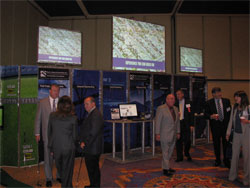 | �
�| Event exhibitors and sponsors contribute to an informative and engaging environment | �
�This year’s meeting was the best yet for the industry-leading construction defect and claims event.
�This year’s seminar concluded on May 13, 2011 with the Construction Defect Community Charitable Foundation Golf Tournament, held at Strawberry Farms Golf Course.
�The Disneyland Hotel in Anaheim, California was the place where more than 1,500 attendees convened for two days of professional development activities and seminars that included CLE workshops and panel discussions of special interest to legal and insurance professionals concerned with construction defect and claims litigation. Key events included “Challenges for Experts in Construction Defect Claims and Litigation,” “Keeping Up with Construction Defect Coverage,” and “Tips for Avoiding the ‘Perfect Storm’ in Handling of Wrap Claims.”
� �  | �
�| Supporting the golf tournament at the 15th hole | �
�This year’s Ollie award was given to George D. Calkins II, Esq. The West Coast Casualty Jerrold S. Oliver Award of Excellence was named in honor of the late Judge Jerrold S. Oliver, and recognizes an individual who is outstanding or has contributed to the betterment of the construction community.
�In addition to being the most comprehensive professional development seminar in the area of construction defects, this year’s seminar was equally valuable as a networking opportunity for members of the industry. People participated in professional development events during the day and then continued networking in the evening at numerous social events. The Lawn Party as well as the legendary Wood, Smith, Henning & Berman events were very well attended. Additional valuable networking events were hosted by a number of industry professionals at the House of Blues, and Tortilla Joe’s.
�As of this writing the 2011, West Coast Casualty's Construction Defect Seminar has applied for or has already received the following continuing education accreditation in the following areas;
�Read the full story…
�For more information about next year’s event, visit West Coast Casualty.
Preventing Costly Litigation Through Your Construction Contract
August 17, 2011 — Douglas Reiser, Builders Counsel
It’s Tuesday, which means it ’s the middle of your work week. Tuesday is a great time to take an hour to look over your contracts, while the crews are pushing through their scheduled work. Today’s food for thought: How do you use your contract to reduce your litigation burden?
�Your contract should do many things. It should discuss the scope of work, scheduling of work, quality of work, coverage for liabilities and conditions and timeliness for payment. But often overlooked is how your contract can lend to dispute resolution.
�Commonly, you will see a simple provision that covers governing law, venue for disputes and the awarding of attorneys’ fees. But you can do better. Remember, a contract is enforced to the maximum extent possible in Washington state.
Read the full story…
�Reprinted courtesy of Douglas Reiser of Reiser Legal LLC. Mr. Reiser can be contacted at info@reiserlegal.com
Australian Group Seeks Stronger Codes to Combat Dangerous Defects�
October 23, 2012 — CDJ Staff
The Owners Corporation Network, a group that represents condominium owners in Australia, has raised concerns about building defects in high-rise building that can lead to safety problems. The group prepared a statement which would strengthen the rights of owners, but the government official, Fair Trading Minister Anthony Roberts, declined to sign it. A spokesperson for the group cited a fatal fire at a Sydney high rise, noting that “there had been issues of certification which has been a concern of the Owners Corporation Network.” The Australian Broadcasting Network reports that the government will be reviewing the laws concerning high-rise apartment buildings.
� Read the full story…
�
Construction Defect Lawsuit Stayed by SB800
September 13, 2012 — CDJ Staff
The California Court of Appeals has reversed the decision of the lower court and has stayed, instead of dismissed, a claim of construction defects. A group of Victorville homeowners sued their homebuilder, K. Hovnanian Communities on a claim of construction defects. Hovnanian argued that under the procedures set forth in SB800, the suit should be dismissed, and that the claims should undergo arbitration. The trial agreed, dismissing the claims of 82 plaintiffs under a first motion, and then granted a second motion to dismiss, which affected a further 21 plaintiffs. The homeowners appealed.
�The Court noted that “the parties disagree about the standard of review,” with the Court determining that as the facts were not in dispute, they would use “an independent standard of review.”
�Reviewing the relevant statues, the Court concluded that the terms of the limited warranty set out the pre-litigation procedure, noting that “plaintiffs admit they did not comply with the limited warranty because they challenge its validity and enforceability.” The Court concluded that “plaintiffs’ action was premature.”
�The Court further noted that “a civil action will not be filed until after the contractual procedures have been followed.” Until these procedures have been followed, the Court said that they “decline to resolve issues about validity and enforceability.” However, as these issues could arise after the limited warranty procedures, the court stayed, rather than dismissed the claims.
Read the court’s decision…
Condo Board May Be Negligent for not Filing Construction Defect Suit in a Timely Fashion
December 9, 2011 — CDJ Staff
The Maryland Court of Special Appeals has ruled that condominium association boards have a duty to “properly pursue any claims,” overturning the decision of a lower court that said that it had no legal duty to file suit. Tom Schild, writing at Marylandcondominiumlaw.net, writes about Greenstein v. Avalon Courts Six Condominium, Inc.
In this case, the condominium board waited six years after residents complained about water intrusion problems before suing the developer. The court ruled that the suit could not be filed, as the statute of limitations was only three years. After residents were assessed for the repairs, homeowners sued the board, arguing that their delay lead to the need for the special assessment.
After overturning the decision, the Court of Special Appeals has asked the trial court to review the negligence claim.
Read the full story…
Builder Cannot Receive Setoff in Construction Defect Case
July 10, 2012 — CDJ Staff
The California Court of Appeals has dismissed an appeal in a San Diego construction defect case. In Smith v. Walters Group, Christopher and Maud Smith sued The Walters Group, a real estate developer, and Galen C. Pavelko, Inc, the builder of their home. Walters had bought five lots and hired Pavelko to build houses on them, selling one of these homes to the Smiths. “After moving in, the Smiths noticed a strong and obnoxious odor permeating the house.” The Smiths sued but were ordered to arbitrate instead, pursuant to a clause in the purchase contract. The Smiths were awarded $1.5 million at arbitration.
Walters requested that the arbitration remain open to determine if Walters was entitled to a setoff for settlements from defendants not involved in the arbitration. During this time, Pavelko made a settlement with the Smiths, which the court found was in good faith. At the same time, the arbitrator “reached the opposite conclusion.” The arbitrator concluded that “only settlements made ‘in good faith before verdict or judgment’ qualified for setoff.”
Walters moved that the trial court “‘correct’ the award,” but the trial court declined to do so and confirmed the award. In the appeal, Walters raised the issue of “whether Pavelko’s settlement occurred ‘before verdict or judgment.’” The appeals court dismissed the appeal, noting that “Walters would not be entitled to a $500,000 setoff if we reversed the trial court’s order determining the Smith-Pavelko settlement was made in good faith because Pavelko’s $500,000 payment was expressly conditioned on such an order.” They add that “were we to reverse the trial court’s order, Pavelko would have no obligation to pay the Smiths the $500,000.” This would then “deprive Walters of the corresponding statutory right to a setoff.”
Read the court’s decision…