Homebuilding Still on the Rise
December 20, 2012 — CDJ Staff
The National Association of Home Builders reports that spending on private homes was up three percent in October 2012, bringing it to a four-year high. This was part of a trend in which fourteen of the last fifteen months have seen increases in spending on residential construction. Likewise, multifamily residences have seen thirteen months of increased spending, putting it 82% higher than its low, two years ago. ¬?In addition to new homes, remodeling is also up, reaching its highest point in five years.
Read the full story…
Analysis of the “owned property exclusion” under Panico v. State Farm
March 8, 2011 — March 8, 2011, Colorado Construction Litigation
The U.S. Court of Appeals for the Tenth Circuit recently concluded that the “owned property exclusion” applied to bar coverage for claims of property damage. See Panico v. State Farm Fire and Cas. Co., 2011 WL 322830 (10th Cir. 2011). In Panico, the plaintiffs sold property in Aspen, Colorado to the Taylors, who sued the Panicos upon discovering the property was not as represented. After refusing to defend, the Panicos sued State Farm for breach of contract. The district court concluded that the Taylors’ claims were not covered under the Panicos insurance policies and granted summary judgment in State Farm’s favor. The U.S. Court of Appeals for the Tenth Circuit affirmed.
�Mr. Panico built the house on the property as well as several additions to the house. As the Taylors lived in Florida, they primarily relied on their real estate agent and an inspector to ensure the property was acceptable. According to their complaint, the Taylors discovered that the house was “virtually uninhabitable due to serious design and construction defects, mold, rodents, and drainage problems.” Id. at *1. In their complaint, the Taylors asserted three claims for relief against the Panicos based upon misrepresentation and fraudulent concealment about the condition of the property.
�Read the full story...
�Reprinted courtesy of Heather M. Anderson of Higgins, Hopkins, McClain & Roswell, LLP. Ms Anderson can be contacted at anderson@hhmrlaw.com
Former Zurich Executive to Head Willis North America Construction Insurance Group
March 1, 2012 — CDJ Staff
Insurance Journal reports that Sean McGroarty will be directing surety operations for their construction practice in North America. Previously, Mr. McGroarty was the senior vice president and head of international surety with Zurich Financial Services. He has also worked for Liberty Mutual Group and the St. Paul Companies.
�Mr. McGroarty will be leading a team of professionals offering brokerage services for contract and commercial surety.
Read the full story…
US Courts in Nevada Busy with Yellow Brass
August 2, 2012 — CDJ Staff
Judge Robert C. Jones, the chief judge of the United States District Court of Nevada, and Judge Peggy A. Leen, a magistrate judge with the same court, have issued orders in cases involving allegations of high-zinc yellow brass plumbing components. Judge Jones issued orders on Waterfall Homeowners Association v. Viega, Inc. and Greystone Nevada, LLC v. Anthem Highlands Community Association on July 9, 2012. Judge Leen issued orders on Southern Terrace Homeowners Association v. Viega, Inc. on July 10, and The Seasons Homeowners Association, Inc. v. Richmond American Homes of Nevada, Inc. on July 19.
Chief Judge Jones held an omnibus hearing on Waterfall v. Viega on June 12. During that hearing “Chief Judge Jones had already agreed that the claims against the product manufacturers should be be severed from the majority of the other claims and that discovery should proceed on different tracks.” Judge Leen ordered that the Southern Terrace claims be referred to Chief Judge Jones to determine if it should be consolidated with other yellow brass cases.
Chief Judge Jones’s decision in Greystone Nevada rests on issues of whether the affected homeowners had signed arbitration agreements. The judge found that the “Defendant’s claims that the seven homeowners they have identified are subsequent purchasers who need not arbitrate with Greystone is definitively refuted by the evidence.”
Judge Leen cites the Greystone decision in her ruling on Seasons Homeowners Association v. Richmond American Homes of Nevada. Richmond seeks to compel individual arbitration, stating that “the arbitration clause used singular rather than plural terms, and therefore, class arbitration was foreclosed.” Judge Leen determined that “under Nevada law, a homeowners association has statutory authority to represent homeowners associations in these types of actions. She did, however, accept Richmond’s argument that they could compel arbitration.
The Waterfall order involves an attempt by two homeowners associations to seek a class action against seventeen defendants, the first twelve of whom are described as “the Viega Defendants” and “the Uponor Defendants.” Chief Judge Jones notes that “many of these Defendants have been sued in identical class actions by the same law firms, but with different named defendants.” The homeowner association seek to “represent their own 998 members directly but also wish to represent up to 10,000 homeowner associations representing up to 250,000 similarly situated homeowner members throughout the Las Vega area via this class action.”
The judge has denied the Viega Defendants’ attempt to deny class certification, noting that the plaintiffs “argue that they intend to argue for class certification under Rule 23(b)(3). He also denied the motions by the two groups of the Viega Defendants. The U.S. Viega Defendants sought to be dismissed from the case for a variety of reasons. The judge noted of the claim that the plaintiffs had no injury of fact and are not alleging actual damage is contradicted by the allegations of actual damage made by the plaintiffs. ”They have alleged that the parts are defective and have already begun to corrode in at least a few sample circumstances, even if they have not yet failed.” To the argument that there re not particular claims made against defendants, the judge notes, “it is clear from the Complaint which Defendants are alleged to have manufactured and sold which brands of allegedly defective products, and which Defendants are alleged to have installed them.”
The German Viega firms also sought to be dismissed from the suit, noting that “they have no property, employees, accounts, advertisements, etc. in Nevada and have not sold any products in Nevada.” However, the judge notes that “at least Waterfall, and perhaps Red Bluff, was still under construction when Viega, Inc. became the sole shareholder of Vanguard Industries, Inc.”
Finally, both of Chief Judge Jones’s rulings cite a related case in the U.S. District Court for the District of Minnesota involving a class action settlement for those with F1807 systems. He notes in both these cases that “Plaintiffs disclaimed any claims based upon F1807 components.”
Read the courts' decisions…
Waterfall Homeowners Association v. Viega, Inc.
Greystone Nevada, LLC v. Anthem Highlands Community Association
Southern Terrace Homeowners Association v. Viega, Inc.
The Seasons Homeowners Association, Inc. v. Richmond American Homes of Nevada, Inc.
Australian Developer Denies Building Problems Due to Construction Defects
June 15, 2011 — CDJ Staff
The Sunland Group, the developer, is objecting to claims that it is responsible for corrosion damage in a residential building in Gold Coast, Australia, as reported in the Courier & Mail. Residents of Q1, the world’s tallest residential tower, are suing the developer, claiming that defects and corrosion “compromise the long-term durability and appearance of” the six-year-old building.
�The developer has not only denied that there are defects in the building, but has also stated that the construction contract “did not warrant that the construction would be defects-free.” Sunland claimed that corrosion was due to the homeowners association having “failed to carry out the maintenance requirements.”
�Repair of the building is expected to cost millions of dollars. Sunland denies that it should pay any of that.
�Read the full story…
Construction Defect Not an Occurrence in Ohio
November 7, 2012 — CDJ Staff
The Ohio Supreme Court has concluded that claims of defective construction or workmanship are not an occurrence under a general liability policy. The court looked at appellate decisions and concluded that CGL policies are not intended to insure against risks under the control and management of the insured. These risks should instead be mitigated with performance bonds.
The question was raised in the case Westfield Ins. Co. v. Custom Agri Systems, Inc. The Sixth District Court of Ohio concluded it was an “open question under Ohio law whether a CGL policy covers defective construction claims.” Westfield filed a motion, granted by the Sixth Circuit, to certify the question to the state Supreme Court. The Sixth Court additionally found that the contractual liability exclusion barred coverage in the case, issues a summary judgment to Westfield.
Read the full story…
Contractors with Ties to Trustees Reaped Benefits from LA Community College Modernization Program
March 3, 2011 — Original reporting by Gale Holland, Michael Finnegan and Doug Smith, Los Angeles Times
In the latest installment of the “Billions To Spend” series of investigative reports focused on construction defects, management, and cost issues relevant to LACC’s Community College Modernization Projects, the LA Times examines the costs associated with the various layers of construction management and benefits that accrued to contractors with ties to LACC trustees.
�The reporting by the Times is seemingly critical of the project’s utilization of “body shops” an industry term for companies that function as employers of record. The article segment published today cites a number of circumstances wherein their utilization appears to have escalated costs substantially.
�“To gauge the cost of the staffing system, The Times reviewed thousands of pages of financial records from April 2007, when URS began managing the program, to July 2010. Reporters identified two dozen contractors serving as conduits for pay and benefits for employees they did not supervise.
�At least 230 people were employed in this manner, at a total cost of about $40 million, the records show.
�Approximately $18 million of the total was paid to the employees, according to the Times analysis. The remaining $22 million went to profit and overhead for contractors, the records indicate.
�For employees on its own payroll, the district says that medical and other benefits increase compensation costs 40% above base salaries. So if the district had employed its construction staff directly, the total cost for the period studied would have been $25 million instead of $40 million, a savings of $15 million, The Times calculated.”
�Read Full Story...
Houses Can Still Make Cents: Illinois’ Implied Warranty of Habitability
March 1, 2011 — Original Story by
Marisa L. Saber Cozen O’Connor Subrogation & Recovery Law BlogIn a report published earlier this week Marisa L. Saber writes about the implied warranty of habitability in the context of construction defect litigation. The piece speaks of the difficulties in alleging tort theories against builders and vendors in light of Illinois’ expansion of the economic loss doctrine, and how the implied warranty of habitability may provide another avenue for recovery.
�Read Full Story...
Ceiling Collapse Attributed to Construction Defect
May 19, 2011 — May 16, 2011 - CDJ Staff
WSMV, Nashville reports that the ceiling collapse in a Franklin, Tennessee Kohl’s was attributed to a construction defect by fire officials. The officials noted that the ceiling was renovated at the time. No injuries were reported.
�The report notes that “inspectors were supposed to look at the renovations next week, but fire officials said that will have to be delayed until another time.”
�Read the full story…
General Contractors Must Plan to Limit Liability for Subcontractor Injury
May 18, 2011 — May 18, 2011 - Douglas Reiser in the Builders Counsel Blog
It takes more than a hard hat, but safety checks, a good policy and a smart contract might save you some problems.If you are a general contractor, you will want to pay close attention to this article. A new Washington appellate decision showcases a general contractor’s liability to subcontractors who are injured on the job, when security barriers fail. But can a general limit this liability? Will its contract help?
�In Wrought Corporation, Inc., Appellant V. Mario Interiano (quick note: this opinion is unpublished, but we are here to talk about an issue that was not determined on appeal – WISHA compliance), a subcontractor was injured when a security barrier failed and he fell into an elevator shaft.
�A jury awarded a $1.56 million verdict against the general contractor, and the court of appeals affirmed on the basis that the general contractor has a non-delegable duty to ensure compliance with the Washington Industrial Safety and Health Act of 1973, codified under RCW 49.17 (WISHA).
�Read the full story… �Reprinted courtesy of Douglas Reiser of Reiser Legal LLC. Mr. Reiser can be contacted at info@reiserlegal.com
Window Manufacturer Weathers Recession by Diversifying
October 28, 2011 — CDJ Staff
American Openings, a Tuscon-based window manufacturer, has responded to the loss of its sales of windows for new home construction by moving into new markets. The Arizona Daily Star reports that American Openings used to see providing windows for new homes as half their business. Now, Tom Regina, the founder and president says “single family is just dead.”
Their products are insulated windows, designed to comply with Energy Star standards. Without new homes being built, now the company is focusing on homeowners and building owners looking for more energy efficient windows. As the windows have two or three panes and special coatings, homeowners using them are eligible for tax credits.
One of their newer products combines their energy-saving coatings with “break resistant” glass. The article notes that the windows repel “all but the most determined burglars.” However, the company is still awaiting special equipment to cut the glass.
Read the full story...
2011 West Coast Casualty Construction Defect Seminar – Recap
June 1, 2011 — CDJ Staff
� 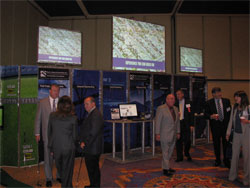 | �
�| Event exhibitors and sponsors contribute to an informative and engaging environment | �
�This year’s meeting was the best yet for the industry-leading construction defect and claims event.
�This year’s seminar concluded on May 13, 2011 with the Construction Defect Community Charitable Foundation Golf Tournament, held at Strawberry Farms Golf Course.
�The Disneyland Hotel in Anaheim, California was the place where more than 1,500 attendees convened for two days of professional development activities and seminars that included CLE workshops and panel discussions of special interest to legal and insurance professionals concerned with construction defect and claims litigation. Key events included “Challenges for Experts in Construction Defect Claims and Litigation,” “Keeping Up with Construction Defect Coverage,” and “Tips for Avoiding the ‘Perfect Storm’ in Handling of Wrap Claims.”
� �  | �
�| Supporting the golf tournament at the 15th hole | �
�This year’s Ollie award was given to George D. Calkins II, Esq. The West Coast Casualty Jerrold S. Oliver Award of Excellence was named in honor of the late Judge Jerrold S. Oliver, and recognizes an individual who is outstanding or has contributed to the betterment of the construction community.
�In addition to being the most comprehensive professional development seminar in the area of construction defects, this year’s seminar was equally valuable as a networking opportunity for members of the industry. People participated in professional development events during the day and then continued networking in the evening at numerous social events. The Lawn Party as well as the legendary Wood, Smith, Henning & Berman events were very well attended. Additional valuable networking events were hosted by a number of industry professionals at the House of Blues, and Tortilla Joe’s.
�As of this writing the 2011, West Coast Casualty's Construction Defect Seminar has applied for or has already received the following continuing education accreditation in the following areas;
�Read the full story…
�For more information about next year’s event, visit West Coast Casualty.
Save A Legal Fee? Sometimes You Better Talk With Your Construction Attorney�
May 10, 2012 — Douglas Reiser, Builders Counsel
I love writing this column, because I think it’s refreshing for contractors to hear that they don’t always need an attorney. Today’s post is the “Un-Save a Legal Fee” because I want to point out a specific illustration of when you definitely need your attorney. Using a construction contract template can be fine, but you always need to consider its application to each project ? or it could bite you in the rear.
�Seattle attorney Paul Cressman published a prime depiction of bad contract management, last week. A Florida appellate court struck down a general contractor’s “pay if paid” clause when it became ambiguous because of some incorporated language from its prime contract. Specifically, a clause in the prime contract required the general contractor to pay all subcontractors before receiving payment from the owner, while the general contractor’s “pay if paid” clause required its subcontractors to wait for payment until it arrived from the owner.
� Read the full story…
�
Colorado Court of Appeals holds that insurance companies owe duty of prompt and effective communication to claimants and repair subcontractors
March 1, 2011 — Courtesy
Colorado Construction LitigationIn Dunn v. American Family Insurance, 09CA2173, 2010 WL 4791948 (Colo. App. Nov. 24, 2010), the Dunns reported a claim to American Family on their homeowners insurance policy after sewer and water backup caused sewage to flood their basement. American Family gave the Dunns contact information for a contractor (ICA) to remediate the flooding. However, ICA was unsuccessful and sewage began to infiltrate the Dunns’ HVAC system. Subsequently, black mold was detected in the HVAC system, the Dunns suffered health and respiratory problems, and they soon after vacated the home. The Dunns hired and fired two more contractors for unsatisfactory work throughout the winter before hiring a fourth to finish the job. Because the home remained vacant and unheated throughout the winter, the water pipes ruptured. The mold spread throughout the entire home and all of the contents needed to be replaced, which amounted to a claim of $340,000 on the policy.
�American Family agreed to pay the full $340,000. However, the Dunns brought suit claiming that American Family breached the implied duty of good faith and fair dealing by: 1) failing to screen ICA for expertise; 2) failing to screen ICA for liability insurance coverage; 3) failing to monitor ICA’s work; 4) failing to advise them that flooding can cause further damage, including freezing pipes and mold; and, 5) failing to adequately and promptly communicate with them and remediation subcontractors in the course of investigating and handling their claim.�The trial court found no duty owed by American Family beyond adjustment and timely payment of claims. Because American Family paid timely and in full, they dismissed all of the Dunns’ claims. However, the Court of Appeals reversed in part.
�Read the full story...
�Reprinted courtesy of Chad Johnson, Higgins, Hopkins, McLain & Roswell, LLC. Mr. Johnson can be contacted at johnson@hhmrlaw.com
Seller Cannot Compel Arbitration for Its Role in Construction Defect Case<
March 1, 2012 — CDJ Staff
The buyer of a leaky home in Venice, California cannot be compelled to arbitration with the seller in a construction defect lawsuit, according to a decision in Lindemann v. Hume, which was heard in the California Court of Appeals. Lindemann was the trustee of the Schlei Trust which bought the home and then sued the seller and the builder for construction defects.
�The initial owner was the Hancock Park Trust, a real estate trust for Nicholas Cage. Richard Hume was the trustee. In 2002, Cage agreed to buy the home which was being built by the Lee Group. Cage transferred the agreement to the Hancock Park Trust. Hancock had Richard Nazarin, a general contractor, conduct a pre-closing walk through. They also engaged an inspector. Before escrow closed, the Lee Group agreed to provide a ten-year warranty “to remedy and repair any and all damage resulting from water infiltration, intrusion, or flooding due to the fact that the door on the second and third floors of the residence at the Property were not originally installed at least one-half inch (1/2”) to one inch (1”) above the adjacent outside patio tile/floor on each of the second and third floors.”
�Cage moved in and experienced water intrusion and flooding. The Lee Group was unable to fix the problems. Hume listed the home for sale. The Kamienowiczs went as far as escrow before backing out of the purchase over concerns about water, after the seller’s agent disclosed “a problem with the drainage system that is currently being addressed by the Lee Group.”
�The house was subsequently bought by the Schlei Trust. The purchase agreement included an arbitration clause which included an agreement that “any dispute or claim in Law or equity arising between them out of this Agreement or any resulting transaction, which is not settled through mediation, shall be decided by neutral, binding arbitration.” The warranty the Lee Group had given to Hancock was transferred to the Schlei trust and Mr. Schlei moved into the home in May 2003.
�Lindemann enquired as to whether the work done would prevent future flooding. Nazarin sent Schlei a letter that said that measures had been taken “to prevent that situation from recurring.” In February, 2004, there was flooding and water intrusion. Lindemann filed a lawsuit against the Lee Group and then added the Hancock Park defendants.
�The Hancock Park defendants invoked the arbitration clause, arguing that Lindemann’s claims “were only tangentially related to her construction defect causes of action against the Lee Group.” On June 9, 2010, the trial court rejected this claim, ruling that there was a possibility of conflicting rulings on common issues of law. “With respect to both the developer defendants and the seller defendants, the threshold issue is whether there was a problem with the construction of the property in the first instance. If there was no problem with the construction of the property, then there was nothing to fail to disclose.” Later in the ruling, the trial court noted that “the jury could find there was no construction defect on the property, while the arbitration finds there was a construction defect, the sellers knew about it, and the sellers failed to disclose it.” The appeals court noted that while Hancock Park had disclosed the drainage problems to the Kamienowiczs, no such disclosure was made to Sclei.
�The appeals court described Hancock Park’s argument that there is no risk of inconsistent rulings as “without merit.” The appeals court said that the issue “is not whether inconsistent rulings are inevitable but whether they are possible if arbitration is ordered.” Further, the court noted that “the Hancock Park defendants and the Lee Group have filed cross-complaints for indemnification against each other, further increasing the risk of inconsistent rulings.”
�The court found for Lindemann, awarding her costs.
Read the court’s decision…
Washington Court Limits Lien Rights of Construction Managers
August 17, 2011 — Douglas Reiser, Builders Counsel
A newly filed, yet unpublished, court opinion opines that a construction manager cannot file a construction lien in Washington state. So, how far reaching is this opinion?
�In the case of Blue Diamond Group Inc. v. KB Seattle 1, Inc., et al, a New York construction manager filed a lien against the Westfield Southcenter Mall in Tukwila, Washington. The lien was filed after the owner of a coffee stand failed to pay Blue Diamond for consulting services used in the construction of a kiosk.
�Blue Diamond served as the owner’s agent, assisting with managing subcontractors, vendors and other tasks. The manager’s tasks also included paying invoices, managing deliveries, setting schedules and other site managerial tasks. Blue Diamond was not registered as a contractor under Washington’s RCW 18.27.
Read the full story…
�Read the court’s decision…
�Reprinted courtesy of Douglas Reiser of Reiser Legal LLC. Mr. Reiser can be contacted at info@reiserlegal.com
Virginia Chinese Drywall and pollution exclusion
May 27, 2011 — CDCoverage.com
In Nationwide Mut. Ins. Co. v. The Overlook, LLC, No. 4:10cv69 (E.D. Va. May 13, 2011), homeowner Edmonds sued insured developer/general contractor Overlook seeking damages resulting from defective Chinese drywall installed in Edmonds’ home. Overlook’s CGL insurer Nationwide defended Overlook under a reservation of rights and filed a declaratory judgment action. The federal district trial court granted Nationwide’s motion for summary judgment.
Read the full story…
Reprinted courtesy of CDCoverage.com
Anti-Assignment Provision Unenforceable in Kentucky
December 20, 2012 — Tred Eyerly, Insurance Law Hawaii
On a certified question from the Federal District Court, the Supreme Court of Kentucky decided that an anti-assignment provision in a policy is unenforceable.Wehr Constructors v. Paducah Div. Assur. Co. of Am., 2012 Ky. LEXIS 183 (Ky. Oct. 25, 2012).
Before building an addition to its hospital, Murray Calloway County Hospital purchased a builder's risk policy from Assurance Company of America.The policy provided, "Your rights and duties under this policy may not be transferred without Assurance's written consent . . . ." The Hospital contracted with Wehr Constructors to install concrete subsurfaces and vinyl floors in order to expand the hospital. After installation, a portion of the floors and subsurface work was damaged. The Hospital submitted a claim to Assurance for $75,000, but the claim was denied.
Wehr sued the Hospital to recover money for its work on the construction project. In settling the case, the Hospital assigned to Wehr any claim or rights the Hospital had against Assurance.
Read the full story…
Reprinted courtesy of Tred R. Eyerly, Insurance Law Hawaii. Mr. Eyerly can be contacted at te@hawaiilawyer.com