Manhattan Developer Breaks Ground on $520 Million Project
November 18, 2011 — CDJ Staff
Rebuilding an area of Midtown West that has been condemned for decades, the Gotham Organization has broken ground on a 1,200-unit project that will include housing for a variety of household incomes and a school. One unit of the project will be affordable housing for families of annual incomes up to $40,000. Another will be for middle-income households. Additionally, there will be a 31-story tower with 550 luxury units.
The site CityBiz quotes Mayor Michael Bloomberg, as saying that the project “will grow our economy by creating 2,900 construction-related jobs.” The president of the Gotham Organization, David L. Picket notes that it will “create hundreds of new jobs, generate millions of dollars in revenue for the construction industry, contribute towards the building of a new primary, and provide homes to thousands of New Yorkers.”
Read the full story…
Insurer Must Cover Construction Defects Claims under Actual Injury Rule
March 1, 2012 — Tred Eyerly, Insurance Law Hawaii
The Texas Court of Appeals held that the insured need not prove the exact dates physical damage occurred in order to trigger defense and indemnity coverage. Vines-Herrin Custom Homes, LLC v. Great Am. Lloyds Ins. Co., 2011 Tex. App. LEXIS 10027 (Tex. Ct. App. Dec. 21, 2011).
�In 1999, the insured built a home. He was insured under a CGL policy issued by Great American from November 9, 1998 to November 9, 2000. Thereafter, the insured held a CGL policy issued by Mid-Continent from November 9, 2000 to September 18, 2002.
�After construction was completed, the insured sold the house to the buyer in May 2000. After moving in, the buyer found numerous construction defects in the home, including water entering cracks in the home, and sinking and sagging of parts of the house. The buyer sued the insured, who sought coverage under the two policies. When the insurers refused to defend the underlying suit, the insured sued for a declaratory judgment.
�The underlying case went to arbitration and an award of $2.4 million was granted to the buyer. The insured assigned to the buyer his claims against the insurers.
Read the full story…
���Reprinted courtesy of Tred R. Eyerly, Insurance Law Hawaii. Mr. Eyerly can be contacted at te@hawaiilawyer.com
�
Seller Cannot Compel Arbitration for Its Role in Construction Defect Case<
March 1, 2012 — CDJ Staff
The buyer of a leaky home in Venice, California cannot be compelled to arbitration with the seller in a construction defect lawsuit, according to a decision in Lindemann v. Hume, which was heard in the California Court of Appeals. Lindemann was the trustee of the Schlei Trust which bought the home and then sued the seller and the builder for construction defects.
�The initial owner was the Hancock Park Trust, a real estate trust for Nicholas Cage. Richard Hume was the trustee. In 2002, Cage agreed to buy the home which was being built by the Lee Group. Cage transferred the agreement to the Hancock Park Trust. Hancock had Richard Nazarin, a general contractor, conduct a pre-closing walk through. They also engaged an inspector. Before escrow closed, the Lee Group agreed to provide a ten-year warranty “to remedy and repair any and all damage resulting from water infiltration, intrusion, or flooding due to the fact that the door on the second and third floors of the residence at the Property were not originally installed at least one-half inch (1/2”) to one inch (1”) above the adjacent outside patio tile/floor on each of the second and third floors.”
�Cage moved in and experienced water intrusion and flooding. The Lee Group was unable to fix the problems. Hume listed the home for sale. The Kamienowiczs went as far as escrow before backing out of the purchase over concerns about water, after the seller’s agent disclosed “a problem with the drainage system that is currently being addressed by the Lee Group.”
�The house was subsequently bought by the Schlei Trust. The purchase agreement included an arbitration clause which included an agreement that “any dispute or claim in Law or equity arising between them out of this Agreement or any resulting transaction, which is not settled through mediation, shall be decided by neutral, binding arbitration.” The warranty the Lee Group had given to Hancock was transferred to the Schlei trust and Mr. Schlei moved into the home in May 2003.
�Lindemann enquired as to whether the work done would prevent future flooding. Nazarin sent Schlei a letter that said that measures had been taken “to prevent that situation from recurring.” In February, 2004, there was flooding and water intrusion. Lindemann filed a lawsuit against the Lee Group and then added the Hancock Park defendants.
�The Hancock Park defendants invoked the arbitration clause, arguing that Lindemann’s claims “were only tangentially related to her construction defect causes of action against the Lee Group.” On June 9, 2010, the trial court rejected this claim, ruling that there was a possibility of conflicting rulings on common issues of law. “With respect to both the developer defendants and the seller defendants, the threshold issue is whether there was a problem with the construction of the property in the first instance. If there was no problem with the construction of the property, then there was nothing to fail to disclose.” Later in the ruling, the trial court noted that “the jury could find there was no construction defect on the property, while the arbitration finds there was a construction defect, the sellers knew about it, and the sellers failed to disclose it.” The appeals court noted that while Hancock Park had disclosed the drainage problems to the Kamienowiczs, no such disclosure was made to Sclei.
�The appeals court described Hancock Park’s argument that there is no risk of inconsistent rulings as “without merit.” The appeals court said that the issue “is not whether inconsistent rulings are inevitable but whether they are possible if arbitration is ordered.” Further, the court noted that “the Hancock Park defendants and the Lee Group have filed cross-complaints for indemnification against each other, further increasing the risk of inconsistent rulings.”
�The court found for Lindemann, awarding her costs.
Read the court’s decision…
Statute of Limitations Upheld in Construction Defect Case
September 30, 2011 — CDJ Staff
The Missouri Court of Appeals has ruled in Ball v. Friese Construction Co., finding that Mr. Ball’s claims were barred by the statute of limitations.
Mr. Ball hired Friese Construction Company to build a single-family home. The sale was completed on March 29, 2001. That December, Mr. Ball complained of cracks in the basement floor. SCI Engineering, n engineering firm, hired by Friese, determined that the home’s footing had settled and recommended that Mr. Ball hire a structural engineer to determine if the footings were properly designed and sized. In September 2002, the structural engineer, Strain Engineering, determined that the cracks were due to slab movement, caused in part by water beneath the slab, recommending measures to move water away from the foundation. In 2005, Mr. Ball sent Friese correspondence “detailing issues he was having with the home, including problems with the basement slab, chimney structure, drywall tape, and doors.” All of these were attributed to the foundation problems. In 2006, Friese stated that the slab movement was due to Ball’s failure to maintain the storm water drains.
In 2009, Ball received a report from GeoTest “stating the house was resting on highly plastic clay soils.” He sued Friese in May, 2010. Friese was granted a summary judgment dismissing the suit, as the Missouri has a five-year statute of limitations. Ball appealed on the grounds that the extent of the damage could not be determined until after the third expert report. The appeals court rejected this claim, noting that a reasonable person would have concluded that after the conclusion of SCI and Strain Engineering that “injury and substantial damages may have occurred.”
The court concluded that as there were not “continuing wrongs causing new and distinct damages,” he should have filed his lawsuit after the first two expert reports, not waiting seven years for a third expert to opine.
Read the court’s decision…
New Web Site Tracks Settled Construction Defect Claims
June 19, 2012 — CDJ Staff
Peter Lissner, a former Nevada homebuilder, has created a new site to help track homes that have been involved in construction defect litigation. His site, housefaxreview.com, collections documentation about homes where claims of construction defects have been made. He told The Builders Magazine concerns about “the number of homes that have been served notices, received compensation, yet the homes weren’t repaired.” On the site, the creator is identified as “a family owned builder.” According to the site, “the builder had no claims until the neighborhood reached the statutory claims limit 10 years.”
Lissner also claims that in many cases, after settling construction defect lawsuits, the homeowners sell to subsequent buyers without disclosing the lawsuit or their failure to repair. “Who is going to let the new homeowner know about the issue?” he asks.
Documents on the site are priced according to their relevance. Lissner notes that those who provide documents to the site will receive free access.
Read the full story…
Homeowners May Not Need to Pay Lien on Defective Log Cabin
July 1, 2011 — CDJ Staff
The Idaho Supreme Court has ruled in the case of Perception Construction Management v. Bell. The Bells hired PCM to build a log home, agreeing to play monthly invoices in full within ten days. The Bells paid the first four invoices in full, part of the fifth, and ceased payment after that. Beofre seventh invoice, the Bells terminated the contract and hired a new contractor. PCM filed a claim of lien and ceased work.
�The Bells responded that PCM was in breach of contract and had failed to fulfill the contract in a workmanlike manner. They claimed construction defects and in the lien suit, sought to include testimony from an architect and a plumber reviewing PCM’s work. The court only allowed the architect to testify as to whether the amount of the lien was reasonable. No testimony was permitted from the plumber.
�The Idaho Supreme Court concluded that the claims of construction defects were important to case and remanded it to the lower court for a new trial taking into evidence that Bell’s contention that PCM’s work was defective.
Read the court’s decision
Tenth Circuit Finds Insurer Must Defend Unintentional Faulty Workmanship
December 9, 2011 — Tred R. Eyerly, Insurance Law Hawaii
Applying Colorado law, the Tenth Circuit found a duty to defend construction defect claims where the faulty workmanship was unintentional. Greystone Const. Inc. v. National Fire & Marine Ins. Co., 2011 U.S. App. LEXIS 22053 (10th Cir. Nov. 1, 2011). A prior post [here] discussed the Tenth Circuit’s certified question to the Colorado Supreme Court in this matter, a request that was rejected by the Colorado court.
In two underlying cases, Greystone was sued by the homeowner for damage caused to the foundation by soil expansion. In both cases, the actual construction was performed by subcontractors. Further, in neither case was the damage intended or anticipated. Nevertheless, National Union refused to defend, contending property damage resulting from faulty construction was not an occurrence.
Relying on a Colorado Court of Appeals case, General Security Indemn. Co. of Arizona v. Mountain States Mut. Cas. Co., 205 P.3d 529 (Colo. App. 2009), the district court granted summary judgment to National Union.
On appeal, the Tenth Circuit first considered whether Colorado legislation enacted to overturn General Security could be applied retroactively. The statute, section 13-20-808, provided courts "shall presume that the work of a construction professional that results in property damage, including damage to the work itself or other work, is an accident unless the property damage is intended and expected by the insured."
Read the full story…
Reprinted courtesy of Tred R. Eyerly, Insurance Law Hawaii. Mr. Eyerly can be contacted at te@hawaiilawyer.com
No “Special Relationship” in Oregon Construction Defect Claim
July 10, 2012 — CDJ Staff
Writing on his firm’s blog, Justin Stark discusses recent changes in construction defect claims in Oregon where, as he points out, “courts in Oregon have been lowering legal hurdles that construction defect plaintiffs must overcome in bringing their cases.” He cites a case in which water damage was discovered more than six years after construction was complete. The owners claimed breach of contract and negligence. The trial court found for the contractor, who argued “that there was no ‘special relationship’ with the owners that could support the negligence claim.”
This was overturned on appeal, with the court concluding that if there was a violation of the building code, then the negligence claim could stand. This was appealed to the Oregon Supreme court which concluded that “neither a special relationship nor a statutory standard of care, such as the building code, is necessary to bring a negligence claim here.”
Stark notes that “many forms of construction contract incorporate the phrase ‘workmanlike,’ which implicates the ‘common law standard of care’ in negligence law.
Read the full story…
Insurer Beware: Failure to Defend Ends with Hefty Verdict
June 1, 2011 — Douglas Reiser in the Builders Counsel Blog
Served with a lawsuit that you turned over to your insurer? Insurer refusing to defend you? Well, find some hope in this news. Washington’s IFCA has the claws to ensure that insurers perform their duties.
�Contractors heavily rely on the defense provisions of their Commercial General Liability (CGL) policies. In construction, a legal dispute can easily rear its head when you least expect it. Luckily, Washington registered contractors are required to maintain CGL insurance. That insurance often provides contractors with adequate legal defense in the event that they are sued.
�But, what if your insurer turns down the defense request? They might be staring at massive damages. A current Reiser Legal client, Australia Unlimited, Inc., recently won a large verdict against Hartford Insurance, after the insurer unreasonably denied their claim. The firm who represented Australia Unlimited Inc. in that case, Hackett Beecher and Hart, were successful in procuring a $5.43 Million verdict
�Read the full story…
�Reprinted courtesy of Douglas Reiser of Reiser Legal LLC. Mr. Reiser can be contacted at info@reiserlegal.com
Insurer Has Duty to Defend in Water Intrusion Case
July 10, 2012 — CDJ Staff
The Seventh Circuit Court of Appeals has upheld a summary judgment against an insurance company in a construction defect suit. Lagestee-Mulder, Incorporated (LMI) was hired by Crown Centre to construct a multi-story office building in Franfort, Illinois. LMI hired Frontrunner Glass & Metal to supply and install windows and doors. Frontrunner purchased an insurance policy from Consolidated which named LMI as an additional insured. The project experienced water intrusion and other construction defects and Crown sued LMI. Consolidated denied coverage. LMI sued Consolidated and the US District Court granted a summary judgment against Consolidated.
The appeals court reviewed the grounds for summary judgment and determined that under Illinois law, Consolidated had a duty to defend. The court cited an earlier opinion that “if the underlying compliant alleges facts within or potentially within policy coverage, an insurer is obligated to defend its insured even if the allegations are groundless, false, or fraudulent.”
Read the court’s decision…
Coverage for Construction Defects Barred by Business Risk Exclusions
September 1, 2011 — Tred Eyerley, Insurance Law Hawaii
Although the court determined there was an occurrence, coverage was excluded by the business risk exclusions. See Cont’l W. Ins. Co. v. Shay Constr. Co., 2011 U.S. Dist. LEXIS 82839 (D. Colo. July 28, 2011).
White was the general contractor on the project. White had three subcontracts with Shay to provide framing, siding, and related work on the project. Shay was insured under a CGL policy issued by Continental Western.
Two of Shay’s subcontractors furnished materials, labor and equipment to Shay. These subcontractors filed suit in state court alleging they had not been compensated for the work and materials. White and Shay were named as defendants. White cross claimed against Shay, alleging Shay had breached its obligations under the subcontracts. Several allegations sounded in contract. Other allegations, however, contended Shay had performed defective work and had damaged the work of other trades in correcting deficiencies in its own performance.
Shay sought coverage under Continental Western’s policy. Continental Western filed suit for a declaratory judgment and moved for summary judgment.
Read the full story…
Reprinted courtesy of Tred R. Eyerly, Insurance Law Hawaii. Mr. Eyerly can be contacted at te@hawaiilawyer.com
Battle of “Other Insurance” Clauses
March 23, 2011 —
Tred R. Eyerly -
Insurance Law Hawaii - March 23, 2011
The New York Court of Appeals considered the impact of competing “other insurance” provisions located in both a CGL policy and a D&O policy. See Fieldston Property Owners Assoc., Inc. v. Hermitage Ins. Co., Inv., 2011 N.Y. LEXIS 254 (N.Y. Feb. 24, 2011).
�In the underlying case, Fieldston’s officers were charged with making false statements and fraudulent claims with respect to a customer's right to access its property from adjacent streets. Suit was eventually filed against Fieldston and its officers, alleging several causes of action including injurious falsehood. Damages were sought.
�Fieldston’s CGL policy was issued by Hermitage. The “other insurance” provision stated, “If other valid and collectible insurance is available to the insured for a loss we cover . . . our obligations are limited,” but also stated it would share with all other insurance as a primary policy.
�Read the full story...�Reprinted courtesy of Tred R. Eyerly, Insurance Law Hawaii. Mr. Eyerly can be contacted at te@hawaiilawyer.com
Is Construction Heading Off the Fiscal Cliff?
December 20, 2012 — CDJ Staff
After a period of growth, the construction industry lost 20,000 jobs in November, based on the federal jobs data. Damon Scott of New Mexico Business Weekly suggests that contractors may have laid off employees in anticipation of the “fiscal cliff.” Ken Simpson, the chief economist of the National Association of Home Builders said in a press release that “it is discouraging that construction employment is still struggling after three years of expansion in the overall economy.”
Read the full story…
Record-Setting Construction in Fargo
November 7, 2012 — CDJ Staff
Prairie Business reports that Fargo is experiencing the most new construction it has ever seen, totaling $434 million in value, which exceeds the previous high in 2006 of $428 million. Many of the construction starts are for single family homes, although there is also an increase in construction of apartments and townhomes.
The Home Builders Association of Fargo-Moorhead also noted that there was also a large of remodeling projects. Terry Becker, the president of the HBA, said that “remodeling is just huge right now.”
Read the full story…
2011 West Coast Casualty Construction Defect Seminar – Recap
June 1, 2011 — CDJ Staff
� 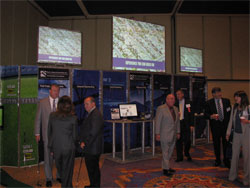 | �
�| Event exhibitors and sponsors contribute to an informative and engaging environment | �
�This year’s meeting was the best yet for the industry-leading construction defect and claims event.
�This year’s seminar concluded on May 13, 2011 with the Construction Defect Community Charitable Foundation Golf Tournament, held at Strawberry Farms Golf Course.
�The Disneyland Hotel in Anaheim, California was the place where more than 1,500 attendees convened for two days of professional development activities and seminars that included CLE workshops and panel discussions of special interest to legal and insurance professionals concerned with construction defect and claims litigation. Key events included “Challenges for Experts in Construction Defect Claims and Litigation,” “Keeping Up with Construction Defect Coverage,” and “Tips for Avoiding the ‘Perfect Storm’ in Handling of Wrap Claims.”
� �  | �
�| Supporting the golf tournament at the 15th hole | �
�This year’s Ollie award was given to George D. Calkins II, Esq. The West Coast Casualty Jerrold S. Oliver Award of Excellence was named in honor of the late Judge Jerrold S. Oliver, and recognizes an individual who is outstanding or has contributed to the betterment of the construction community.
�In addition to being the most comprehensive professional development seminar in the area of construction defects, this year’s seminar was equally valuable as a networking opportunity for members of the industry. People participated in professional development events during the day and then continued networking in the evening at numerous social events. The Lawn Party as well as the legendary Wood, Smith, Henning & Berman events were very well attended. Additional valuable networking events were hosted by a number of industry professionals at the House of Blues, and Tortilla Joe’s.
�As of this writing the 2011, West Coast Casualty's Construction Defect Seminar has applied for or has already received the following continuing education accreditation in the following areas;
�Read the full story…
�For more information about next year’s event, visit West Coast Casualty.
New Apartment Tower on the Rise in Seattle
September 13, 2012 — CDJ Staff
The Seattle Times reports that groundbreaking is planned for a forty-story tower in Seattle. The building process will take at least five years, during which time, according to the paper, there will be nearly eight thousand new apartments in Seattle. The planned tower will add another 386 units to that.
�The developer, Holland Partner Group, has four other apartments buildings planned or in construction currently, which will account for more than a thousand of the units being added to the city’s apartment stock.
Read the full story…
Insurer Settles on Construction Defect Claim
July 10, 2012 — CDJ Staff
Law360 reports that Arch Specialty Insurance Company has settled over claims that it wrongly denied coverage in a construction defect claim. The court dismissed Arch with prejudice. Terms of the settlement were not disclosed and the attorneys made not comment to Law360.
Read the full story…
Legislatures Shouldn’t Try to Do the Courts’ Job
March 1, 2012 — CDJ Staff
David Thamann, writing in Property Casualty 360, argues that current actions by legislatures on insurance coverage amount to “legislative interference or overreach.” He notes that under current Colorado law, “a court shall presume that the work of a construction professional that results in property damage — including damage to the work itself or other work — is an accident unless the property damage is intended and expected by the insured.” He argues that here legislators are stepping into the role of the courts. “Insureds and insurers are not always going to be pleased with a court ruling, but that is the system we have.”
Read the full story…