Florida: No Implied Warranties for Neighborhood Improvements
July 10, 2012 — CDJ Staff
A new law in Florida ends suits from homeowners associations from suing over damages from off-site improvements on the basis of implied warranties. Rob Samouch, writing for the Naples Daily News quotes House Biill 1013: “There is no cause of action in law or equity available to a purchaser of a home or to a homeowners’ association based upon the doctrine or theory of implied warranty of fitness and merchantability or habitability for damages to off-site improvements." The off-site improvements are defined as: "The street, road, driveway, sidewalk, drainage, utilities, or any other improvement or structure that is not located on or under the lot on which a new home is constructed.”
Mr. Samouch notes that “there are no statutory warrant rights in homeowner associations of fitness and merchantability or habitability like there is for condominium associations.” He predicts that the Florida legislature will have to address this issue “once new homeowners start screaming and yelling to them about their shoddy infrastructure for which they have no legal remedy.”
The bill took effect on July 1, 2012 and applies to “all cases accruing before, pending on, or filed after July 1, 2012.”
Read the full story…
2011 West Coast Casualty Construction Defect Seminar – Recap
June 1, 2011 — CDJ Staff
� 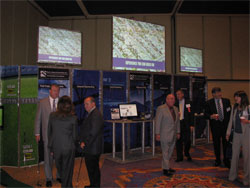 | �
�| Event exhibitors and sponsors contribute to an informative and engaging environment | �
�This year’s meeting was the best yet for the industry-leading construction defect and claims event.
�This year’s seminar concluded on May 13, 2011 with the Construction Defect Community Charitable Foundation Golf Tournament, held at Strawberry Farms Golf Course.
�The Disneyland Hotel in Anaheim, California was the place where more than 1,500 attendees convened for two days of professional development activities and seminars that included CLE workshops and panel discussions of special interest to legal and insurance professionals concerned with construction defect and claims litigation. Key events included “Challenges for Experts in Construction Defect Claims and Litigation,” “Keeping Up with Construction Defect Coverage,” and “Tips for Avoiding the ‘Perfect Storm’ in Handling of Wrap Claims.”
� �  | �
�| Supporting the golf tournament at the 15th hole | �
�This year’s Ollie award was given to George D. Calkins II, Esq. The West Coast Casualty Jerrold S. Oliver Award of Excellence was named in honor of the late Judge Jerrold S. Oliver, and recognizes an individual who is outstanding or has contributed to the betterment of the construction community.
�In addition to being the most comprehensive professional development seminar in the area of construction defects, this year’s seminar was equally valuable as a networking opportunity for members of the industry. People participated in professional development events during the day and then continued networking in the evening at numerous social events. The Lawn Party as well as the legendary Wood, Smith, Henning & Berman events were very well attended. Additional valuable networking events were hosted by a number of industry professionals at the House of Blues, and Tortilla Joe’s.
�As of this writing the 2011, West Coast Casualty's Construction Defect Seminar has applied for or has already received the following continuing education accreditation in the following areas;
�Read the full story…
�For more information about next year’s event, visit West Coast Casualty.
Colorado Senate Bill 12-181: 2012’s Version of a Prompt Pay Bill�
May 10, 2012 — W. Berkeley Mann, Jr., Higgins, Hopkins, McLain & Roswell, LLC
A potentially important legislative bill has been introduced in waning days of the 2012 legislative session, which would change many of the commercial practices that prevail in the construction industry. Senate Bill 12-181 applies to all building and construction contracts and would prohibit any contract provision that requires a contractor, subcontractor, or supplier to waive their lien in advance of payment. It also would ban any “choice of law” provisions that make a Colorado-based construction contract subject to enforcement only in another state, or under the laws of another state.
�The bill also seeks to change many existing commercial practices between contractors, subcontractors, and suppliers. It is presently unclear whether the bill allows parties to contract around these payment procedure provisions, or whether these requirements are simply “gap filling” provisions that pertain if there are no written contract terms specified on these issues. The proposed statute would mandate payment to subcontractors and material suppliers due within seven days in the absence of a dispute about the work or materials being billed. After this seven day period, the bill would require the payment of interest at the rate of 1.5% monthly (18% annually). In any later suit for payment, the creditor would also be able to collect reasonable attorneys’ fees. Additionally, non-payment to a subcontractor or supplier who is later found to be entitled to prompt payment would excuse the subcontractor or supplier, and its surety bond provider, from any further performance under the contract.
�It is presently unclear whether the bill allows parties to contract around these payment procedure provisions. However, it is clear that the bill provides some leeway for change orders, as long as there is (1) negotiation in good faith between the parties concerning the changed scope of work, and (2) a 50% payment of a subcontractor’s costs by the changing party within 30 days of the change order work being done. Additionally, the bill provides for retainage, but in an amount of no more than 5%.
�The bill is presently set for hearing before the Colorado Senate Committee on Business, Labor, and Technology Committee on May 2, 2012 at 1:30 p.m.
� Read the full story…
�Reprinted courtesy of W. Berkeley Mann, Jr. of Higgins, Hopkins, McLain & Roswell, LLC. Mr. Mann can be contacted at mann@hhmrlaw.com.
�
Texas Construction Firm Files for Bankruptcy
December 20, 2012 — CDJ Staff
A Texas construction firm, founded in 1937, filed for bankruptcy, bringing twenty-two projects to a sudden halt, and resulting in the loss of jobs for hundreds of employees. Ballenger Construction told its employees to go home, as it could not complete the jobs. In some cases, work will need to be done to ensure that the work sites do not cause public safety hazards.
Read the full story…
Construction Defect Lawsuits? There’s an App for That
July 10, 2012 — CDJ Staff
The website ebeeky.com reviews Picture It Settled, an app designed to help people engaged in lawsuits figure out where settlement strategies would be most successful. First available for Android and then iOS, the app is now available for Blackberry. One user of the application wrote that “anyone who has set through a construction defect mediation can immediately grasp the value of this app.
The app tracks the negotiation process, allowing users to see a history of bids and counteroffers. It also models the negotiation process in order to predict the ultimate cost of settlement. These numbers are based on past similar negotiations that the user has entered.
Read the full story…
Builder to Appeal Razing of Harmon Tower
August 2, 2012 — CDJ Staff
An attorney for Tutor Perini, George Ogilvie, has said that he will appeal to the state Supreme Court to stop Clark County District Court Judge Elizabeth Gonzalez’s ruling from taking effect. She has given the go-ahead to MGM Resorts and CityCenter to implode the building. Ogilvie described the demolition as “a do-over at Perini’s expense” in protesting Gonzalez’s order. Gonzalez has said that she will instruct jurors that the demolition was an admission that the building was badly built. Ogilvie says this is “allowing MGM to bury its mistakes.”
MGM claims that it is only following the directive of county safety officials. “When Clark County demanded that CityCenter abate the potential hazard created by faulty construction at the Harmon, we determined that demolition is the surest, safest and fasted way to do so.”
Read the full story…
California Supreme Court to Examine Arbitration Provisions in Several Upcoming Cases
December 9, 2011 — CDJ Staff
Glen C. Hansen, writing on Abbott & Kinderman’s Land Use Law Blog looks at several cases pending before the California Supreme Court which ask if a developer can insist on arbitration of construction defect claims, based on provision in the CC&Rs. Currently, there is a split of opinions in the California appeals courts on the issue.
Four of the cases are in California’s Fourth Appellate District. In the earliest case, Villa Milano Homeowners Association v. Il Davorge, from 2000, the court concluded that the arbitration clause was sufficient to require that construction defect claims undergo arbitration. However, the Fourth Appellate District Court concluded in three later cases that the arbitration clauses did not allow the developer to compel arbitration. In two cases, argued in 2008 and 2010, the court concluded that to do otherwise would deprive the homeowners of their right to a jury trial. In the most recent case, Villa Vicenza Homeowners Association v. Nobel Court Development, the court decided that the CC&Rs did not create contractual rights for the developer.
The Second Appellate District Court came to a similar decision in Promenade at Playa Vista Homeowners Association v. Western Pacific Housing, Inc. In their decision, the court noted that CC&Rs could be enforced by homeowners and homeowners associations, but not developers.
Read the full story…
Battle of “Other Insurance” Clauses
March 23, 2011 —
Tred R. Eyerly -
Insurance Law Hawaii - March 23, 2011
The New York Court of Appeals considered the impact of competing “other insurance” provisions located in both a CGL policy and a D&O policy. See Fieldston Property Owners Assoc., Inc. v. Hermitage Ins. Co., Inv., 2011 N.Y. LEXIS 254 (N.Y. Feb. 24, 2011).
�In the underlying case, Fieldston’s officers were charged with making false statements and fraudulent claims with respect to a customer's right to access its property from adjacent streets. Suit was eventually filed against Fieldston and its officers, alleging several causes of action including injurious falsehood. Damages were sought.
�Fieldston’s CGL policy was issued by Hermitage. The “other insurance” provision stated, “If other valid and collectible insurance is available to the insured for a loss we cover . . . our obligations are limited,” but also stated it would share with all other insurance as a primary policy.
�Read the full story...�Reprinted courtesy of Tred R. Eyerly, Insurance Law Hawaii. Mr. Eyerly can be contacted at te@hawaiilawyer.com
Ohio Court Finds No Coverage for Construction Defect Claims
March 1, 2012 — Tred Eyerly, Insurance Law Hawaii
Charles and Valerie Myers hired Perry Miller to build their home. Myers v. United Ohio Ins. Co., 2012 Ohio App. LEXIS 287 (Ohio Ct. App. Jan. 26, 2012). After completion of the home, Miller was again hired to construct an addition which included a full basement, staircases, bathroom, bedroom, hallway and garage.
�After the addition was completed, one of the basement walls began to crack and bow. Miller began to make repairs, but eventually stopped working on the project. Other contractors were hired to make repairs, but further problems developed. A second basement wall began to bow and crack, allowing water into the basement. The wall eventually had to be replaced. Subsequently, the roof over the addition began to leak in five or six places before the drywall could be painted. The leaks caused water stains on the drywall and cause it to separate and tear. It was discovered the roof needed to be replaced.
�The Myers sued Miller and his insurer, United Ohio Insurance Company. The trial court ruled that the policy did not provide coverage for faulty workmanship, but did provide coverage for consequential damages caused by repeated exposure to the elements. United Ohio conceded liability in the amount of $2,000 to repair water damage to the drywall. United Ohio was also found liable for $51,576, which included $31,000 to repair the roof and ceiling and $18,576 to replace the basement wall.
Read the full story…
���Reprinted courtesy of Tred R. Eyerly, Insurance Law Hawaii. Mr. Eyerly can be contacted at te@hawaiilawyer.com
�
Loss Caused by Seepage of Water Not Covered
July 10, 2012 — Tred Eyerly, Insurance Law Hawaii
The anti-concurrent clause in a homeowner’s policy barred coverage for damage caused by hidden seepage. Boazova v. Safety Ins. Co., 2012 Mass. LEXIS 462 (Mass. May 29, 2012).
The insured had a concrete patio built along the rear wall of her house at a grade higher than the home’s foundation. Years later, severe deterioration was discovered in the floor joists, wall studs and other parts of the home. The insured held a homeowner’s policy with Safety. An inspector hired by Safety determined the deterioration was caused by the placement of the concrete patio slab adjacent to the wall of the house, allowing water to seep onto the top of the foundation.
Safety denied coverage because the damage was caused by a combination of surface water, deterioration, settling and improper construction of the concrete patio.
Read the full story…
Reprinted courtesy of Tred R. Eyerly, Insurance Law Hawaii. Mr. Eyerly can be contacted at te@hawaiilawyer.com
Court Grants Summary Judgment to Insurer in HVAC Defect Case
August 4, 2011 — CDJ Staff
The US District Court in Colorado has determined in the case of RK Mechanical, Inc. v. Travelers Property Casualty Company of America that Travelers did not breach its insurance contract when it refused to cover RK Mechanical.
�RK Mechanical performed an HVAC installation for a residential project for which J.E. Dunn Rocky Mountain was the general contractor. As part of the work, RK “installed approximately one hundred seventy-one CPVC flanges, which were manufactured by Charlotte Pipe and Foundry Company.” Two of these flanges failed in June, 2009 leading to water damage. RK replaced the cracked flanges and engaged in water remediation. “Travelers paid Dunn and RK for the costs associated with the water damage associated with the Flange Failure.” The court notes that Travelers did not pay for the cracked flanges, however.
�Subsequently, RK examined the remaining flanges, finding many cracked ones. These were replaced with new ones. Later, all the Charlotte flanges were replaced with ones from another manufacturer. RK applied for coverage.
�All sides brought in their experts: “Microbac Laboratories, Inc. prepared a report on behalf of RK concluding that the Flange Failure was due, in part, to an assembly or workmanship defect in addition to manufacturing defects in the flanges. Higgins & Associates prepared a report on behalf of Travelers concluding that the flanges failed due to improper installation. Plastic Failure Labs prepared a report on behalf of the flange manufacturer concluding that the flanges failed due to improper installation by RK.”
�At this point, Travelers denied coverage. RK sued alleging that the coverage for flange failure and water damage implicitly includes mitigation costs. The court rejected this claim, noting it would do so even if Travelers had paid for the replacement of the first two flanges. Nor did the court find that replacement of the faulty flanges is not "a covered cause of loss." RK also argued that as it was required to mitigate, Travelers was obligated to cover costs. However, the court found that “the mitigation costs expended by RK were not incurred in an effort to avoid damages from a potential breach of contract by Travelers.” The court additionally noted that despite RK’s claims, the Colorado courts have not found a common law duty to mitigate. Finally, the court found that the exclusions in the policy were not in violation of public policy.
� Read the court’s decision…
Arizona Court of Appeals Decision in $8.475 Million Construction Defect Class Action Suit
May 9, 2011 — May 9, 2011 Beverley BevenFlorez - Construction Defect Journal
In the case of Leflet v. Fire (Ariz. App., 2011), which involved an $8.475 million settlement in a construction defect class action suit, the question put forth to the Appeals court was “whether an insured and an insurer can join in a Morris agreement that avoids the primary insurer’s obligation to pay policy limits and passes liability in excess of those limits on to other insurers.” The Appeals court provided several reasons for their decision to affirm the validity of the settlement agreement as to the Non-Participatory Insurers (NPIs) and to vacate and remand the attorney fee awards.
�First, the Appeals court stated, “The settlement agreement is not a compliant Morris agreement and provides no basis for claims against the NPIs.” They conclude, “Appellants attempt to avoid the doctrinal underpinnings of Morris by arguing that ‘the cooperation clause did not prohibit Hancock from assigning its rights to anyone, including Appellants.’ This narrow reading of the cooperation clause ignores the fact that Hancock did not merely assign its rights — it assigned its rights after stipulating to an $8.475 million judgment that neither it nor its Direct Insurers could ever be liable to pay. Neither Morris nor any other case defines such conduct as actual ‘cooperation’—rather, Morris simply defines limited circumstances in which an insured is relieved of its duty to cooperate. Because Morris agreements are fraught with risk of abuse, a settlement that mimics Morris in form but does not find support in the legal and economic realities that gave rise to that decision is both unenforceable and offensive to the policy’s cooperation clause.”
�The Appeals court further concluded that “even if the agreement had qualified under Morris, plaintiffs did not provide the required notice to the NPIs.” The court continued, “Because an insurer who defends under a reservation of rights is always aware of the possibility of a Morris agreement, the mere threat of Morris in the course of settlement negotiations does not constitute sufficient notice. Instead, the insurer must be made aware that it may waive its reservation of rights and provide an unqualified defense, or defend solely on coverage and reasonableness grounds against the judgment resulting from the Morris agreement. The NPIs were not given the protections of this choice before the agreement was entered, and therefore can face no liability for the resulting stipulated judgment.”
�Next, the Appeals court declared that “the trial court abused its discretion in awarding attorney’s fees under A.R.S § 12-341.” The Appeals court reasoned, “In this case, the NPIs prevailed in their attack on the settlement. But the litigation did not test the merits of their coverage defenses or the reasonableness of the settlement amount. And Plaintiffs never sued the NPIs, either in their own right or as the assignees of Hancock. Rather, the NPIs intervened to test the conceptual validity of the settlement agreement (to which they were not parties) before such an action could commence. In these circumstances, though it might be appropriate to offset a fee award against some future recovery by the Plaintiff Leflet v. Fire (Ariz. App., 2011) class, the purposes of A.R.S. § 12-341.01 would not be served by an award of fees against them jointly and severally. We therefore conclude that the trial court abused its discretion in awarding fees against Plaintiffs ‘jointly and severally.’”
�The Appeals court made the following conclusion: “we affirm the judgment of the trial court concerning the validity of the settlement agreement as to the NPIs. We vacate and remand the award of attorney’s fees. In our discretion, we decline to award the NPIs the attorney’s fees they have requested on appeal pursuant to A.R.S. § 12-341.01(A).”
�Read the court’s decision…
Micropiles for bad soil: a Tarheel victory
March 14, 2011 — Original article by by Melissa Brumback on March 14, 2011
Despite foundation challenges, construction is almost complete on the expansion at University of North Carolina’s Kenan stadium. The project started with a deep foundation system from design-build contractor GeoStructures. Known as the Carolina Student-Athlete Center for Excellence, the addition was built on a parcel with a knotty mix of fill soils, subsurface boulders and varying depths to rock. To achieve uniform foundation support, GeoStructures designed a Micropile system (also known as a Mini pile system) which could be drilled into the variable ground conditions.
�Read the full story...
�Reprinted courtesy of Melissa Brumback of Ragsdale Liggett PLLC. Ms. Brumback can be contacted at mbrumback@rl law.com.
Arizona Contractor Designs Water-Repellant Cabinets
September 9, 2011 — CDJ Staff
Dubbing his product “Baltic Duck,” a Mesa, Arizona building contractor is offering household cabinets made with specially treated water-repellent plywood instead of the usual particle board. Pete Celano calls his product Baltic Duck because the plywood is made in the Baltic region of Eastern Europe. To further protect the cabinets from moisture, a silicone-based sealant is applied to the corners and edges.
Celano’s cabinets use standard decorative fronts. The design of the cabinets allows spilled liquids to drain away without encountering the decorative wood.
Read the full story…
Is Construction Heading Off the Fiscal Cliff?
December 20, 2012 — CDJ Staff
After a period of growth, the construction industry lost 20,000 jobs in November, based on the federal jobs data. Damon Scott of New Mexico Business Weekly suggests that contractors may have laid off employees in anticipation of the “fiscal cliff.” Ken Simpson, the chief economist of the National Association of Home Builders said in a press release that “it is discouraging that construction employment is still struggling after three years of expansion in the overall economy.”
Read the full story…
No Coverage For Damage Caused by Chinese Drywall
October 28, 2011 — Tred Eyerley, Insurance Law Hawaii
The pollution exclusion barred coverage for alleged property damage and bodily injury in Evanston Ins. Co. v. Harbor Walk Dev., LLC, No. 2:10cv312 (E.D. Va. Sept. 9, 2011).
Homeowners sued the insured, Harbor Walk, in three lawsuits, alleging the Chinese drywall installed in their homes emitted sulfides and other noxious gases. This caused corrosion and damage to the air-conditioning and ventilation units, refrigeration coils, copper tubing, faucets, metal surfaces, electrical appliances and other personal items. The homeowners also alleged the compounds emitted by the drywall caused bodily injury, such as allergic reactions, headaches, etc.
Harbor Walk’s insurer, Evanston, filed for a declaratory judgment that the pollution exclusion precluded coverage.
Read the full story...
Reprinted courtesy of Tred R. Eyerly, Insurance Law Hawaii. Mr. Eyerly can be contacted at te@hawaiilawyer.com
Court Voids Settlement Agreement in Construction Defect Case
September 1, 2011 — CDJ Staff
A U.S. District Court Judge in Florida has ruled in favor of a company that sought to void a settlement agreement. The case, Water v. HDR Engineering, involved claims of construction defects at Florida’s C.W. Bill Young Regional Reservoir. The Tampa Bay Water Authority attributed these to both HDR Engineering’s design and Bernard Construction Company which had built the embankment. Bernard Construction filed a complaint against their subcontractor, McDonald.
Tampa Bay Water settled with Bernard Construction and McDonald, in an agreement that set a minimum and maximum settlement, but also would “prohibit Barnard and McDonald from presenting any evidence on several claims and positions of TBW, to require Barnard to call certain witnesses at trial, to preclude Barnard and McDonald from calling other witnesses, and to restrict the filing of trial and post-trial motions.” HDR Engineering moved to void the agreement as collusive.
The judge that the agreement¬? contained “133 paragraphs of ‘Agreed Facts’ that the parties stipulated would survive any order declaring the Settlement Agreement void or unenforceable.” He characterized these as stipulating “that Barnard neither caused nor contributed to TBW’s damages.” HDR motioned that a summary judgment be given to Barnard Engineering.
The court found that “the evidence identified by TBW is patently insufficient to survive summary judgment.” Further, TBW’s expert initially held Barnard responsible for “lenses, pockets, streaks and layers within the embankment,” but then later withdrew this assigning the responsibility to HDR. Further, the court notes that, “TBW’s arguments that lenses, pockets, streaks, and layers in the soil wedge caused or contributed to its damages and that Barnard is liable for those damages have been foreclosed by the Agreed Facts.”
As TBW failed to provide sufficient evidence to withstand summary judgment, the court granted summary judgment, mooted the claim against McDonald, and terminated the agreement between TBW and the other parties.
Read the court’s decision…
Summary Judgment in Construction Defect Case Cannot Be Overturned While Facts Are Still in Contention in Related Cases
September 9, 2011 — CDJ Staff
The Alabama Court of Civil Appeals has dismissed an appeal of a summary judgment in the case Bella Investments, Inc. v. Multi Family Services, Inc. MFS was hired by Bella to be the general contractor for a hotel in Gardendale, Alabama. MFS hired various subcontractors, including the architect for the project. After completion of the hotel in April, 2006, Bella made requests for MFS to repair cracked floor tiles.
In August, 2008, Bella sued MFS, the architect, and various fictitiously named defendants. Subsequently, Bella amended its complaint, naming some of the fictitiously named defendants.
MFS in turn claimed that Bella’s claims were void under the statute of limitations and that Bella was in beach of contact by failing to pay MFS the full amount owed. MFS moved for summary judgment under the statute of limitations, which was granted by the court.
Bella requested that the court “alter, amend, or vacate its summary judgment order.” When this was denied, Bella appealed to the Alabama Supreme Court, which transferred the appeal to the Court of Civil Appeals. The Court of Appeals refused to vacate the summary judgment as claims that form part of the case against MFS are also part of Bella’s claims against the other defendants. For this reason, the court upheld the summary judgment.
Read the court’s decision…