2011 West Coast Casualty Construction Defect Seminar – Recap
June 1, 2011 — CDJ Staff
� 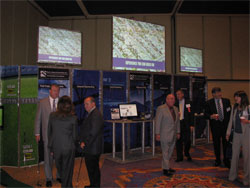 | �
�| Event exhibitors and sponsors contribute to an informative and engaging environment | �
�This year’s meeting was the best yet for the industry-leading construction defect and claims event.
�This year’s seminar concluded on May 13, 2011 with the Construction Defect Community Charitable Foundation Golf Tournament, held at Strawberry Farms Golf Course.
�The Disneyland Hotel in Anaheim, California was the place where more than 1,500 attendees convened for two days of professional development activities and seminars that included CLE workshops and panel discussions of special interest to legal and insurance professionals concerned with construction defect and claims litigation. Key events included “Challenges for Experts in Construction Defect Claims and Litigation,” “Keeping Up with Construction Defect Coverage,” and “Tips for Avoiding the ‘Perfect Storm’ in Handling of Wrap Claims.”
� �  | �
�| Supporting the golf tournament at the 15th hole | �
�This year’s Ollie award was given to George D. Calkins II, Esq. The West Coast Casualty Jerrold S. Oliver Award of Excellence was named in honor of the late Judge Jerrold S. Oliver, and recognizes an individual who is outstanding or has contributed to the betterment of the construction community.
�In addition to being the most comprehensive professional development seminar in the area of construction defects, this year’s seminar was equally valuable as a networking opportunity for members of the industry. People participated in professional development events during the day and then continued networking in the evening at numerous social events. The Lawn Party as well as the legendary Wood, Smith, Henning & Berman events were very well attended. Additional valuable networking events were hosted by a number of industry professionals at the House of Blues, and Tortilla Joe’s.
�As of this writing the 2011, West Coast Casualty's Construction Defect Seminar has applied for or has already received the following continuing education accreditation in the following areas;
�Read the full story…
�For more information about next year’s event, visit West Coast Casualty.
The King of Construction Defect Scams
June 19, 2012 — CDJ Staff
Echoing Businessweek, the Las Vegas Sun agrees that the Nevada HOA scandal is the “king of all Vegas real estate scams,” and says that the Nevada legislatures should take action. The Sun notes that the case involves only 12 out of 2,356 HOAs in Southern Nevada.
To date, 25 people have plead guilty in the case. At the center were an attorney and contractor who allegedly referred work to each other. To enable this, they assembled a wider conspiracy of people who enriched by the process. In the words of the Sun, those involved “upended the concept of a ‘common interest’ community.”
Read the full story…
Ambitious Building Plans in Boston
November 18, 2011 — CDJ Staff
Although most are unlikely to change the Boston skyline, there are several large projects on the drawing boards. The site BostInnovation covered ten of them in a recent post. Downtown Boston will be the site of several of these large projects, including three towers to be added to the Christian Science Plaza, a 404-unit residential tower in the Theater District, and perhaps the largest of these projects, a 47-story tower to be built over Copley Plaza, which will tower over the adjacent buildings. None of the planned buildings will challenge the Hancock Tower’s 60 stories.
Read the full story…
When is a Construction Project truly “Complete”? That depends. (law note)
August 2, 2012 — Melissa Dewey Brumback, Construction Law North Carolina
Long-time readers of the blog may remember my earlier post on substantial completion. However, in looking over my blog stats to see what search terms lead people here, it looks like this is hot topic. The blog searches came in two general categories:
1. Those searching strictly for a definition of substantial completion. Some examples:
- What does “substantial completion” mean?
- when does a building achieve substantial completion
- contracts “substantial completion”
- substantial completion undefined
- when is a project substantially complete
Read the full story…
Reprinted courtesy of Melissa Dewey Brumback of Ragsdale Liggett PLLC. Ms. Brumback can be contacted at mbrumback@rl-law.com.
California Supreme Court Finds Associations Bound by Member Arbitration Clauses
September 13, 2012 — CDJ Staff
In a decision with great implications for construction defect suits in California, the California Supreme Court has ruled in Pinnacle Museum Tower Association v. Pinnacle Market Development that arbitration clauses binding on the members of the association are also binding on the association itself. They concluded this, even though “the association did not exist as an entity independent of the developer when the declaration was drafted and recorded.” The opinion, written by Justice Baxter, was joined by four additional justices, with two separate concurrences and a dissenting opinion by Justice Kennard.
�The Pinnacle homeowners sought to bring suit over construction defect claims. In response, the developer filed a motion to compel arbitration. The association argued that the arbitration clause signed by its individual members was not binding on it. The Appeals Court invalidated the arbitration agreement “finding it marked by slight substantive unconscionability and high degree of procedural unconscionability. The Appeals Court determined that “for all intents and purposes, Pinnacle was the only party to the ‘agreement,’ and there was no independent homeowners association when Pinnacle recorded the CC&R’s.” However, the California Supreme Court said that this was “not persuasive in light of the statutory and contract principles in play.”
�The opinion notes that “the Project CC&R’s provides that Pinnacle and, by accepting a deed to any portion of the Project property, the Association and each individual condominium owner agree to submit any construction dispute to binding arbitration in accordance with the FAA.” The Court noted that “settled principles of condominium law establish that an owners association, like its constituent members, must act in conformity with the terms of a recorded declaration,” which, as the Court notes, includes the CC&Rs.
�After finding that the terms were binding on the Association, the Court then questioned whether the terms were “unenforceable as unconscionable,” noting that “the party resisting arbitration bears the burden of proving unconscionability.” But the Court found that “the arbitration provisions of article XVIII are not substantively unconscionable.” Additionally, they found “no support for the Association’s claims of unfairness and absence of mutuality.”
Read the court’s decision…
Statute of Repose Dependant on When Subcontractors Finished
July 10, 2012 — CDJ Staff
Scott C. Sandberg of Snell and Wilmer writes a post on the JDSupra site about the Colorado Court of Appeals decision in Shaw Construction v. United Builder Services. Sanberg notes that when the general contractor was sued by an HOA, the contractor turned around and sued its subcontractors. The contractor made three claims. They claimed that “improvement” referred to the whole project, that “substantial completion” was reached when the architect certified completion, and that the statute of repose was tolled by the HOA’s service of a Construction Defect Action Reform Act notice.
The subcontractors claimed that “improvement” only referred to their specific work, which reached “substantial completion” when they finished, despite work to be done by other later, and the HOA’s notice to the contractor did not affect the subcontractors. The Colorado court agreed with the subcontractors.
Sandberg notes that some of the contractor’s were not addressed by the court, noting that “the court did not decide whether an improvement triggering the statute of repose can be determined on a trade-by-trade basis,” and that “the court did not decide whether substantial completion occurs when a certificate of occupancy is issued or when the architect certifies completion.”
Read the full story…
Louisiana Politicians Struggle on Construction Bills, Hospital Redevelopment
June 16, 2011 — CDJ Staff
Louisiana politicians are still working on a compromise in the state’s construction budget, as reported in the Times-Picayune. Rob Marrianneax, the chair of the Senate Revenue and Fiscal Affairs Committee, removed a $45 million request from Governor Bobby Jindal and added $4 million for projects that Jindal vetoed last year.
�Two senators have formed competing plans to fund redevelopment construction for New Orleans’s Methodist Hospital. Mitch Landrieu, the mayor of New Orleans, hoped for $30 million dollars in state bonds. Senator Cynthia Willard-Lewis proposed an amendment that would supply $1.6 million, while Senator J.P. Morrell has an amendment that would supply $4 million.
�Read the full story…
Homeowner’s Policy Excludes Coverage for Loss Caused by Chinese Drywall
November 18, 2011 — Tred Eyerley, Insurance Law Hawaii
Exclusions barred the homeowners from recovering for losses caused by Chinese drywall in their home. Ross v. C. Adams Const. & Design, L.L.C., 2011 La. App. LEXIS 769 (La. Ct. App., released for publication Oct. 5, 2011).
Two years after purchasing their home, the Rosses began experiencing chronic malfunctions in the heating, ventilation and air conditioning system. After discovering the presence of gypsum drywall, or "Chinese drywall", they submitted a claim to their insurer, Louisiana Citizens Property Insurance Company, for damages caused by the Chinese drywall. Louisiana Citizens denied the claim.
The Rosses sued. The trial court granted summary judgment to Louisiana Citizens based upon exclusions in the policy.
On appeal, the appellate court first agreed the Rosses had sustained a direct physical loss. The inherent qualities of the Chinese drywall created a physical loss to the home and the drywall had to be removed and replaced.
Read the full story…
Reprinted courtesy of Tred R. Eyerly, Insurance Law Hawaii. Mr. Eyerly can be contacted at te@hawaiilawyer.com
Contractor’s Coverage For Additional Insured Established by Unilateral Contract
November 18, 2011 — Tred Eyerley, Insurance Law Hawaii
The contractor was covered as an additional insured under the subcontractor’s policy even though the parties had never actually signed an agreement to add the contractor to the policy. Evanston Ins. Co. v. Westchester Surplus Lines Ins. Co., 2011 U.S. App. LEXIS 20081 (9th Cir. Oct. 3, 2011).
The policies held by Bellevue Master, the general contractor, required it to be an additional insured under any subcontractor’s liability policy. Northwest Tower Crane Services was a subcontractor. Bellevue Master LLC, faxed a message that Northwest could continue to be a subcontractor on the project if it complied with Bellevue Master’s insurance requirements. Northwest contacted its insurance broker and requested an insurance certificate be issued to Bellevue Master so that it would be an additional insured under Northwest’s policy.
Read the full story…
Reprinted courtesy of Tred R. Eyerly, Insurance Law Hawaii. Mr. Eyerly can be contacted at te@hawaiilawyer.com
Construction Defects Are Occurrences, Says South Carolina High Court
December 20, 2012 — CDJ Staff
The South Carolina Supreme Court has left the legislature’s new, expanded definition of “occurrence” in place, declining to declare it unconstitutional. South Carolina included faulty workmanship as an occurrence in response to a Supreme Court decision, which the court later reversed. One of the parties in that earlier decision, Harleysville Insurance, challenged the new law, claiming that the legislature didn’t have the power to pass a law to overturn a court ruling. The court did not concur.
However, the court did determine that the law was not retroactive and covered only claims filed after the law became effective in May 2011. The Chief Justice of South Carolina noted that “insurance coverage for construction liability lacks clarity, particularly with respect to whether construction defects constitute ‘occurrences’ under construction general insurance policies.”
Read the full story…
Renovation Contractors: Be Careful How You Disclose Your Projects
December 9, 2011 — Derek J. Lindenschmidt, Colorado Construction Litigation
In Palu and Beyer v. Toney, 2011 WL 2560249 (Bankr. D. Colo.), the United States Bankruptcy Court for the District of Colorado determined that a Colorado District Court order granting summary judgment in favor of plaintiff home buyers was binding on the Bankruptcy Court in the defendant contractor’s bankruptcy proceeding based on issue preclusion.
Pertinent to this column is the subject matter of the summary judgment motion: Colorado’s Seller’s Property Disclosure (Form LC-18-5-04). In the underlying state court action, the plaintiff home buyers filed a motion for summary judgment contending that the defendant contractor represented to them, through the Seller’s Property Disclosure, that there were no present or past conditions involving moisture or water problems, roof problems or leaks, skylight problems, or gutter downspout problems.
In granting plaintiffs’ motion, the state court determined that the defendant contractor made these representations on her Seller’s Property Disclosure despite witnessing water leaking from the skylight onto the floor and being aware of repairs to the roof, skylight, and interior drywall prior to the sale of the property.
Read the full story…
Reprinted courtesy of Derek J. Lindenschmidt of Higgins, Hopkins, McClain & Roswell, LLP. Mr. Lindenschmidt can be contacted at lindenschmidt@hhmrlaw.com
Is Construction Heading Off the Fiscal Cliff?
December 20, 2012 — CDJ Staff
After a period of growth, the construction industry lost 20,000 jobs in November, based on the federal jobs data. Damon Scott of New Mexico Business Weekly suggests that contractors may have laid off employees in anticipation of the “fiscal cliff.” Ken Simpson, the chief economist of the National Association of Home Builders said in a press release that “it is discouraging that construction employment is still struggling after three years of expansion in the overall economy.”
Read the full story…
Court Sends Construction Defect Case from Kansas to Missouri
August 2, 2012 — CDJ Staff
The United State Court of Appeals for the Tenth Circuit has ruled in Mid-Continent Casualty Company v. The Village at Deer Creek Homeowners Association. The prior case was heard by the United States District Court for the District of Kansas. In this appeal, Mid-Continent sought a declaratory judgement. The Village at Deer Creek Homeowners Association moved to dismiss, and the district court had granted this, giving jurisdiction to the Missouri state courts.
The homeowners association had sued Greater Midwest Builders, Ltd., who had constructed the subdivision, in the Kansas state courts. The suit ended with a verdict against Greater Midwest for more than $7 million. The association and other plaintiffs in that case filed for equitable garnishment against State Auto, Mid-Continent, and Greater Midwest. State Auto removed the garnishment action to federal court in Missouri. Mid-Continent moved to sever the actions against it and transfer the case to the District of Kansas.
Subsequently, the plaintiffs filed a notice of voluntary dismissal in the Western District of Missouri. A second garnishment action followed in which Mid-Continent was named as an additional plaintiff. State Auto again removed to the Western District of Missouri, while Mid-Continent moved to sever and transfer to the District of Kansas. The Kansas court granted the association’s motion to dismiss.
In the appeal, Mid-Continent sought a declaratory judgment. This was denied by the appeals court. The district court “concluded that the Missouri courts were better situated to provide complete relief to all parties involved in the coverage dispute.” The appeals court affirmed the association’s movement to dismiss. Mid-Continent’s motion was denied as moot.
Read the court's decision…
Federal District Court Predicts Florida Will Adopt Injury In Fact Trigger�
October 23, 2012 — Tred Eyerly, Insurance Law Hawaii
The U. S. District Court for the Middle District of Florida was confronted with determining whether Florida would follow the manifestation or injury in fact trigger in Axis Surplus Ins. Co. v. Contravest Constr. Co., 2012 U.S. Dist. LEXIS 104502 (D. Fla. June 5, 2012).
�The homeowner's association sued the insureds for alleged negligent construction and development of individual dwelling units and common areas of their condominium. Due to this negligence, severe damage was caused by water intrusion. The Association's members only became aware of the defects through the retention of construction experts.
�The insured had CGL coverage with Axis, with policies issued from 2003 to 2007. Coverage was denied for the periods 2003-2004 and 2004-2005. Axis provided a defense under the policies issued for 2005-2006 and 2006-2007, but under a reservation of rights. Axis sought a declaration that it had no duty to defend or indemnify because the damage manifested before its policy periods.
�For coverage to exist, "property damage" must have "occurred" during Axis' policy period.
� Read the full story…
��Reprinted courtesy of Tred R. Eyerly, Insurance Law Hawaii. Mr. Eyerly can be contacted at te@hawaiilawyer.com
��
Colorado “occurrence”
January 6, 2012 — CDCoverage.com
In Greystone Construction, Inc. v. National Fire & Marine Insurance Co., No. 09-1412 (10th Cir. November 1, 2011), general contractors Greystone and Branan were each sued by purchases of homes built by each alleging defective construction performed by subcontractors. CGL insurer American Family Mutual Insurance Company defended both Greystone and Brannon while co-insurer National Fire & Marine Insurance Company denied a defense. Greystone, Branan, and American Family sued National Fire for contribution towards defense costs. The federal district trial court entered summary judgment for National Fire.
Read the full story…
Reprinted courtesy of CDCoverage.com
Driver’s Death May Be Due to Construction Defect
August 16, 2012 — CDJ Staff
A man driving a rental truck collided with a parking ramp at the Mall of America in Bloomington, Minnesota, leading to his death when the ramp broke and crushed the cab of the truck. One expert said that the ramp should have been built to withstand the impact. Tim Galarnyk told Fox News that the building feature didn’t’ even bear weight, describing it as “a cosmetic facial panel.” Nevertheless, in a contest with a truck he said the ramp portion should “peel it like a tin can before it takes the concrete element down.”
The Mall of American is not commenting on the accident.
Read the full story…
Remodels Replace Construction in Redding
September 9, 2011 — CDJ Staff
The Record Searchlight reports that while new construction is down in Redding, California, residential and commercial remodel permits are up 17 percent. By August 2010, there had been 63 housing and commercial business starts in Redding, while this year has seen only 15.
One such remodel, that of Parkview Market, will cost about $201,000. Safeway is planning on two $80,000 remodels of its grocery stores in Redding. In all, the 150 building permits for remodels are worth a total of $2.8 million.
Read the full story…
Houses Can Still Make Cents: Illinois’ Implied Warranty of Habitability
March 1, 2011 — Original Story by
Marisa L. Saber Cozen O’Connor Subrogation & Recovery Law BlogIn a report published earlier this week Marisa L. Saber writes about the implied warranty of habitability in the context of construction defect litigation. The piece speaks of the difficulties in alleging tort theories against builders and vendors in light of Illinois’ expansion of the economic loss doctrine, and how the implied warranty of habitability may provide another avenue for recovery.
�Read Full Story...