Contractor Convicted of Additional Fraud
November 18, 2011 — CDJ Staff
A Pennsylvania contractor in prison for fraud has been convicted with insurance fraud. The York Daily Record reports that Steven D. Gebhart was already in jail for fraud for about $350,000 for work he either failed to finish or even start or by using substandard materials and practices when he was convicted of insurance fraud. Gebbert’s offices were destroyed in a fire that was later determined to be arson. He was not charged with this, but instead for overestimating his losses to the insurance company. Sentencing for the fraud charge will be on December 21.
Read the full story…
Association May Not Make Claim Against Builder in Vermont Construction Defect Case�
October 23, 2012 — CDJ Staff
The Vermont Supreme Court issued a ruling on September 28 on Long Trail House Condominium Association. The case was heard by a panel of two Supreme Court justices, Marilyn Skoglund and Brian Burgess, and three justices specially assigned for the case, Kupersmith, Davenport, and Johnson. The decision came down with a 3-2 split; Judges Kupersmith and Johnson joining in a dissent.
�In the underlying case, Stratton Corporation entered into an agreement with Engelberth Construction in which Engelberth would supply “recommendations on construction feasibility, consultation as to the selection of materials and equipment, assistance with zoning requirements and permits, and cooperation with the ‘design team’ to provide valuable engineering services.” Engelberth was not responsible to determine that the drawings and specifications were in accordance with the law and building codes, nor were they responsible “for the design team’s designs, errors, or omissions.”
�Subsequent to the agreement was a construction project which culminated in the incorporation of the Long Trail House Condominium Association. The condominium owners initiated a lawsuit over alleged defects. Stratton, Intrawest, and the association settled claims for $7,025,00 with Stratton and Intrawest both pursuing claims against Engelberth. This case is still unsettled.
�The association progressed on remediation, which cost about $1,500,00 more than was provided by the settlement, and so the association also sued Engelberth. In this case, the court granted a summary judgment to Engelberth, concluding that negligence claim was barred both “by the economic loss rule and that the absence of contractual privity was fatal to the warranty claims.”
�The court upheld both determinations of the lower court. The court noted that “the economic loss rule ‘prohibits recovery in tort for purely economic losses’” and that “in tort law, duties are imposed by law to protect the public from harm.” A negligence claim could only be supported with evidence of “some accompanying physical harm, which does not include economic loss.”
�The association made the claim that the economic loss rule applies only when there is a contractual relationship between the two parties. The court rejected this argument, citing a reference that “economic interests are protected, if at all, by contract principles, rather than tort principles.”
�Nor did the court find it persuasive that a “professional services” exception to the economic loss doctrine applied, noting that the court has rejected this notion in two prior cases. The noted that the association’s losses were purely economic, and their inability to settle those claims with Engelberth did not mean that they had not means of settling them, as they were able to settle these very claims with Stratton and Intrawest.
�The association also raised claims of an implied warranty, resting on the construction contract between Engelberth and Stratton. This was also rejected by the court, noting that Vermont “case law plainly contemplates the existence of contractual privity before a breach of implied warranty claim can be raised.” The court noted that there was neither a contract nor a sale between Engelberth and the association, and thus there were no grounds for an implied warranty. The court concluded that “the Association’s warranty remedy lies against the entity that sold it the condominium units and implicitly warranted through the sale that the units were built in a good and workmanlike manner and that they were suitable for habitation.”
� Read the court’s decision …
�
Lower Court “Eminently Reasonable” but Wrong in Construction Defect Case
July 10, 2012 — CDJ Staff
Noting that “circuit court’s orders are eminently reasonable, logical and just” the Supreme Court of Appeals of West Virginia has granted a writ to halt enforcement of these orders and to compel arbitration instead in the case of State v. Tucker. The initial case concerned claims that an HVAC system had been improperly designed, constructed, manufactured, or maintained, leading to serious problems. Glenmark Holding, the owner of the Suncrest Executive Plaza brought a lawsuit against seven defendants. Three of the defendants, Morgan Keller, Inc, York International Corporation, and Johnson Controls, Inc. argued that Glenmark was obligated to enter into arbitration.
Glenmark and the other defendants argued that the motions for arbitration should be denied “so all the claims and cross-claims of the parties could be litigated in one forum, in one proceeding.” The circuit court noted that arbitration is preferred over litigation because of its supposed “expeditious, economic resolution of issues,” but that in this case, “the petitioners would expend additional, not fewer resources responding to the parties’ claims and cross-claims.” As “compulsory arbitration would be insufficient and inequitable” the court denied the request, finding the arbitration clauses “unconscionable and, therefore, unenforceable.”
Morgan Keller, York, and Johson argued that “the interpretation of arbitration clauses is governed exclusively by the Federal Arbitration Act.” The appeals court found that “the circuit court was within its authority to consider Glenmark’s claim that the arbitration clauses were unenforceable.” However, the appeals court rejected the circuit court’s conclusion about the “piecemeal” resolution of the conflict, as it contradicts a Supreme Court ruling. The Supreme Court stated in 1983 that the FAA “requires piecemeal resolution when necessary to give effect to an arbitration agreement.” In a 1985 decision, the Court held that a court could “not substitute [its] own views of economy and efficiency.”
Nor could the court find the arbitration clause to be unconscionable or unenforceable. The court noted that the contract was a standard AIA form, and was amended by the parties involved, whom the court characterized as “commercially sophisticated.” The court found that the agreement limited the rights of all parties and was not one-sided.
As the arbitration clause was neither unconscionable nor unenforceable, and Supreme Court rulings preclude a court from substituting its own procedures, even when these are “eminently reasonable, logical and just,” the appeals court halted the order of the circuit court, sending the matter to arbitration.
Read the court’s decision…
Texas Windstorm Insurance Agency Under Scrutiny
April 5, 2011 — April 5, 2011 Beverley BevenFlorez - Construction Defect Journal
Representative Larry Taylor has introduced a bill in the Texas Legislature (HB 2818) that would further regulate the Texas Windstorm Insurance Agency (TWIA). According to Taylor, “In order to be adequately prepared for future hurricane seasons, it is imperative that TWIA be operating at maximum efficiency, that the Reserve Trust Fund be solvent and that the agency have adequate management measures in place to protect consumers and ensure that claims are paid in a timely manner. House Bill 2818 is an important step in the right direction toward restoring public confidence in TWIA.”
�HB 2818 includes measures that would create an expert panel that would advise the commissioner on how to evaluate loss from the storm, and a greater transparency of TWIA Board meetings and actions.
�In addition, the Texas Department of Insurance (TDI) has placed TWIA on Administrative Oversight. According to TDI, “While under Administrative Oversight, the Department may require its prior review and approval of executive decisions, certain expenditures, and other transactions. The insurer is required to fully cooperate with the Department and provide complete and timely disclosure of all information responsive to Department requests.”
�Read the full story (Rep. Taylor’s Press Release)...
�Read the full story (Texas Department of Insurance’s Press Release)...
2011 West Coast Casualty Construction Defect Seminar – Recap
June 1, 2011 — CDJ Staff
� 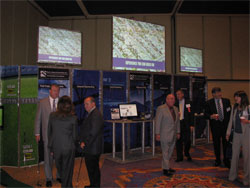 | �
�| Event exhibitors and sponsors contribute to an informative and engaging environment | �
�This year’s meeting was the best yet for the industry-leading construction defect and claims event.
�This year’s seminar concluded on May 13, 2011 with the Construction Defect Community Charitable Foundation Golf Tournament, held at Strawberry Farms Golf Course.
�The Disneyland Hotel in Anaheim, California was the place where more than 1,500 attendees convened for two days of professional development activities and seminars that included CLE workshops and panel discussions of special interest to legal and insurance professionals concerned with construction defect and claims litigation. Key events included “Challenges for Experts in Construction Defect Claims and Litigation,” “Keeping Up with Construction Defect Coverage,” and “Tips for Avoiding the ‘Perfect Storm’ in Handling of Wrap Claims.”
� �  | �
�| Supporting the golf tournament at the 15th hole | �
�This year’s Ollie award was given to George D. Calkins II, Esq. The West Coast Casualty Jerrold S. Oliver Award of Excellence was named in honor of the late Judge Jerrold S. Oliver, and recognizes an individual who is outstanding or has contributed to the betterment of the construction community.
�In addition to being the most comprehensive professional development seminar in the area of construction defects, this year’s seminar was equally valuable as a networking opportunity for members of the industry. People participated in professional development events during the day and then continued networking in the evening at numerous social events. The Lawn Party as well as the legendary Wood, Smith, Henning & Berman events were very well attended. Additional valuable networking events were hosted by a number of industry professionals at the House of Blues, and Tortilla Joe’s.
�As of this writing the 2011, West Coast Casualty's Construction Defect Seminar has applied for or has already received the following continuing education accreditation in the following areas;
�Read the full story…
�For more information about next year’s event, visit West Coast Casualty.
Construction Jobs Expected to Rise in Post-Hurricane Rebuilding
November 7, 2012 — CDJ Staff
Businessweek reports that construction jobs and materials will see increased demand as property owners in New York and New Jersey rebuild after hurricane Sandy. Tom Jeffery, of Irvine, California-based CoreLogic, a real estate information service, noted that “a high percent of damaged properties are going to be repaired.” Experts estimate property damage to total anywhere from $7 billion to $40 billion.
It is also estimated that about 739,000 properties in the area are underwater in the way that has nothing to do with flooding, with negative equity of 25 percent or more. Many of these homeowners are likely to walk away from their mortgages.
Ken Simonson, chief economist of the Associated General Contractors of America, expects “localized spikes in construction employment throughout November and the winter.” Martin Connor, the chief financial officer of Toll Brothers, expects to see more a rise in labor costs than in materials.
Read the full story…
Insurers Reacting to Massachusetts Tornadoes
August 11, 2011 — CDJ Staff
The Patriot-Ledger reports that insurers could pay out as much as $200 million to cover homes damaged or destroyed in the tornadoes that hit central and southern Massachusetts in June, 2011. Joseph Murphy, Commissioner of the State Division of Insurance didn?t foresee problems with insurers covering these claims. “At this point, there doesn’t seem to be any one company overexposed in that area,” he told the Patriot-Ledger.
�Insurance executives did not think the tornadoes would cause them to raise rates. Steve Chevalier, CEO of NLC Companies, said, “it’s a major event for those impacted by it, but it’s not close to a financial hit to us.”
�One insurer noted that the winter weather generated more claims; however the cumulative value of those claims was $15 million.
� Read the full story…
General Contractor/Developer May Not Rely on the Homeowner Protection Act to Avoid a Waiver of Consequential Damages in an AIA Contract
August 4, 2011 — Higgins, Hopkins, McLain & Roswell, LLC
Recently, in Caribou Ridge Homes, LLC v. Zero Energy, LLC, et al., Case No. 10CV1094, Boulder County District Court Judge Ingrid S. Bakke entered a ruling and order on the Plaintiff’s Motion for Determination of Question of Law Pursuant to C.R.C.P. 56(h) on Issue of Damages. The Order found that the Plaintiff was not a homeowner intended to be protected by the Homeowner Protection Act (the “HPA”) and thus could not pursue its claims for consequential damages against Defendant.
�By way of background, on June 18, 2008, Plaintiff Caribou Ridge Homes, LLC (“Caribou”) entered into a Standard Form Agreement Between Owner and Contractor AIA Document A114-2001 (the “Contract”) with Defendant Zero Energy, LLC (“Zero Energy”). Plaintiff hired Zero Energy to serve as a general contractor for the construction of a single-family home in the Caribou Ridge subdivision in Nederland, Colorado. A provision in the contract contained a mutual waiver of consequential damages (“Waiver”).
Read the full story…
�Reprinted courtesy Higgins, Hopkins, McLain & Roswell, LLC
Yellow Brass Fittings Play a Crucial Role in Baker v Castle & Cooke Homes�
May 10, 2012 — CDJ Staff
Baker v Castle & Cooke Homes Hawaii, et al. is a “class action filed by homeowners who allege that their homes have a construction defect. They allege that their plumbing systems include brass fittings susceptible to corrosion and likely to cause leaks. They bring this action against the developer of their homes and the manufacturers of the brass fittings.”
�Zurn, the manufacturer of the allegedly defective brass fittings, sought a dismissal, or if that could not be achieved, then “a more definite statement, of five of the six claims.” Zurn moved for summary judgment on the sixth claim, or alternately sought “summary judgment on one of the five claims it” sought to dismiss.” The court granted in part the motion, and denied the motion for summary judgment.
�The developer, Castle & Cooke, sought dismissal of the First Amended Complaint stating “that Plaintiffs have not complied with Hawaii’s Contractor Repair Act, chapter 672E of Hawaii Revised Statutes, which requires, among other things, a plaintiff to give a contractor the results of any testing done before filing an action against that contractor.” The court couldn’t determine “certain facts essential to ruling” on Castle & Cooke’s motion, and therefore denied the motion, but ordered Plaintiffs to submit requested material by the stated deadline.
�The Baker v Castle & Cooke case began with the Plaintiffs claim that the use of yellow brass fittings can lead to construction defects. They allege that “yellow brass is particularly susceptible to dezincification, a corrosion process in which zinc leaches into potable water that comes into contact with the brass. According to Plaintiffs, as the brass corrodes, it becomes porous and mechanically weak. Plaintiffs further allege that the PEX systems in the putative class members’ homes have begun to, or are about to, leak water into the walls, ceilings, and floors of their homes. Plaintiffs allege that the leakage will cause water damage and mold growth, exposing the occupants to toxins.”
�In response to the plaintiffs’ claims, Zurn argued “because their yellow brass fittings have not failed to date, Plaintiffs fail to allege, and have no evidence showing, that they have suffered any actual injury.” Plaintiffs replied, “even if the fittings have not failed as of today, failure in the future is inevitable.”
�However, the court stated, “whether Plaintiffs have suffered any injury, or whether Plaintiffs are attempting to proceed based solely on future injury, implicates Plaintiffs’ standing to bring this action, as well as whether this case is ripe for adjudication.” The court has requested the parties to submit “supplemental briefing on whether this case should be dismissed pursuant to Rule 12(b)(1). In supplemental briefs, Zurn argues that dismissal is appropriate because Plaintiffs lack standing, and Castle & Cooke argues that dismissal is appropriate because Plaintiffs’ claims are not ripe.”
�The court continues to discuss the problem of standing: “To establish standing, a plaintiff must demonstrate three things. First, the plaintiff must suffer an "injury-in-fact," which means that there must be a concrete and particularized "invasion of a legally protected interest" and the invasion is actual or imminent. Lujan v. Defenders of Wildlife, 504 U.S. 555, 560 (1992). Second, the injury must be fairly traceable to the challenged action. Third, a favorable decision must be likely to redress the injury. Id. It is the first element (injury-in-fact) that is in issue here.”
�The court found that the plaintiffs do have standing: “Even if the court could not rely on the allegations that the pipes will soon leak, the court would conclude that, for standing purposes, Plaintiffs have a sufficient injury-in-fact in the form of their alleged economic loss.” In a hearing, Plaintiffs argued that their homes had decreased in value.
�The court also denied Castle & Cooke’s motion to dismiss based on a lack of ripeness, stating “the same reasons Plaintiffs satisfy the injury-in-fact requirement for standing purposes, they satisfy the constitutional ripeness requirement.”
�Plaintiffs asserted six counts against Zurn. Zurn, in response, made a motion to dismiss counts VIII, IX, X, XII, and XIII. The court granted Zurn’s motion for Counts VIII, IX, and X only: “Counts VIII (product liability), IX (negligence), and X (strict liability) sound in tort. Zurn argues that, because Plaintiffs allege no injury other than to the PEX systems and the yellow brass fittings themselves, the economic loss rule bars their tort claims. The court agrees.”
�The court disagreed with Zurn’s motion regarding Count XII: “Count XII asserts that Zurn has breached the implied warranty of merchantability. Zurn argues that Count XII is barred by the applicable statute of limitations and that Plaintiffs do not sufficiently allege an injury. The court disagrees.”
�Zurn’s motion regarding Count XIII was also denied: “Count XIII asserts that Zurn violated section 480-2 of Hawaii Revised Statutes.” Furthermore, “Plaintiffs allege that Zurn ‘engaged in unfair and deceptive acts or practices when [it] designed, manufactured and sold Yellow Brass Fittings.’ Zurn argues that Plaintiffs fail to state a claim under section 480-2(a) because their claims are barred by the statute of limitations and they do not adequately allege reliance or a cognizable injury. The court disagrees.”
�The court denied the motion for summary judgment with respect to Counts XI and XII.
�Castle & Cooke sought to dismiss “Plaintiffs’ claims against it under section 672E-2 of Hawaii Revised Statutes, which provides for dismissal when claimants fail to comply with chapter 672E.” There was some discussion regarding the test results. Apparently, the plaintiffs had failed to provide a written notice of claim at least 90 days before filing the action. However, it is unclear if the Plaintiffs have since complied with the requirements of the chapter. “The court has received no supplemental information from either party about whether any test results from another case have been turned over or whether those materials are subject to a confidentiality agreement. The record at this point does not establish noncompliance with the requirement in chapter 672E to provide such information. The court therefore denies the motion to dismiss.”
�In summary, “Zurn’s motion to dismiss is granted as to Count VIII, Count IX, and Count X. Zurn’s motion to dismiss is denied with respect to Plaintiffs’ other claims. Zurn’s request for a more definite statement and its summary judgment motion are denied. Plaintiffs are given leave to file an amended Complaint no later than May 21, 2012.” Furthermore, “the court denies Castle & Cooke’s motion, but directs Plaintiffs to file, within two weeks, either a certificate of compliance with section 672E-3(c), or an explanation as to why they have not complied. Castle & Cooke may submit a response within two weeks of Plaintiffs’ submission. Each party’s submission is limited to 1000 words.”
� Read the court’s decision…
�
Construction Firm Sues City and Engineers over Reservoir Project
October 28, 2011 — CDJ Staff
The city of Fremont, Ohio and Arcadis have been sued by Trucco Construction. Trucco had been hired by the city to build a reservoir designed by Arcadis, the News-Messenger reports. Peter Welin, attorney for Trucco, said that he found “startling evidence of the company’s negligence” when he deposed Arcadis engineers. “This project could never be built the way they bid it.”
Their suit alleges that Arcadis and the city were aware that the site was not conducive to construction and also that Arcadis failed to be a neutral party in discussions between Trucco and the city regarding compensation.
Sam Wamper, an attorney for Fremont, said he was going to file a motion which would include “quite an interesting story,” but declined to elaborate.
Read the full story...
Damron Agreement Questioned in Colorado Casualty Insurance v Safety Control Company, et al.
February 10, 2012 — CDJ Staff
Safety Control and EMC appealed the judgment in Colorado Casualty Insurance Company versus Safety Control Company, Inc., et al. (Ariz. App., 2012). The Superior Court in Maricopa County addressed “the validity and effect of a Damron agreement a contractor and its excess insurer entered into that assigned their rights to sue the primary insurer.” Judge Johnsen stated, “We hold the agreement is enforceable but remand for a determination of whether the stipulated judgment falls within the primary insurer’s policy.”
� The Opinion provides some facts and procedural history regarding the claim. “The Arizona Department of Transportation (“ADOT”) hired DBA Construction Company (“DBA”) to perform a road-improvement project on the Loop 101 freeway. Safety Control Company, Inc. was one of DBA’s subcontractors. As required by the subcontract, Safety Control purchased from Employer’s Mutual Casualty Company (“EMC”) a certificate of insurance identifying DBA as an additional insured on a policy providing primary coverage for liability arising out of Safety Control’s work.”
� A collision occurred on site, injuring Hugo Roman. Roman then sued ADT and DBA for damages. “Colorado Casualty tendered DBA’s defense to the subcontractors, including Safety Control. Safety Control and EMC rejected the tender. Roman eventually settled his claims against DBA and ADOT. DBA and ADOT stipulated with Roman for entry of judgment of $750,000; Roman received $75,000 from DBA (paid by Colorado Casualty) and $20,000 from ADOT, and agreed not to execute on the stipulated judgment. Finally, DBA, ADOT and Colorado Casualty assigned to Roman their rights against the subcontractors and other insurers.”
� Colorado Casualty attempted to recover what “it had paid to defend DBA and ADOT and settle with Roman. However, Roman intervened, and argued that “Colorado Casualty had assigned its subrogation rights to him as part of the settlement agreement.” The suit was not dismissed, but the Superior Court allowed Roman to intervene. “Roman then filed a counterclaim against Colorado Casualty and a cross-claim against the subcontractors.”
� All claims were settled against all of the defendants except Safety Control and EMC. “The superior court ruled on summary judgment that EMC breached a duty to defend DBA and that as a result, ‘DBA was entitled to settle with Roman without EMC’s consent as long as the settlement was not collusive or fraudulent.’ After more briefing, the court held the stipulated judgment was neither collusive nor procured by fraud and that EMC therefore was liable to Roman on the stipulated judgment and for his attorney’s fees. The court also held Safety Control breached its subcontract with DBA by failing to procure completed-operations insurance coverage and would be liable for damages to the extent that EMC did not satisfy what remained (after the other settlements) of the stipulated judgment and awards of attorney’s fees.” Safety Control and EMC appealed the judgment.
� Four reasons were given for the decision of the ruling. First, “the disagreement between Roman and Colorado Casualty does not preclude them from pursuing their claims against EMC and Safety Control.” Second, “the settlement agreement is not otherwise invalid.” Third, “issues of fact remain about whether the judgment falls within the EMC policy.” Finally, “Safety Control breached the subcontract by failing to procure ‘Completed Operations’ coverage for DBA.”
� In conclusion, the Superior Court affirmed in part, reversed in part, and remanded . “Although, as stated above, we have affirmed several rulings of the superior court, we reverse the judgment against EMC and remand for further proceedings consistent with this Opinion to determine whether the stipulated judgment was a liability that arose out of Safety Control’s operations. In addition, we affirm the superior court’s declaratory judgment against Safety Control but remand so that the court may clarify the circumstances under which Safety Control may be liable for damages and may conduct whatever further proceedings it deems appropriate to ascertain the amount of those damages. We decline all parties’ requests for attorney’s fees pursuant to A.R.S. § 12-341.01 without prejudice to a request for fees incurred in this appeal to be filed by the prevailing party on remand before the superior court.”
Read the court’s decision…
Harmon Hotel Construction Defect Update
July 18, 2011 — CDJ Staff
Coverage of the ongoing litigation concerning the Harmon Hotel continues to proliferate. Architectural Record and a number of other news outlets continue to provide additional details and coverage of the matter. Chief among the conditions alleged are improperly installed reinforcing steel inside link beams on 15 floors. MGM Claims that the conditions amount to hundreds of millions of dollars in damages, while Perini (the builder) indicated in a July 12th statement that the buildings problems are related to the design, and the they are “fixable.”
�There is significant speculation that MGM Resorts International isn’t interested in repairing the hotel due to a glut of hotel rooms attendant to the troubled economy. In a statement Tuesday Perini reportedly stated that “Repairing and opening the Harmon would only create a greater glut of unused hotel rooms for MGM,” “If market conditions were better and MGM found that demand existed for the Harmon hotel rooms, MGM would not be claiming that the Harmon is unstable.”
�MGM asserts that Perini failed to ”properly construct” the project. Clark County’s Department of Development Services has reportedly asked MGM to provide a plan to fix the project by August 15th.
�The Harmon is part of the $8.5 billion CityCenter project that opened in the fourth quarter of 2009 and is jointly owned by MGM Resorts and Dubai World.
�Prior reports indicated that the owner (MGM) had considered razing the entire project. The future of the project remains uncertain.
District Court Awards Summary Judgment to Insurance Firm in Framing Case
August 4, 2011 — CDJ Staff
In the case of Continental Western Insurance Company v. Shay Construction Inc., Judge Walker Miller has granted a summary judgment against Shay Construction and their co-defendant, Milender White Construction Company.
�Shay was the framing subcontractor for Milender White on what the court described as “a major construction project in Grand County, Colorado.” Two of Shay’s subcontractors, Wood Source Inc. and Chase Lumber Company furnished materials, labor, and equipment to Shay. They subsequently sued for nonpayment and sought to enforce mechanic’s liens, naming both Shay and Milender as defendants. Milender White alleged that Shay had “breached its obligation under its subcontracts with Milender White.”
�Shay’s insurance provider, Continental Western, stated that its coverage did not include “the dispute between Shay, its subcontractors, particularly the cross claims asserted by Milender White.” Shay then sued Continental Western, alleging breach of contract and statutory bad faith.
�The court, however, has found with Continental Western and has granted them a summary judgment. They found “no genuine issue as to any material fact.” The judge did not side with Continental Western on their interpretation of the phrase “those sums that the insured becomes legally obligated to pay as damages.” The court found that the Colorado courts have not limited this to tort actions only. However, as Milender’s cross claim included claims of faulty workmanship on the part of Shay, Judge Miller found for Continental.
Read the court’s decision…
No “Special Relationship” in Oregon Construction Defect Claim
July 10, 2012 — CDJ Staff
Writing on his firm’s blog, Justin Stark discusses recent changes in construction defect claims in Oregon where, as he points out, “courts in Oregon have been lowering legal hurdles that construction defect plaintiffs must overcome in bringing their cases.” He cites a case in which water damage was discovered more than six years after construction was complete. The owners claimed breach of contract and negligence. The trial court found for the contractor, who argued “that there was no ‘special relationship’ with the owners that could support the negligence claim.”
This was overturned on appeal, with the court concluding that if there was a violation of the building code, then the negligence claim could stand. This was appealed to the Oregon Supreme court which concluded that “neither a special relationship nor a statutory standard of care, such as the building code, is necessary to bring a negligence claim here.”
Stark notes that “many forms of construction contract incorporate the phrase ‘workmanlike,’ which implicates the ‘common law standard of care’ in negligence law.
Read the full story…
Construction Defect Bill Introduced in California
June 10, 2011 — CDJ Staff
Linda Halderman (R-Fresno) has introduced a bill which would require lawyers soliciting clients for construction defect cases to provide their prospective clients with a statement including that sellers may be required to disclose that they were engaged in a construction lawsuit. Further, the bill would require lawyers to disclose that they cannot guarantee financial recovery.
�Halderman was quoted by The Business Journal as saying, “Lawsuit abuse has been very damaging, especially to homeowners in the Valley.” Halderman hopes that her bill will discourage class action lawsuits against builders and that this will protect jobs in the construction industry.
�Read the full story…
Reference to "Man Made" Movement of Earth Corrects Ambiguity
December 20, 2012 — Tred Eyerly, Insurance Law Hawaii
In Pioneer Tower Owners Assn. v. State Farm Fire & Cas. Co., 12 NY3d 302 (2009), the New York Court of Appeals found an "earth movement" exclusion was ambiguous when applied to an excavation. The court now considered whether a similar exclusion, expressly made applicable to "man made" movement of earth, eliminated the ambiguity when loss was created by excavation. Bentoria Holdings, Inc. v. Travelers Indem. Co., 2012 N.Y. LEXIS 3087 (N.Y. Oct. 25, 2012).
Plaintiff's building suffered cracks due to an excavation being conducted on the lot next door. A claim was submitted to Travelers, plaintiff's insurer. Travelers rejected the claim, relying on the earth movement exclusion.
Read the full story…
Reprinted courtesy of Tred R. Eyerly, Insurance Law Hawaii. Mr. Eyerly can be contacted at te@hawaiilawyer.com
Park District Sues over Leaky Roof
August 2, 2012 — CDJ Staff
The Glen Ellyn Park District has filed suit against multiple firms over the leaks in the Ackerman Sports and Fitness Center. The district alleges at least twenty leaks can be found throughout the facility. In order to prevent further damage, they have put in a system of “buckets, tarps and flexible piping.”
According to the Chicago Daily Herald, the park district has most recently added the project construction manager, the building designer, and insurer that issued a performance bond on the builder. T.A. Bowman Constructors, the builder of the project, sued the park district. They were first name in the district’s countersuit.
The park district isn’t waiting for the outcome of the suit to repair the roof. Instead, they are using existing funds to pay for roof repairs.
Read the full story…
SB800 Cases Approach the Courts
July 10, 2012 — CDJ Staff
California’s Right to Repair Law turns ten this year and cases under the statute are finally coming to trial, as John V. O’Meara of Bremer Whyte Brown & O’Meara writes for the Martindale-Hubble Legal Library. Mr. O’Meara notes that SB800 eliminated “the traditional definitions of construction defect,” replacing them with “functionality standards.” He argues that these standards are not uniform: “some standards require damage and others do not.” He also wonders what terms like “significant cracks,” “intended water” and “materially comply” mean in a court.
Mr. O’Meara states that “defendants in construction defect cases have a right to know the standards that apply to a case, the definitions that will be presented to the jury, and the burden of proof that attaches.”
Read the full story…