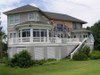
July 8, 2011 — Tred R. Eyerly, Insurance Law Hawaii
The homeowners hired the insured to raise the structure of their home twenty-four inches above the flood zone. Lafayette Ins. Co. v. Peerboom, 2011 U.S. Dist. LEXIS 58985 (S.D. Miss. June 2, 2011). When the insured’s crew returned from lunch one day, they found the house had fallen from hydraulic jacks being used to raise the structure a few inches at a time. There was substantial damage to the entire structure.
�The homeowners sued, asserting several claims, including negligence and breach of contract. The complaint alleged the homeowners entered a contract with the insured to raise their structure while maintaining its integrity. However, the insured failed to use proper equipment, which caused the house to fall and be completely destroyed.
�The insured tendered the claim to its insurer, Lafayette Insurance Company. Lafayette defended under a reservation of rights and filed suit for a declaratory judgment. Lafayette’s subsequent motion for summary judgment contended there was no “occurrence” alleged in the underlying complaint and, even if there was, the business risk exclusions barred coverage.
In Palm Beach Grading, Inc. v. Nautilus Ins. Co., No. 10-12821 (11th Cir. July 14, 2011), claimant general contractor Palm Beach Grading (?PBG?) subcontracted with insured A-1 for construction of a sewer line for the project.  A-1 abandoned its work and PBG hired another subcontractor to complete construction of the sewer line.  The new subcontractor discovered that A-1?s work was defective requiring repair and replacement of portions of the sewer line which also required the destruction and replacement of surrounding work.�
Coverage of the ongoing litigation concerning the Harmon Hotel continues to proliferate. Architectural Record and a number of other news outlets continue to provide additional details and coverage of the matter. Chief among the conditions alleged are improperly installed reinforcing steel inside link beams on 15 floors. MGM Claims that the conditions amount to hundreds of millions of dollars in damages, while Perini (the builder) indicated in a July 12th statement that the buildings problems are related to the design, and the they are “fixable.”
�There is significant speculation that MGM Resorts International isn’t interested in repairing the hotel due to a glut of hotel rooms attendant to the troubled economy. In a statement Tuesday Perini reportedly stated that “Repairing and opening the Harmon would only create a greater glut of unused hotel rooms for MGM,” “If market conditions were better and MGM found that demand existed for the Harmon hotel rooms, MGM would not be claiming that the Harmon is unstable.”
�MGM asserts that Perini failed to ”properly construct” the project. Clark County’s Department of Development Services has reportedly asked MGM to provide a plan to fix the project by August 15th.
�The Harmon is part of the $8.5 billion CityCenter project that opened in the fourth quarter of 2009 and is jointly owned by MGM Resorts and Dubai World.
�Prior reports indicated that the owner (MGM) had considered razing the entire project. The future of the project remains uncertain.
FHA Lists Bridges and Overpasses that May Have Defective Grout
September 13, 2012 — CDJ Staff
The Federal Highway Administration has released a list of bridges and overpasses that may be prone to corrosion problems due to grout that was in chlorides when it was supposed to be completely free of them. Currently, the FHA is working with state departments of transportation to determine if the defective grout was indeed used on additional bridges and overpasses. The initial FHA list of structures determined to have been built with the defective grout lists thirty-four sites, of which four are in Ohio, the largest number for any state.
�California contains only one such site, the intersection of the 55 and 405 freeways, one of the few items on the list not designated as a bridge.
Read the full story…
Construction Jobs Expected to Rise in Post-Hurricane Rebuilding
November 7, 2012 — CDJ Staff
Businessweek reports that construction jobs and materials will see increased demand as property owners in New York and New Jersey rebuild after hurricane Sandy. Tom Jeffery, of Irvine, California-based CoreLogic, a real estate information service, noted that “a high percent of damaged properties are going to be repaired.” Experts estimate property damage to total anywhere from $7 billion to $40 billion.
It is also estimated that about 739,000 properties in the area are underwater in the way that has nothing to do with flooding, with negative equity of 25 percent or more. Many of these homeowners are likely to walk away from their mortgages.
Ken Simonson, chief economist of the Associated General Contractors of America, expects “localized spikes in construction employment throughout November and the winter.” Martin Connor, the chief financial officer of Toll Brothers, expects to see more a rise in labor costs than in materials.
Read the full story…
Florida trigger
May 18, 2011 — May 18, 2011 - CDCoverage.com
In Johnson-Graham-Malone, Inc. v. Austwood Enterprises, Inc., No. 16-2009-CA-005750-XXXX-MA (Fla. 4th Cir. Ct. Duval County, April 29, 2011), insured JGM was the general contractor for an apartment project completed in 1998. In 2007, the project owner sued JGM seeking damages for defective construction resulting in moisture penetration property damage. JGM tendered its defense to Amerisure. Amerisure denied a defense. JGM defended and settled the underlying suit and then filed suit against Amerisure seeking recovery of defense and settlement costs. The trial court granted JGM’s motion for partial summary judgment. The court first addressed Amerisure’s duty to defend. Applying Florida law, the court held that, although the underlying complaint alleged that the property damage was not discovered until after expiration of the Amerisure policies
�Read the full story…
�Reprinted courtesy of CDCoverage.com
Another Guilty Plea in Las Vegas HOA Scandal
December 20, 2012 — CDJ Staff
A twenty-eighth person has plead guilty in the ongoing Las Vegas HOA scandal. Dax Louderman, who had been a construction company manager had acknowledged that he stole more than $495,000 from his former employers, Alpha 1 Construction and the Stone Canyon Homeowners Association, and further that he did not report this improper income on his tax returns. He has agreed to work with prosecutors and to pay $134,860 to the IRS. His actual sentencing will happen on June 24.
Read the full story…
Seven Former North San Diego County Landfills are Leaking Contaminants
April 7, 2011 — April 7, 2011 Beverley BevenFlorez - Construction Defect Journal
Deborah Sullivan Brennan of the North County Times reported that seven former dumps in San Diego are leaking contaminants into the surrounding groundwater. John R. Odermatt, a senior engineering geologist for the California Regional Water Quality Control Board s San Diego region, told the North County Times, “the risk to most county residents is very small or negligible, while local water supplies located in more rural areas may be at a somewhat elevated but unquantified level of risk.”
�This issue is causing heavy scrutiny of a new proposed landfill in Gregory Canyon. The landfill would be located on 308 acres of undeveloped land near Pala, alongside the San Luis Rey River. The group “Save Gregory Canyon” has been speaking out against the landfill, stating that “the project threatens major detrimental impacts to both surface and groundwater, as well as a potential compromise of the two major San Diego Water Authority pipelines nearby.” Richard Felago, a Gregory Canyon Ltd. Consultant, told the North County Times that the 8-foot-thick liner, composed of layers of gravel and synthetic material, would not leak.
�The appeal hearing is being rescheduled later this month after one of the three panelists recused himself due to having a competing interest in the property, according to the article by Gary Warth in the North County Times.
�Read the full story (link 1)...
�Read the full story (link 2)...
Unit Owners Have No Standing to Sue under Condominium Association’s Policy
February 10, 2012 — Tred Eyerly, Insurance Law Hawaii
If a condominium owner suffers damage caused by a leak from another unit, may it sue the insurer for the Association of Apartment Owner (AOAO) for coverage? The federal district court for Hawaii said "no" in a decision by Judge Mollway. See Peters v. Lexington Ins. Co., 2011 U.S. Dist. LEXIS 148734 (D. Haw. December 27, 2011).
� Two cases were consolidated. In each case, Plaintiffs owned condominium units at the Watercrest Resort on Molokai. Water leaking from another unit damaged Plaintiffs’ units.
� Watercrest Resort was insured by Lexington pursuant to a policy maintained by the AOAO. Plaintiffs filed claims with Lexington. Lexington hired an adjustor.
� Unhappy with the adjustment of their claims, Plaintiffs sued Lexington and the adjustor.
Read the full story…
� Reprinted courtesy of Tred R. Eyerly, Insurance Law Hawaii. Mr. Eyerly can be contacted at te@hawaiilawyer.com
Construction Firm Charged for Creating “Hail” Damage
June 19, 2012 — CDJ Staff
A Burlington County, Pennsylvania judge has sentenced a firm and its employee for insurance fraud. In the scam, representatives of Precision Builders visited homes after hailstorms and advised homeowners that they could get new roofs and sidings covered by insurance. Many of the homeowners noted that they had not noticed any hail damage.
After homeowners filed claims, employees of Precision Builders would visit the homes and damage the roofs and sidings consistent with the adjusters’ reports.
One employee of Precision Builders, Dominik Sadowski, has pleaded guilty to third-degree insurance fraud. He has been sentenced to four years probation and 100 hours of community service. Another defendant, Marcin Gradziel, is alleged to have visited and damaged properties. He has plead not guilty.
Read the full story…
Texas exclusions j(5) and j(6).
April 27, 2011 — April 27, 2011, by CDCoverage.com
In Evanston Ins. Co. v. D&L Masonry of Lubbock, Inc., No. 07-10-00358-CV (Tex. Ct. App. April 18, 2011), insured masonry subcontractor D&L sued its CGL insurer Evanston to recover costs incurred by D&L for the replacement of window frames damaged by D&L while performing masonry work adjacent to the window frames. The trial court granted summary judgment for D&L.
�Read the full story…
�Reprinted courtesy of CDCoverage.com
Illinois Court Determines Insurer Must Defend Property Damage Caused by Faulty Workmanship
July 11, 2011 — Tred R. Eyerly, Insurance Law Hawaii
The Illinois Court of Appeals determined the insurer must defend allegations of property damage arising from faulty workmanship. Milwaukee Mut. Ins. Co. v. J.P. Larsen, Inc., 2011 Ill. App. Unpub. LEXIS 1443 (Ill. Ct. App. June, 20, 2011).
�Larsen was a subcontractor for Weather-Tite in a condominium building. Weather-Tite installed windows on the project and hired Larsen to apply sealant to the windows. The windows subsequently leaked and caused water damage within the complex.
�The homeowner’s association sued Weather-Tite for breach of express and implied warranties. Weather-Tite filed a third-party complaint against Larsen, seeking contribution and alleging that Larsen was in breach of contract by failing to add Weather-Tite as an additional insured under Larsen’s CGL policy.
�Both Weather-Tite and Larsen tendered to Larsen’s insurer. Both tenders were denied because the insurer contended the complaints alleged only construction defects, and not “property damage” or an “occurrence” within the terms of the policy.
�The insurer filed suit for a declaratory judgment. The trial court granted the insurer’s motion as to Weather-Tite, but granted Larsen’s cross-motion for summary judgment.
� Read the full story…
�Reprinted courtesy of Tred R. Eyerly, Insurance Law Hawaii. Mr. Eyerly can be contacted at te@hawaiilawyer.com
Largest Per Unit Settlement Ever in California Construction Defect Case?
October 28, 2011 — CDJ Staff
BusinessWire reports that the Chelsea Court Homeowners Association has settled their construction defect case for $5.4 million. That works out to $169,000 per unit, which BusinessWire describes as “California’s largest per-unit recovery known to be on record to date.”
Most of the money in the settlement is coming from insurance companies for the builder and thirteen subcontractors. Issues included roof and window leaks, deck failures, and unsafe walkways.
Read the full story...
Illinois Court Determines Insurer Must Defend Negligent Misrepresentation Claim
December 9, 2011 — Tred R. Eyerly, Insurance Law Hawaii
Although the insureds disclosed flooding problems in the basement, the buyers purchased their home. USAA Cas. Ins. Co. v. McInerney, 2011 Ill. App. LEXIS 1130 (Ill Ct. App. Oct. 31, 2011). In a supplemental disclosure, the insureds reported that during heavy rains light seepage occurred in the basement.
After moving in, the buyers experienced significant water infiltration and flooding in the basement. The buyers and their children also began to experience mold-related illnesses.
The buyers sued for rescission of the contract or, in the alternative, damages. They alleged breach of contract, fraudulent misrepresentation and negligent misrepresentation. In the claim for negligent misrepresentation, the buyers alleged that the insureds carelessly omitted the fact that there were material defects in the basement and foundation when they should have known of such defects.
Read the full story…
Reprinted courtesy of Tred R. Eyerly, Insurance Law Hawaii. Mr. Eyerly can be contacted at te@hawaiilawyer.com
Tacoma Construction Site Uncovers Gravestones
August 11, 2011 — CDJ Staff
The Seattle Times reports that a transit construction project has uncovered about twenty-five gravestones. The area was historically sensitive, as it is in territory once occupied by the Puyallup Tribe. At current report, no human remains have been found and the article cites the project?s archeological consultant as describing the gravestones as “not historically significant.”
Read the full story…
Geometrically Defined Drainage Cavities in EIFS as a Guard Against Defects
July 10, 2012 — CDJ Staff
The blog Stucco & Insulation Contractor writes up some details on a “relatively new modification to modern Exterior Insulation Finish Systems,” known as “geometrically defined insulation boards.” They note that the insulation has grooves cut in the back to provide a route for water to drain, instead of getting trapped. They note that when EIFS is installed by a skilled applicator, this is unnecessary. However, with less experienced (and cheaper) installers, problems are more likely.
By cutting these channels, the application of EIFS is rendered “idiot proof,” as they note. Their preference would be that EIFS installers take the time to do the job right, but call this “a step in the right direction.”
Read the full story…
Georgia Law: “An Occurrence Can Arise Where Faulty Workmanship Causes Unforeseen or Unexpected Damage to Other Property”
March 5, 2011 — By
CDCoverage.com, March 5, 2011
In American Empire Surplus Lines Ins. Co. v. Hathaway Development Co., Inc., No. S10G0521 (Ga. March 7, 2011), insured plumbing subcontractor Whisnant was sued by general contractor Hathaway seeking damages for costs incurred by Hathaway in repairing damage to property other than Whisnant’s plumbing work resulting from Whisnant’s negligently performed plumbing work on three separate projects. On one project, Whisnant installed a pipe smaller
�Read the full story...�Reprinted courtesy of CDCoverage.com
Save A Legal Fee? Sometimes You Better Talk With Your Construction Attorney�
May 10, 2012 — Douglas Reiser, Builders Counsel
I love writing this column, because I think it’s refreshing for contractors to hear that they don’t always need an attorney. Today’s post is the “Un-Save a Legal Fee” because I want to point out a specific illustration of when you definitely need your attorney. Using a construction contract template can be fine, but you always need to consider its application to each project ? or it could bite you in the rear.
�Seattle attorney Paul Cressman published a prime depiction of bad contract management, last week. A Florida appellate court struck down a general contractor’s “pay if paid” clause when it became ambiguous because of some incorporated language from its prime contract. Specifically, a clause in the prime contract required the general contractor to pay all subcontractors before receiving payment from the owner, while the general contractor’s “pay if paid” clause required its subcontractors to wait for payment until it arrived from the owner.
� Read the full story…
�