













2011 West Coast Casualty Construction Defect Seminar – Recap
June 1, 2011 — CDJ Staff
 |
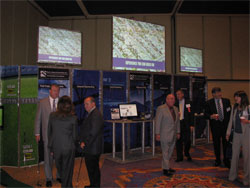
| Event exhibitors and sponsors contribute to an informative and engaging environment |
This year’s meeting was the best yet for the industry-leading construction defect and claims event.
This year’s seminar concluded on May 13, 2011 with the Construction Defect Community Charitable Foundation Golf Tournament, held at Strawberry Farms Golf Course.
The Disneyland Hotel in Anaheim, California was the place where more than 1,500 attendees convened for two days of professional development activities and seminars that included CLE workshops and panel discussions of special interest to legal and insurance professionals concerned with construction defect and claims litigation. Key events included “Challenges for Experts in Construction Defect Claims and Litigation,” “Keeping Up with Construction Defect Coverage,” and “Tips for Avoiding the ‘Perfect Storm’ in Handling of Wrap Claims.”
 |
| Supporting the golf tournament at the 15th hole |
This year’s Ollie award was given to George D. Calkins II, Esq. The West Coast Casualty Jerrold S. Oliver Award of Excellence was named in honor of the late Judge Jerrold S. Oliver, and recognizes an individual who is outstanding or has contributed to the betterment of the construction community.
In addition to being the most comprehensive professional development seminar in the area of construction defects, this year’s seminar was equally valuable as a networking opportunity for members of the industry. People participated in professional development events during the day and then continued networking in the evening at numerous social events. The Lawn Party as well as the legendary Wood, Smith, Henning & Berman events were very well attended. Additional valuable networking events were hosted by a number of industry professionals at the House of Blues, and Tortilla Joe’s.
As of this writing the 2011, West Coast Casualty's Construction Defect Seminar has applied for or has already received the following continuing education accreditation in the following areas;
Read the full story…
For more information about next year’s event, visit West Coast Casualty.
Hilton Grand Vacations Defect Trial Delayed
October 23, 2012 — CDJ Staff
A settlement agreement between Conti Electric and Westgate Resorts has lead to a delay in starting the trial over construction defect claims and billing disputes over Hilton Grand Vacations a time share tower in Las Vegas. According to the Las Vegas Review-Journal, the dispute includes claims of $23.3 million owed to the general contractor against which the developer has placed $30 million in construction defect claims.
Read the full story…
High School Gym Closed by Construction Defects
October 28, 2011 — CDJ Staff
The high school gym in Lake Oswego, Oregon has been shut down because testing has revealed that the construction defects have lead to deterioration of the structural integrity of the roof. The school district noted that there was a chance of collapse if there were a “significant seismic event or heavy rain and winds and snow.” The school district has been in a lawsuit with the builders since 2008, which was recently settled for $600,000.
The school board is still determining whether the original contractor will be asked to correct the defect or if they will bid the job out.
Read the full story...
Georgia Law: “An Occurrence Can Arise Where Faulty Workmanship Causes Unforeseen or Unexpected Damage to Other Property”
March 5, 2011 — By
CDCoverage.com, March 5, 2011
In American Empire Surplus Lines Ins. Co. v. Hathaway Development Co., Inc., No. S10G0521 (Ga. March 7, 2011), insured plumbing subcontractor Whisnant was sued by general contractor Hathaway seeking damages for costs incurred by Hathaway in repairing damage to property other than Whisnant’s plumbing work resulting from Whisnant’s negligently performed plumbing work on three separate projects. On one project, Whisnant installed a pipe smaller
Read the full story...Reprinted courtesy of CDCoverage.com
Insurer Has Duty to Defend in Water Intrusion Case
July 10, 2012 — CDJ Staff
The Seventh Circuit Court of Appeals has upheld a summary judgment against an insurance company in a construction defect suit. Lagestee-Mulder, Incorporated (LMI) was hired by Crown Centre to construct a multi-story office building in Franfort, Illinois. LMI hired Frontrunner Glass & Metal to supply and install windows and doors. Frontrunner purchased an insurance policy from Consolidated which named LMI as an additional insured. The project experienced water intrusion and other construction defects and Crown sued LMI. Consolidated denied coverage. LMI sued Consolidated and the US District Court granted a summary judgment against Consolidated.
The appeals court reviewed the grounds for summary judgment and determined that under Illinois law, Consolidated had a duty to defend. The court cited an earlier opinion that “if the underlying compliant alleges facts within or potentially within policy coverage, an insurer is obligated to defend its insured even if the allegations are groundless, false, or fraudulent.”
Read the court’s decision…
Colorado Court of Appeals holds that insurance companies owe duty of prompt and effective communication to claimants and repair subcontractors
March 1, 2011 — Courtesy
Colorado Construction LitigationIn Dunn v. American Family Insurance, 09CA2173, 2010 WL 4791948 (Colo. App. Nov. 24, 2010), the Dunns reported a claim to American Family on their homeowners insurance policy after sewer and water backup caused sewage to flood their basement. American Family gave the Dunns contact information for a contractor (ICA) to remediate the flooding. However, ICA was unsuccessful and sewage began to infiltrate the Dunns’ HVAC system. Subsequently, black mold was detected in the HVAC system, the Dunns suffered health and respiratory problems, and they soon after vacated the home. The Dunns hired and fired two more contractors for unsatisfactory work throughout the winter before hiring a fourth to finish the job. Because the home remained vacant and unheated throughout the winter, the water pipes ruptured. The mold spread throughout the entire home and all of the contents needed to be replaced, which amounted to a claim of $340,000 on the policy.
American Family agreed to pay the full $340,000. However, the Dunns brought suit claiming that American Family breached the implied duty of good faith and fair dealing by: 1) failing to screen ICA for expertise; 2) failing to screen ICA for liability insurance coverage; 3) failing to monitor ICA’s work; 4) failing to advise them that flooding can cause further damage, including freezing pipes and mold; and, 5) failing to adequately and promptly communicate with them and remediation subcontractors in the course of investigating and handling their claim.The trial court found no duty owed by American Family beyond adjustment and timely payment of claims. Because American Family paid timely and in full, they dismissed all of the Dunns’ claims. However, the Court of Appeals reversed in part.
Read the full story...
Reprinted courtesy of Chad Johnson, Higgins, Hopkins, McLain & Roswell, LLC. Mr. Johnson can be contacted at johnson@hhmrlaw.com
Safer Schools Rendered Unsafe Due to Construction Defects
February 10, 2012 — CJD Staff
Built on a program for safer school buildings, schools in Neenan County, Colorado have been shown to have mild-to-moderate structural problems, rendering some of them unsafe. The Denver Post reports that a third-party review of schools built by the Neenan Company has shown structural issues in all fifteen school buildings.
One school, Meeker Elementary, has been closed as it could collapse under high winds or during an earthquake. Sargent Junior-Senior High School is in use, but there are plans to evacuate the buildings if winds exceed 25 mile per hour. Two schools have roofs that are unable to bear expected loads of snow during the winter.
The Neenan Company says that the school buildings are not up to their standards and is working with the school districts to repair the buildings. Repairs are expected to be complete by August.
Read the full story…
Unit Owners Have No Standing to Sue under Condominium Association’s Policy
February 10, 2012 — Tred Eyerly, Insurance Law Hawaii
If a condominium owner suffers damage caused by a leak from another unit, may it sue the insurer for the Association of Apartment Owner (AOAO) for coverage? The federal district court for Hawaii said "no" in a decision by Judge Mollway. See Peters v. Lexington Ins. Co., 2011 U.S. Dist. LEXIS 148734 (D. Haw. December 27, 2011).
Two cases were consolidated. In each case, Plaintiffs owned condominium units at the Watercrest Resort on Molokai. Water leaking from another unit damaged Plaintiffs’ units.
Watercrest Resort was insured by Lexington pursuant to a policy maintained by the AOAO. Plaintiffs filed claims with Lexington. Lexington hired an adjustor.
Unhappy with the adjustment of their claims, Plaintiffs sued Lexington and the adjustor.
Read the full story…
Reprinted courtesy of Tred R. Eyerly, Insurance Law Hawaii. Mr. Eyerly can be contacted at te@hawaiilawyer.com
Colorado Court of Appeals Rejects Retroactive Application of C.R.S. § 13-20-808.
April 25, 2012 — Chad W. Johnson, Higgins, Hopkins, McClain & Roswell, LLC
In TCD, Inc. v. American Family Mutual Insurance Company, TCD appealed the district court’s summary judgment ruling in favor of American Family. TCD, Inc. v. American Family Mutual Insurance Company Colo. App. No. 11CA1046 (April 12, 2012). TCD was the general contractor on a project to construct a building for Frisco General Gateway Center, LLC (“Gateway”). TCD subcontracted with a roofer named Petra Roofing and Remodeling Company (“Petra”) to performing the roofing work for the building. The subcontract required Petra to defend and indemnify TCD and to name TCD as an additional insured under its CGL policy. American Family issued a CGL policy to Petra that named TCD as an additional insured from 2006-2007.
TCD filed suit against Gateway seeking payment for its work at the project. Gateway counterclaimed against TCD for breach of contract, negligence, and violation of the CCPA. TCD demanded that American Family defend it from the counterclaims pursuant to Petra’s policies. American Family denied coverage and a separate coverage suit ensued. At the trial court level, the court entered summary judgment for American Family because the counterclaims of Gateway did not trigger the duty to defend or indemnify TCD as an additional insured.
On appeal, TCD argued that: 1) the counterclaims raise a genuine issue of material fact regarding American Family’s duty to defend; 2) the court should hear evidence beyond the four corners of the complaint; and, 3) the court should apply C.R.S. § 13-20-808 retroactively.
Read the full story…Reprinted courtesy of Chad W. Johnson of Higgins, Hopkins, McClain & Roswell, LLC. Mr. Johnson can be contacted at johnson@hhmrlaw.com.
A Call to Washington: Online Permitting Saves Money and the Environment
October 28, 2011 — Douglas Reiser, Builders Counsel
Here’s some good news for Oregon contractors: Electronic Permitting is here. That’s right, no more standing in line with folders full of printed submittals and waiting all day for your permit. The click of a few buttons and you are in business. Great news, right? Unfortunately, Oregon isn’t sharing that celebration with Washington. So I say - why not?
Last week, the State of Oregon released its new ePermitting online interface. The website allows contractors, owners and even local building departments to create an account, submit building plans and procure permits. With your account, you can track the progress of submissions, print documents and get posting information.
The state ran a limited test version in the City of Florence since 2009, working out the kinks. Perhaps the most impressive result of the new system is that Oregon tackled the task of coagulating a local process into one central location.
Read the full story...
Reprinted courtesy of Douglas Reiser of Reiser Legal LLC. Mr. Reiser can be contacted at info@reiserlegal.com
Geometrically Defined Drainage Cavities in EIFS as a Guard Against Defects
July 10, 2012 — CDJ Staff
The blog Stucco & Insulation Contractor writes up some details on a “relatively new modification to modern Exterior Insulation Finish Systems,” known as “geometrically defined insulation boards.” They note that the insulation has grooves cut in the back to provide a route for water to drain, instead of getting trapped. They note that when EIFS is installed by a skilled applicator, this is unnecessary. However, with less experienced (and cheaper) installers, problems are more likely.
By cutting these channels, the application of EIFS is rendered “idiot proof,” as they note. Their preference would be that EIFS installers take the time to do the job right, but call this “a step in the right direction.”
Read the full story…
Parking Garage Collapse May Be Due to Construction Defect
November 7, 2012 — CDJ Staff
A parking garage under construction at the Doral campus of Miami Dade College collapsed on October 9. Experts state that the collapse may have been due to errors in the construction process, either in the fabrication of the pre-cast components or in their assembly. The Bradenton Herald quotes Mark Santos, a structural engineer, who “would look at erection procedures ?Äì that’s probably the one question to ask first.”
During the failure, floors separated from the south wall of the structure. The contractor responsible for the garage, Ajax Building Corp, said there was “no indication of any potential cause.”
Read the full story…
Manhattan Developer Breaks Ground on $520 Million Project
November 18, 2011 — CDJ Staff
Rebuilding an area of Midtown West that has been condemned for decades, the Gotham Organization has broken ground on a 1,200-unit project that will include housing for a variety of household incomes and a school. One unit of the project will be affordable housing for families of annual incomes up to $40,000. Another will be for middle-income households. Additionally, there will be a 31-story tower with 550 luxury units.
The site CityBiz quotes Mayor Michael Bloomberg, as saying that the project “will grow our economy by creating 2,900 construction-related jobs.” The president of the Gotham Organization, David L. Picket notes that it will “create hundreds of new jobs, generate millions of dollars in revenue for the construction industry, contribute towards the building of a new primary, and provide homes to thousands of New Yorkers.”
Read the full story…
Florida Property Bill Passes Economic Affairs Committee with Amendments
April 14, 2011 — April 14, 2011 Beverley BevenFlorez - Construction Defect Journal
The Florida Property Bill (HBB 803) was passed by the Economic Affairs Committee by a vote of 11-7, according to Property Casualty 360, after adopting nine new amendments. The additions to the bill included limiting notice of claims to a set number of years, extending the statute of limitation on property claims from five years to six years, among others.
HB 803 and SB 408, the Senate companion bill, focus primarily on residential property insurance. They make changes to the Florida Hurricane Catastrophe Fund, while also promoting increased notification of policy changes to policyholders. Sections of the bills provide minor fixes such as renaming Citizens Property Insurance Corporation to Taxpayer-Funded Property Insurance Corporation. However, other sections of the bills contain more significant policy changes such as sinkhole coverage and hurricane claims.
The bills’ intent, according to the SunSentinel.com, is to reduce fraudulent claims and to bring new insurers into the insurance market. However, SunSentinel.com also reports that the bills may drastically increase property insurance premiums.
Read the full Property Casualty 360 article...
Read the full Sun Sentinel article...
Illinois Court Determines Insurer Must Defend Negligent Misrepresentation Claim
December 9, 2011 — Tred R. Eyerly, Insurance Law Hawaii
Although the insureds disclosed flooding problems in the basement, the buyers purchased their home. USAA Cas. Ins. Co. v. McInerney, 2011 Ill. App. LEXIS 1130 (Ill Ct. App. Oct. 31, 2011). In a supplemental disclosure, the insureds reported that during heavy rains light seepage occurred in the basement.
After moving in, the buyers experienced significant water infiltration and flooding in the basement. The buyers and their children also began to experience mold-related illnesses.
The buyers sued for rescission of the contract or, in the alternative, damages. They alleged breach of contract, fraudulent misrepresentation and negligent misrepresentation. In the claim for negligent misrepresentation, the buyers alleged that the insureds carelessly omitted the fact that there were material defects in the basement and foundation when they should have known of such defects.
Read the full story…
Reprinted courtesy of Tred R. Eyerly, Insurance Law Hawaii. Mr. Eyerly can be contacted at te@hawaiilawyer.com
Granting Stay, Federal Court Reviews Construction Defect Coverage in Hawaii
January 6, 2012 — Tred Eyerly, Insurance Law Hawaii
The federal district court ultimately stayed a construction defect case, but offered comments on the current status of coverage disputes for such defects in Hawaii. See National Union Fire Ins. Co. of Pittsburgh, Pa. v. Simpson Mfg. Co., 2011 U.S. Dist. LEXIS 128481(D. Haw. Nov. 7, 2011).
National Union filed a complaint for declaratory relief to establish it had no duty to defend or to indemnify Simpson Manufacturing Company in four actions pending in the Hawaii state courts. The state court actions concerned allegedly defective hurricane strap tie hold downs that were manufactured and sold by Simpson. The hurricane ties allegedly began to prematurely corrode and rust, causing cracking, spalling and other damage to homes.
National Union contended the underlying allegations did not constitute "property damage" caused by an "occurrence," as defined in the policies.
Read the full story…
Reprinted courtesy of Tred R. Eyerly, Insurance Law Hawaii. Mr. Eyerly can be contacted at te@hawaiilawyer.com
Exact Dates Not Needed for Construction Defect Insurance Claim
March 1, 2012 — CDJ Staff
The Texas Court of Appeals reversed the decision of the trial court in Vines-Herrin Custom Homes v Great American Lloyds Insurance Company on December 21, 2011. Vines-Herrin Custom Homes built a single-family home in Plano, Texas in 1999. They obtained a commercial general liability policy from Great American, later purchasing coverage from Mid-Continent, which the decision describes as “a sister company of Great American.”
While the home was under construction, Emil G. Cerullo sought to purchase it. At the time, it was under contract to another buyer. Two months later, Vines-Herrin told Cerullo that the deal had “fell through.” Cerullo bought the house with modifications from the original plan. Upon moving in, Cerullo began having water intrusion and other problems. “Cerullo noticed water gathering on window sills and damage to the sheetrock and baseboard.” Additional problems followed, including cracks, leaks, “and in early 2002, the ceiling and roof began to sag.”
Cerullo sued Vines-Herrin, claiming negligent construction. Vines-Herrin filed a claim seeking defense and indemnification under the insurance policies. Coverage was denied and Vines-Herrin filed suit to require coverage and also bringing claims for “breach of the duty of good faith and fair dealing, breach of contract, and DTPA and insurance code violations.”
In May, 2006 Vines-Herrin stated that it had no more defense funds and went into arbitration with Cerullo. The underlying construction defect action was settled for about $2.5 million. As part of the settlement, “Cerullo became the rightful owner of all remaining claims, rights, and causes of action against” Vines-Herrin’s insurers. He then joined the coverage lawsuit.
The non-jury trial was held under the controlling law of the time which “imposed a duty to defend only if the property damage manifested or became apparent during the policy period.” The court concluded in Cerullo’s favor. During the post-judgment motions, the Texas Supreme Court rejected the manifestation rule. Under this ruling, the trial court set aside its judgment and found in favor of the insurance companies. The trial court noted that although “the Residence was covered by an uninterrupted period of insurance (which began before the Residence was constructed) and that the damages to the Residence manifested during the uninterrupted period of insurance coverage,” “Mr. Cerullo failed to allege the date when actual physical damage to the property occurred.”
The first claim by Cerullo and Vines-Herrin was that the “Final Judgment” occurred in October 2004, and that all proceedings thereafter were void. The court rejected this as the “final judgment” is not “final for the purposes of an appeal unless it actually disposes of every pending claim and party or unless it clearly and unequivocally states that it finally disposes of all claims and all parties.” Despite the use of the word “final,” the trial court’s decision did not do this.
The second issue was the application of the Texas Supreme Court case Don’s Building Supply Inc. v. OneBeacon Insurance. In this case, framing rot due to defective stucco was not discovered until after the end of the policy period. The Supreme Court noted that “the key date is when injury happens, not when someone happens on it.”
The appeals court found that the trial court misapplied the Don’s Building Supply decision. Rather than an exact date, “so long as that damage occurred within the policy period, coverage was provided.” The appeals court noted that “Cerullo alleged the house was constructed in 1999 and he purchased it in May 2000.” “By April of 2001, Cerullo noticed that the windowsills in the study were showing signs of leakage and water damage.” As the court put it, “the petitions then alleged a litany of defects.”
The court noted that coverage by Great American was in effect from November 9, 1999 to November 9, 2000. In May of 2000, the house suffered “substantial flooding from a rainstorm that caused damage.” This was during the policy period. “As a matter of law, actual damages must occur no later than when they manifest.”
The court concluded that as damage manifested during the period of coverage, so must have the damage. The court ruled that “contrary to the trial court’s determination otherwise, the evidence showed Great American’s duty to indemnify was triggered, and expert testimony establishing the exact date of injury was not required to trigger the duty.”
Read the court’s decision…
History of Defects Leads to Punitive Damages for Bankrupt Developer
March 1, 2012 — CDJ Staff
The South Carolina Court of Appeals has ruled that evidence of construction defects at a developer’s other projects were admissible in a construction defect lawsuit. They issued their ruling on Magnolia North Property Owners’ Association v. Heritage Communities, Inc. on February 15, 2012.
Magnolia North is a condominium complex in South Carolina. The initial builder, Heritage Communities, had not completed construction when they filed for bankruptcy protection under Chapter 11. The remaining four buildings were completed by another contractor. The Property Owners’ Association subsequently sued Heritage Communities, Inc. (HCI) alleging defects. The POA also sued Heritage Magnolia North, and the general contractor, BuildStar.
The trial court ruled that all three entities were in fact one. On appeal, the defendants claimed that the trial court improperly amalgamated the defendants. The appeals court noted, however, that “all these corporations share officers, directors, office space, and a phone number with HCI.” Until Heritage Communities turned over control of the POA to the actual homeowners, all of the POA’s officers were officers of HCI. The appeals court concluded that “the trial court’s ruling that Appellants’ entities were amalgamated is supported by the law and the evidence.”
Heritage also claimed that the trial court should not have allowed the plaintiffs to produce evidence of construction defects at other Heritage properties. Heritage argued that the evidence was a violation of the South Carolina Rules of Evidence. The court cited a South Carolina Supreme Court case which made an exception for “facts showing the other acts were substantially similar to the event at issue.” The court noted that the defects introduced by the plaintiffs were “virtually identical across all developments.” This included identical use of the same products from project to project. Further, these were used to demonstrate that “HCI was aware of water issues in the other projects as early as 1998, before construction on Magnolia North had begun.”
The trial case ended with a directed verdict. Heritage charged that the jury should have determined whether the alleged defects existed. The appeals court noted that there was “overwhelming evidence” that Heritage failed “to meet the industry standard of care.” Heritage did not dispute the existence of the damages during the trial, they “merely contested the extent.”
Further, Heritage claimed in its appeal that the case should have been rejected due to the three-year statute of limitations. They note that the first meeting of the POA was on March 8, 2000, yet the suit was not filed until May 28, 2003, just over three years. The court noted that here the statute of limitation must be tolled, as Heritage controlled the POA until September 9, 2002. The owner-controlled POA filed suit “approximately eight months after assuming control.”
The court also applied equitable estoppel to the statute of limitations. During the time in which Heritage controlled the board, Heritage “assured the unit owners the construction defects would be repaired, and, as a result, the owners were justified in relying on those assurances.” Since “a reasonable owner could have believed that it would be counter-productive to file suit,” the court found that also prevented Heritage from invoking the statute of limitations. In the end, the appeals court concluded that the even apart from equitable tolling and equitable estoppel, the statute of limitations could not have started until the unit owners took control of the board in September, 2002.
Heritage also contested the jury’s awarding of damages, asserting that “the POA failed to establish its damages as to any of its claims.” Noting that damages are determined “with reasonable certainty or accuracy,” and that “proof with mathematical certainty of the amount of loss or damage is not required,” the appeals court found a “sufficiently reasonable basis of computation of damages to support the trial court’s submission of damages to the jury.” Heritage also claimed that the POA did not show that the damage existed at the time of the transfer of control. The court rejected this claim as well.
Finally, Heritage argued that punitive damages were improperly applied for two reasons: that “the award of punitive damages has no deterrent effect because Appellants went out of business prior to the commencement of the litigation” and that Heritages has “no ability to pay punitive damages.” The punitive damages were upheld, as the relevant earlier decision includes “defendant’s degree of culpability,” “defendants awareness or concealment,” “existence of similar past conduct,” and “likelihood of deterring the defendant or others from similar conduct.”
The appeals court rejected all of the claims made by Heritage, fully upholding the decision of the trial court.
Read the court’s decision…