Orange County Home Builder Dead at 93
April 25, 2012 — CDJ Staff
Randall E. Presley was a homebuilder in Southern California for more than thirty years, acting as head of Presley Development Company from 1956 until selling the firm to Lyon Homes in 1987. The two companies merged in 1991 as the Presley Cos. Mr. Presley saw the need in the 1950s to provide people in Southern California with low- to medium-priced quality homes.
�His firm built more than 160 communities and was among the ten largest homebuilding firms in the country, expanding beyond California. Mr. Presley was 93 when he succumbed to pneumonia. He is survived by a wife, three children, seven grandchildren, and 11 great-grandchildren.
� Read the full story…
�
Nevada Construction Defect Lawyers Dead in Possible Suicides
March 28, 2012 — CDJ Staff
A number of news sources have reported on the recent death of Nevada construction defect attorney, Nancy Quon. Ms. Quon was implicated in a recent scandal in which a group conspired to control homeowner associations in order to divert construction defect lawsuits to the members of the conspiracy.
�Ms. Quon was found dead in her bathtub. The details are still under investigations. She and her boyfriend were accused of a failed arson/suicide scheme in 2010. Ms. Quon survived an attempt to burn down her home. Subsequently, her boyfriend obtained some gamma-hydroxybutyric acid (GBH) for her, as part of another failed suicide attempt.
�Subsequent to Ms. Quon’s death, David Amesbury was found in California dead by hanging. Mr. Amesbury took a plea deal in the case, and he had admitted his role in providing legal and construction contracts to firms in the conspiracy. He was accused of fixing HOA elections.
Read the full story…
�Read the full story…
�Read the full story…
�Read the full story…
Time to Repair Nevada’s Construction Defect Laws?
February 10, 2012 — CDJ Staff
The Builders Magazine writes that during the previous session of the Nevada legislature, reforms sought by the building industry were stopped by the Speaker of the Nevada Assembly. The new session brings a new speaker and new hope for construction defect reform in Nevada.
� Pat Hickey, a member of the Assembly and a small business owner told The Builders Magazine that “we need to apply pressure on the legislators to fix the law.” He also recommended that people “go to Governor Sandoval and ask for his help.” Builders seeks legislation that will include right to repair and it should “define construction defect in such a way that it allows for a fair process.”
Read the full story…
Exclusions Bar Coverage for Damage Caused by Chinese Drywall
July 5, 2011 —
Tred R. Eyerly,
Insurance Law HawaiiThe insured homeowners were unsuccessful in arguing around the policy's exclusions when seeking coverage for damage caused by Chinese drywall. Ross v. C. Adams. Constr. & Design, L.L.C., 2011 La. App. LEXIS 769 (La. Ct. App. June 14, 2011).
�Before the insureds purchased and moved into their home, it was renovated. After moving in, the insures discovered foreign gypsum drywall, or Chinese drywall. The insureds submitted a claim to Louisiana Citizens Property Insurance Company. In an investigation, the insurer confirmed the presence of Chinese drywall and damage to the metal surfaces caused by corrosion. Louisiana Citizens refused coverage and the insureds sued. The trial court denied the insured's motion for summary judgment and granted summary judgment to Louisiana Citizens.
�The court of appeal affirmed. Initially, the court determined the insureds sustained a direct physical loss. The inherent qualities of the Chinese drywall created a physical loss to the home and required that the drywall be removed and replaced.
�Four exclusions, however, barred coverage. First, damages due to faulty or defective materials were excluded from coverage. The Chinese drywall emitted high levels of sulfuric gas which caused the damage to the insured's plumbing, electrical wiring and metal components.
� Read the full story…
� �Reprinted courtesy of Tred R. Eyerly, Insurance Law Hawaii. Mr. Eyerly can be contacted at te@hawaiilawyer.com
Another Las Vegas Tower at the Center of Construction Defect Claims
November 7, 2012 — CDJ Staff
Accusations are coming from both sides over construction defects at a Las Vegas tower, only this time, it’s not the Harmon Towers, it’s Hilton Grand Vacations, which is part of the Planet Hollywood Resort. The project was originally dubbed PH Towers Westgate, and it was developed by Westgate Resorts, which is suing the contractor, Tutor-Saliba for $10 million over late completion and construction defects.
Among the defects Westgate is claiming are cracked floor tiles in the valet lobby and cracks and delamination of the pool deck. Tutor-Saliba argues that the failure of the valet lobby floor is due to Westgate specifying only 1/16th inch-wide grouting, instead of the specified ¬º inch, and Westgate’s refusal to allow expansion joints on the pool deck has lead to problems there. Westgate’s attorney, Robert Schumacher, attributes the problems to “shoddy construction practices.”
According to the article in the Las Vegas Review Journal, plans were only 60 percent complete when construction began, leading to “thousands of change orders.” Despite not meeting an August completion deadline, Tutor-Saliba is claiming it is owed a $1.5 million bonus nevertheless.
Read the full story…
Water District Denied New Trial in Construction Defect Claim
August 16, 2012 — CDJ Staff
The United District Court in Tampa, Florida has rejected the motion by Tampa Bay Water for a new trial in their claims that HDR Engineering negligently designed the C.W. Bill Young Regional Reservoir. The claims went to a jury trial, at the end of nineteen days, the jury deliberated for four hours, finding for HDR Engineering. In rejecting Tampa Bay’s motion, the judge noted that “on close examination, TBW’s contentions have little to do with the factual determinations of the jury, which evidently concluded that TBW did not meet its burden of proof, an unsurprising conclusion, considering HDR’s evidence and the weaknesses in TBW’s evidence.”
The court cited an earlier decision that “a new trial may be granted where the jury’s ‘verdict is against the great, not merely the greater weight of the evidence.’” However, the court found that the jury’s verdict “was well supported by the evidence” and that “TBW’s case showed signs of weakness at virtually every turn.” TBW’s expert “changed his opinion late in the case concerning the culpability of the contractor.” As a result, “Brumund’s change in opinions effectively bolstered HDR’s faulty construction defense.”
TBW also raised claims a pre-trial order prevented it “from introducing evidence that HDR did not fulfill its contractual quality control responsibilities” and that evidentiary rulings prevented “TBW from introducing evidence concerning quality control.” However, TBW dismissed its claims over quality control, then “attempted no less than three times during ?Ķ testimony to introduce evidence of the purpose of the quality control requirement and quality control assurance.”
TBW also contended “that it was precluded from introducing evidence that HDR’s inspectors never reported that the protective layer exceeded three feet after inspecting the work as part of HDR’s quality control duties.” The court noted that “TBW asked these very questions of HDR’s Engineer of Record.” The court also found that testimony regarding photographs of the construction was properly excluded as TBW never entered the photos into evidence.
TBW had made an argument for a jury view. Prior the trial “after discussion, and to their credit, the parties agreed to a jointly-prepared helicopter ‘flyover’ video.” The court noted that “the size and physical characteristics of the reservoir were adequately and effectively depicted in the video.” The hazards the jury did not, then, have to encounter included the narrow, unpaved rim of the reservoir, snakes, and alligators.
Read the court’s decision…
Sometimes It’s Okay to Destroy Evidence
August 17, 2011 — CDJ Staff
The Minnesota Supreme Court has ruled in the case of Miller v. Lankow that Mr. Miller was within his rights to remediate his home, even though doing so destroyed the evidence of water intrusion.
�Linda Lankow built a home in 1992. In 2001 or 2002, Lankow discovered a stucco problem at the garage which she attributed to moisture intrusion. She asked the original contractor to fix the wall. In 2003, Lankow attempted to sell her home, but the home inspection revealed fungal growth in the basement. Lankow made further repairs, including alterations to the landscaping.
�In 2004, Lankow put her house on the market once again and entered into an agreement with David Miller. Miller declined to have an independent inspection, as the home had been repaired by professional contractors.
�In 2005, Miller put the house on the market. A prospective buyer requested a moisture inspection. The inspection firm, Private Eye, Inc. found “significant moisture intrusion problems.”
�Miller hired an attorney who sent letters to the contractors and to Lankow and her husband. Lankow’s husband, Jim Betz, an attorney, represented his wife and sent a letter to Miller’s attorney that Miller had declined an opportunity to inspect the home.
�In 2007, Miller’s new attorney sent letters to all parties that Miller had decided to begin remediation work on the house. All stucco was removed. Miller then filed a lawsuit against the prior owners, the builders, and the realtors.
�Two of the contractors and the prior owners moved for summary judgment on the grounds that Miller had spoliated evidence by removing the stucco. They requested that Miller’s expert reports be excluded. The district court found for the defendants and imposed sanctions on Miller.
�The Minnesota Supreme court found that “a custodial party’s duty to preserve evidence is not boundless,” stating that “it may be particularly import to allow remediation in cases such as the one before us.” Their reasoning was that “remediation of the moisture intrusion problem in the home may be necessary, even essential, to address immediate health concerns.”
�Given that Miller needed to remediate the problem in order to continue living there, and that he had given the other parties a “full and fair opportunity to inspect,” the court found that he was within his rights. The court reversed the judgment of the lower court and remanded it to them for review.
Read the court’s decision…
One to Watch: Case Takes on Economic Loss Rule and Professional Duties
June 28, 2011 — Douglas Reiser, Builders Counsel
According to the Supreme Court of Washington Blog, The Supreme Court heard oral argument in Jackowski v. Hawkins Poe on Thursday, June 16, 2011. The court’s synopsis of the case can be found on the Washington State Court website.
�In short, two home purchasers brought a lawsuit against the home’s sellers, the sellers’ agent and the purchasers’ own agent, alleging claims of fraud, fraudulent concealment, negligent misrepresentation and breach of common law and statutory duties. The trial court dismissed the buyers’ claims on the basis of the economic loss doctrine and Division II reversed, opining that the ELR does not apply to professional duties. The Supreme Court will now look at applying the Independent Duty Doctrine established last year, and whether professional duties (those of the real estate agents) should be reviewed under a different light.
Read the full story…
�Reprinted courtesy of Douglas Reiser of Reiser Legal LLC. Mr. Reiser can be contacted at info@reiserlegal.com
Unlicensed Contractors Nabbed in Sting Operation
September 9, 2011 — CDJ Staff
The California State License Board charged sixteen people in the Fresno area with accepting contracting jobs without licenses. The Statewide Investigative Fraud Team of the CSLB set up a sting operation at a home in Clovis, California seeking bids on tree service, painting, and general contracting services. Those who bid for jobs at more than $500 are required under California law to be licensed. Unlicensed contractors can only work on jobs with a cost to the homeowner of less than $500 and must inform the homeowner that they are not licensed.
In addition to citing contractors for not possessing appropriate licenses, the CSLB also cited contractors for failure to carry workers compensation insurance and illegal advertising. Further, California law limits down payments to the lesser of ten percent or $1,000. Two contractors were cited for requesting excessive down payments.
One contractor, an unlicensed tree service contractor, had been cited previously in a sting operation. He failed to show up for his court date.
Read the full story…
Homeowners Sue Over Sinkholes, Use Cash for Other Things
January 6, 2012 — CDJ Staff
Quoting one homeowner as saying that his house “can fall in the ground for all I care, I made my money,” the Tampa Bay Times looks at the issue of sinkhole claims in Florida. Homeowners “have paid off mortgages, put in pools, replaced roofs, or otherwise used money from sinkhole claims to do something besides fix sinkhole damage.
It’s been tough for insurance companies. Citizens Property Insurance took in $32 million in premiums for sinkhole coverage in 2010, but paid out $245 million in sinkhole claims. The Tampa Bay Times notes that some of those claims come from settling problems caused by their repairs, including one settlement of $350,000 for repairs to a house worth $39,000.
One couple, after receiving $217,000 from Citizens, sold the house to a company that bought unrepaired sinkhole homes for $190,000. The home has been sold since and remains unrepaired.
Sometimes the preferred solution by the insurance company isn’t the cheapest either. One couple was informed that Citizens was going to spend $150,000 to have the hole filled with grout. After they settled with the insurance company, they fixed the problem by installing steel piers, at a cost of about $45,000.
Read the full story…
Hovnanian Sees Second-Quarter Profit, Points to Recovery
June 19, 2012 — CDJ Staff
Hovnanian Enterprises has shown a profit in the second quarter, which the company attributes to recovery in the homebuilding industry. Apart from a sales promotion in 2007, the company sold more homes per community in April than it has in any other month since 2006. Ara K. Hovnanian said that “the sales improvements we have experienced are fairly wide-based in terms of geography, price points and buyer profiles.”
The quarter’s profit was $1.8 million. In the year prior, Hovnanian faced losses of $72.7 million. The Wall Street Journal’s Marketwatch reported that Hovnanian’s stock price recently went up 19%.
Read the full story…
No Third-Quarter Gain for Construction
November 18, 2011 — CDJ Staff
The Associated Builders and Contractors released their analysis of construction work under contract and found that there was no increase in construction backlog from the second quarter of 2011. There was still improvement, however, over 2010, as the third quarter backlog is 16.3 percent higher than that of a year ago.
The current backlog is 8.1 months, which according to Anirban Basu, the chief economist of the ABC, “is consistent with flat construction spending.” He noted that less than 8 months indicated a decline.
Read the full story…
Construction Worker Dies after Building Collapse
November 18, 2011 — CDJ Staff
A Bronx construction worker died when the pillars gave way in the basement where he was working. The two-story commercial building collapsed, burying Mr. Kebbeh under about six feet of rubble. The New York Times reports that firefighters dug him out with their bare hands. Mr. Kebbeh was taken to Jacobi Medical Center where he died. Two other construction workers escaped unharmed.
Read the full story…
Supreme Court of Oregon Affirms Decision in Abraham v. T. Henry Construction, et al.
April 20, 2011 — April 20, 2011 Beverley BevenFlorez - Construction Defect Journal
After reviewing the decision in Abraham v. T. Henry Construction, et al., the Oregon Supreme Court affirmed that a tort claim for property damage arising from construction defects may exist even when the homeowner and the builder are in a contractual relationship.
�When the case was initially filed, the plaintiffs alleged breach of contract and negligence. The defendants moved for summary judgment arguing that one, the claim was barred by the six-year statute of limitations and two, no special relationship (such as one between a doctor and patient) existed. The court agreed with the defendants. However, the Court of Appeals while affirming the trial court’s decision on breach of contract reversed the decision on negligence. The Court of Appeals stated that an administrative or statute rule could establish a standard of care independent from the contract.
�The Oregon Supreme Court gave an example of cases where a tort claim could exist when a contract is present: “If an individual and a contractor enter into a contract to build a house, which provides that the contractor will install only copper pipe, but the contractor installs PVC pipe instead (assuming both kinds of pipe comply with the building code and the use of either would be consistent with the standard of care expected of contractors), that failure would be a breach of contract only. […] If the failure to install the copper pipe caused a reduction in the value of the house, the plaintiff would be able to recover that amount in an action for breach of contract. […] On the other hand, if the contractor installed the PVC pipe in a defective manner and those pipes therefore leaked, causing property damage to the house, the homeowner would have claims in both contract and tort. […] In those circumstances, the obligation to install copper instead of PVC pipe is purely contractual; the manner of installing the pipe, however, implicates both contract and tort because of the foreseeable risk of property damage that can result from improperly installed pipes.”
�Read the court’s decision…
Insurer Not Liable for Construction Defect Revealed by Woodpecker
September 13, 2012 — CDJ Staff
The Eighth Circuit Court of Appeals has ruled that an insurance provision that excluded construction defects must stand in Friedberg v. Chubb, granting a summary judgment to the insurance firm.
�The Friedbergs discovered extensive water damage to their home after a woodpecker drilled a hole in a vertical support. They sought insurance coverage under their Chubb “Masterpiece” policy. The decision quotes the policy as covering “all risk of physical loss” “unless stated otherwise or an exclusion applies.” These exclusions included “gradual or sudden loss,” “structural movement,” and “faulty planning, construction or maintenance,” but the policy covered “ensuing covered loss unless another exclusion applies.”
�Chubb’s expert determined that the Friedbergs’ home had defective construction, and “attributed the damage to the beams and walls below the beam to a failure to install control joints.” After Chubb denied coverage, the Friedbergs sued, although the court ruled that “even under the Friedbergs’ theory, the water damage was a loss caused by faulty construction and therefore excluded under the policy.”
�On appeal, the Friedbergs argued that “the loss resulted from the combination of both faulty construction and the presence of water” and that Minnesota’s “concurrent causation” doctrine must apply, which according to the decision, “when a loss results from both a covered peril and an excluded peril, coverage exists unless the excluded peril is the ‘overriding cause’ of the loss.” The court rejected this reasoning, noting that “once the house was plagued with faulty construction, it was a foreseeable and natural consequence that water would enter.”
�The Friedbergs also contended that “the damage caused by the intrusion of water into their home is an ‘ensuing covered loss’ for which they are due coverage.” The court also rejected this claim, noting that Minnesota law excludes defective construction from the ensuing loss provision. The court said that “the Friedbergs’ reading of their ensuing-loss clause, by contrast, would dramatically limit their policy’s faulty-construction exclusion, because almost ‘any loss cause by’ faulty construction could also be characterized as an ensuing loss under an all-risk policy.”
Read the court’ decision…
Nevada Assembly Bill Proposes Changes to Construction Defect Litigation
April 14, 2011 — April 14, 2011 Beverley BevenFlorez - Construction Defect Journal
Assemblyman John Oceguera has written a bill that would redefine the term Construction Defect, set statutory limitations, and force the prevailing party to pay for attorney’s fees. Assembly Bill 401 has been referred to the Committee on Judiciary.
�Currently, the law in Nevada states that “a defect in the design, construction, manufacture, repair or landscaping of a new residence, of an alteration of or addition to an existing residence, or of an appurtenance, which is done in violation of law, including in violation of local codes or ordinances, is a constructional defect.” However, AB401 “provides that there is a rebuttable presumption that workmanship which exceeds the standards set forth in the applicable law, including any applicable local codes or ordinances, is not a constructional defect.”
�The Nevada courts may award attorney fees to the prevailing party today. However, AB401 mandates that attorney fees must be awarded, and the exact award is to be determined by the Court. “(1) The court shall award to the prevailing party reasonable attorney’s fees, which must be an element of costs and awarded as costs; and (2) the amount of any attorney’s fees awarded must be determined by and approved by the court.”
�AB401 also sets a three year statutory limit “for an action for damages for certain deficiencies, injury or wrongful death caused by a defect in construction if the defect is a result of willful misconduct or was fraudulently concealed.”
�This Nevada bill is in the early stages of development.
�Read the full story...
Geometrically Defined Drainage Cavities in EIFS as a Guard Against Defects
July 10, 2012 — CDJ Staff
The blog Stucco & Insulation Contractor writes up some details on a “relatively new modification to modern Exterior Insulation Finish Systems,” known as “geometrically defined insulation boards.” They note that the insulation has grooves cut in the back to provide a route for water to drain, instead of getting trapped. They note that when EIFS is installed by a skilled applicator, this is unnecessary. However, with less experienced (and cheaper) installers, problems are more likely.
By cutting these channels, the application of EIFS is rendered “idiot proof,” as they note. Their preference would be that EIFS installers take the time to do the job right, but call this “a step in the right direction.”
Read the full story…
2011 West Coast Casualty Construction Defect Seminar – Recap
June 1, 2011 — CDJ Staff
� 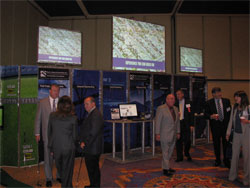 | �
�| Event exhibitors and sponsors contribute to an informative and engaging environment | �
�This year’s meeting was the best yet for the industry-leading construction defect and claims event.
�This year’s seminar concluded on May 13, 2011 with the Construction Defect Community Charitable Foundation Golf Tournament, held at Strawberry Farms Golf Course.
�The Disneyland Hotel in Anaheim, California was the place where more than 1,500 attendees convened for two days of professional development activities and seminars that included CLE workshops and panel discussions of special interest to legal and insurance professionals concerned with construction defect and claims litigation. Key events included “Challenges for Experts in Construction Defect Claims and Litigation,” “Keeping Up with Construction Defect Coverage,” and “Tips for Avoiding the ‘Perfect Storm’ in Handling of Wrap Claims.”
� �  | �
�| Supporting the golf tournament at the 15th hole | �
�This year’s Ollie award was given to George D. Calkins II, Esq. The West Coast Casualty Jerrold S. Oliver Award of Excellence was named in honor of the late Judge Jerrold S. Oliver, and recognizes an individual who is outstanding or has contributed to the betterment of the construction community.
�In addition to being the most comprehensive professional development seminar in the area of construction defects, this year’s seminar was equally valuable as a networking opportunity for members of the industry. People participated in professional development events during the day and then continued networking in the evening at numerous social events. The Lawn Party as well as the legendary Wood, Smith, Henning & Berman events were very well attended. Additional valuable networking events were hosted by a number of industry professionals at the House of Blues, and Tortilla Joe’s.
�As of this writing the 2011, West Coast Casualty's Construction Defect Seminar has applied for or has already received the following continuing education accreditation in the following areas;
�Read the full story…
�For more information about next year’s event, visit West Coast Casualty.