Nevada Supreme Court Reverses Decision against Grader in Drainage Case
June 30, 2011 — CDJ Staff
The Nevada Supreme Court has issued an opinion in the case of Rayburn Lawn & Landscape Designers v. Plaster Development Corporation, reversing the decision of the lower court and remanding the case for a new trial.
�The case originated in a construction defect suit in which Plaster Development Corporation was sued by homeowners. Plaster filed a third-party complaint against its subcontractor, Reyburn. The testimony of Reyburn’s owner was considered to be admission of liability and so the court limited the scope of Reyburn’s closing argument and did not allow the jury to determine the extent of Reyburn’s liability. Reyburn appealed.
�Plaster, in their case, cited California’s Crawford v. Weather Sheild MFG, Inc. The court held the application of these standards, but noted that the “an indemnitor’s duty to defend an indemnitee is limited to those claims directly attributed to the indemnitor’s scope of work and does not include defending against claims arising from the negligence of other subcontractors and the indemnittee’s own negligence.”
�On the matter of law against Reyburn, the court concluded, “Given the conflicting evidence at trial as to whether Reyburn’s work was implicated in the defective retaining walls and sidewalls, and viewing the evidence and inferences in Reyburn’s favor, we conclude that a reasonable jury could have granted relief in favor of Reyburn.” The Nevada Supreme Court conduced that the district court should not have granted Plaster’s motion for judgement.
�Further, the Nevada Supreme Court found that the district court should have apportioned the fees and costs to those claims directly attributed to Reyburn’s scope of work, “if any,” and should not have assigned all attorney costs and court fees to Reyburn.
� Read the court’s decision…
There Is No Non-Delegable Duty on the Part of Residential Builders in Colorado
August 16, 2012 — Brady Iandiorio, Higgins, Hopkins, McLain & Roswell, LLC
Recently, in the Arapahoe District Court, the Honorable Michael Spear, issued an order holding that builders do not owe a non-delegable duty to homeowners. In Marx and Corken v. Alpert Custom Homes, Inc., et al., Judge Spear’s order came in response to plaintiffs’ motion for determination of question of law seeking a finding that the defendants owed a non-delegable duty to the plaintiffs and thus, to strike defendants’ designation of nonparties at fault. After being fully briefed, Judge Spear, found that such a non-delegable duty does not exist.
The case arises from the construction of a single-family residence in Aurora, Colorado. Through the construction and interaction with Alpert Custom Homes, Inc. and Scott and Sally Alpert, the defendants, Paul Marx and Kay Corken, the plaintiffs claimed they suffered various damages and losses, and brought claims for breach of contract-warranty, breach of contract, violation of the Colorado Consumer Protection Act, breaches of the implied covenant of good faith, promissory estoppel, willful breach of contract, and quantum meruit. During litigation, the defendants filed a designation of nonparties at fault, which named several parties which were at fault for the alleged construction defects at issue in the case.
Read the full story…
Reprinted courtesy of Brady Iandiorio, Higgins, Hopkins, McLain & Roswell, LLC. Mr. Iandiorio can be contacted at iandiorio@hhmrlaw.com
Is Construction Heading Off the Fiscal Cliff?
December 20, 2012 — CDJ Staff
After a period of growth, the construction industry lost 20,000 jobs in November, based on the federal jobs data. Damon Scott of New Mexico Business Weekly suggests that contractors may have laid off employees in anticipation of the “fiscal cliff.” Ken Simpson, the chief economist of the National Association of Home Builders said in a press release that “it is discouraging that construction employment is still struggling after three years of expansion in the overall economy.”
Read the full story…
Insurer Not Liable for Construction Defect Revealed by Woodpecker
September 13, 2012 — CDJ Staff
The Eighth Circuit Court of Appeals has ruled that an insurance provision that excluded construction defects must stand in Friedberg v. Chubb, granting a summary judgment to the insurance firm.
�The Friedbergs discovered extensive water damage to their home after a woodpecker drilled a hole in a vertical support. They sought insurance coverage under their Chubb “Masterpiece” policy. The decision quotes the policy as covering “all risk of physical loss” “unless stated otherwise or an exclusion applies.” These exclusions included “gradual or sudden loss,” “structural movement,” and “faulty planning, construction or maintenance,” but the policy covered “ensuing covered loss unless another exclusion applies.”
�Chubb’s expert determined that the Friedbergs’ home had defective construction, and “attributed the damage to the beams and walls below the beam to a failure to install control joints.” After Chubb denied coverage, the Friedbergs sued, although the court ruled that “even under the Friedbergs’ theory, the water damage was a loss caused by faulty construction and therefore excluded under the policy.”
�On appeal, the Friedbergs argued that “the loss resulted from the combination of both faulty construction and the presence of water” and that Minnesota’s “concurrent causation” doctrine must apply, which according to the decision, “when a loss results from both a covered peril and an excluded peril, coverage exists unless the excluded peril is the ‘overriding cause’ of the loss.” The court rejected this reasoning, noting that “once the house was plagued with faulty construction, it was a foreseeable and natural consequence that water would enter.”
�The Friedbergs also contended that “the damage caused by the intrusion of water into their home is an ‘ensuing covered loss’ for which they are due coverage.” The court also rejected this claim, noting that Minnesota law excludes defective construction from the ensuing loss provision. The court said that “the Friedbergs’ reading of their ensuing-loss clause, by contrast, would dramatically limit their policy’s faulty-construction exclusion, because almost ‘any loss cause by’ faulty construction could also be characterized as an ensuing loss under an all-risk policy.”
Read the court’ decision…
A Loud Boom, But No Serious Injuries in World Trade Center Accident
March 1, 2012 — CDJ Staff
The Wall Street Journal reports that nearly twenty tons of steel fell forty stories at the World Trade Center site on February 16. One person was checked by medical personnel. One person who works in the Financial District said it was “almost like thunder.” Frank Pensabene, one of the ironworkers on the site said that after “loud boom,” “all hell broke loose.” The steel beams and cables fell onto a flatbed truck, which was not occupied at the time.
Read the full story…
Nevada Court Adopts Efficient Proximate Cause Doctrine
February 10, 2012 — Tred Eyerly, Insurance Law Hawaii
Although the Nevada Supreme Court adopted the efficient proximate cause doctrine, it determined it did not apply to salvage coverage under an all-risk policy for a rain-damaged building. Fourth Street Place, LLC v. The Travelers Indemn. Co., 2011 Nev LEXIS 114 (Nev. Dec. 29, 2011).
� Fourth Street owned an office building which was insured by an all-risk policy issued by Travelers. Fourth Street hired Above It All Roofing to repair the roof of the office building. Above It All removed the waterproof membrane on the roof and prepared to replace the membrane the following week. Over the weekend, however, substantial rain hit. On Sunday, Above It All returned to cover the exposed portions of the roof with tarps, but wind later blew the tarps away. The building suffered significant interior damage as it continued to be exposed to the rain.
Read the full story…
� � � Reprinted courtesy of Tred R. Eyerly, Insurance Law Hawaii. Mr. Eyerly can be contacted at te@hawaiilawyer.com
2011 West Coast Casualty Construction Defect Seminar – Recap
June 1, 2011 — CDJ Staff
� 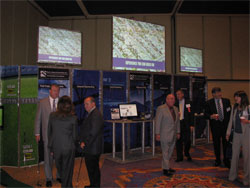 | �
�| Event exhibitors and sponsors contribute to an informative and engaging environment | �
�This year’s meeting was the best yet for the industry-leading construction defect and claims event.
�This year’s seminar concluded on May 13, 2011 with the Construction Defect Community Charitable Foundation Golf Tournament, held at Strawberry Farms Golf Course.
�The Disneyland Hotel in Anaheim, California was the place where more than 1,500 attendees convened for two days of professional development activities and seminars that included CLE workshops and panel discussions of special interest to legal and insurance professionals concerned with construction defect and claims litigation. Key events included “Challenges for Experts in Construction Defect Claims and Litigation,” “Keeping Up with Construction Defect Coverage,” and “Tips for Avoiding the ‘Perfect Storm’ in Handling of Wrap Claims.”
� �  | �
�| Supporting the golf tournament at the 15th hole | �
�This year’s Ollie award was given to George D. Calkins II, Esq. The West Coast Casualty Jerrold S. Oliver Award of Excellence was named in honor of the late Judge Jerrold S. Oliver, and recognizes an individual who is outstanding or has contributed to the betterment of the construction community.
�In addition to being the most comprehensive professional development seminar in the area of construction defects, this year’s seminar was equally valuable as a networking opportunity for members of the industry. People participated in professional development events during the day and then continued networking in the evening at numerous social events. The Lawn Party as well as the legendary Wood, Smith, Henning & Berman events were very well attended. Additional valuable networking events were hosted by a number of industry professionals at the House of Blues, and Tortilla Joe’s.
�As of this writing the 2011, West Coast Casualty's Construction Defect Seminar has applied for or has already received the following continuing education accreditation in the following areas;
�Read the full story…
�For more information about next year’s event, visit West Coast Casualty.
Contractors with Ties to Trustees Reaped Benefits from LA Community College Modernization Program
March 3, 2011 — Original reporting by Gale Holland, Michael Finnegan and Doug Smith, Los Angeles Times
In the latest installment of the “Billions To Spend” series of investigative reports focused on construction defects, management, and cost issues relevant to LACC’s Community College Modernization Projects, the LA Times examines the costs associated with the various layers of construction management and benefits that accrued to contractors with ties to LACC trustees.
�The reporting by the Times is seemingly critical of the project’s utilization of “body shops” an industry term for companies that function as employers of record. The article segment published today cites a number of circumstances wherein their utilization appears to have escalated costs substantially.
�“To gauge the cost of the staffing system, The Times reviewed thousands of pages of financial records from April 2007, when URS began managing the program, to July 2010. Reporters identified two dozen contractors serving as conduits for pay and benefits for employees they did not supervise.
�At least 230 people were employed in this manner, at a total cost of about $40 million, the records show.
�Approximately $18 million of the total was paid to the employees, according to the Times analysis. The remaining $22 million went to profit and overhead for contractors, the records indicate.
�For employees on its own payroll, the district says that medical and other benefits increase compensation costs 40% above base salaries. So if the district had employed its construction staff directly, the total cost for the period studied would have been $25 million instead of $40 million, a savings of $15 million, The Times calculated.”
�Read Full Story...
Insurance Firm Under No Duty to Defend in Hawaii Construction Defect Case
September 13, 2012 — CDJ Staff
The US District Court for Hawaii has granted a motion for summary judgment in Evanston Insurance v. Nagano. The case is related to a construction defect claim, Hu v. Nagano, and the issue at hand is whether Evanston Insurance is obligated to defend the Naganos in the underlying case.
�The Hus hired Eric Nagano and his firm PMX to construct a house. Mr. Nagano’s firm was insured by Evanston, however, he lost his contractor’s license in “approximately March 2006.” Mr. Nagano sought the Hus’ authorization to allow HC Builders to take over the contract. HC Builders is headed by Mr. Nagano’s wife, Hiroko, who has held a contractor’s license since “approximately September 2006.” Ms. Nagano and HC Builders were also insured by Evanston Insurance. The house, started by PMX was finished by HC Builders.
�The Hus authorized construction to begin in July 2003, but “construction did not commence until approximately October 2004 and, even after commencement, there were numerous delays resulting in months of inactivity on the Project.” The Hus had expressed to Mr. Nagano and PMX “that the construction period could not exceed twelve months after July 1, 2003.” As a result of the delays, “the Hus’ community association fined them because of the prolonged construction and the Hus’ construction lender assessed extension fees and fines for exceeding the term of the loan.”
�The Hus noted that the project did not have a licensed contractor from March through September 2006. In the end, the Hus “allege that Defendants did not fulfill the obligations under the Construction Contract,” and that “the Project was ‘grossly delayed’ and the construction was ‘riddled with defects.’” Despite an Owner’s Notice of Completion filed in December 2007, the residence “had no electricity, no hot water, ... no installed appliances” and “parts of the flooring were either missing or incomplete.” And then it leaked.
�The Naganos tendered the defense to Evanston. The Naganos “allege the defense is limited because Evanston: allowed default to be entered against the Naganos (the default was later set aside); delayed retaining experts; and limited the ability of the Naganos’ retained counsel to perform necessary actions to advance the case.” Evanston argues that it “does not have a duty to defend or indemnify Defendants against the Hus’ claims,” as the Hus’ claims are not covered under the policy. Further, the PMX policies have an exclusion for breach of contract.
�The court concluded that all of the claims made by the Hus were based in contract and therefore were outside of the terms of the Naganos insurance coverage, as the courts have "construed Hawaii law as not providing for insurance coverage for contract related claims." Therefore, Evanston does not have a duty to defend the Naganos.
Read the court’s decision…
After Katrina Came Homes that Could Withstand Isaac�
October 23, 2012 — CDJ Staff
In the aftermath of Hurricane Katrina, Louisiana adopted its first uniform building code. Under the new standards, homes are better able to withstand the winds generated by hurricanes. The owner of one home said that during Hurricane Isaac, “there’s no shaking of the building itself, there’s no sign of a storm except for the rain.”
�WWWLTV reports that the new standards require home to be able to withstand 130 mile per hour winds. They also must follow FEMA guidelines for elevation. Build Now, a non-profit organization, is seeking to build green homes that meet the new standards. Their executive director said “we’re building higher. We’re building stronger. We’re building greener.”
� Read the full story…
�
Can We Compel Insurers To Cover Construction Defect in General Liability Policies?
December 9, 2011 — Douglas Reiser, Builders Counsel
Recently, I read an article on Engineering News-Record that outlines a remarkable movement by as many as four states, to mandate coverage of construction defects in contractor general liability insurance policies. Say what? Is this a reality? What will become of affordable insurance?
Commercial General Liability insurance, or CGL, is your basic liability insurance. Every contractor doing business in the State of Washington, and most likely those abroad, has this insurance. Contractors buy this insurance to protect them from unforeseen liabilities arising from their negligence - and right now it’s reasonably affordable.
Why is it so affordable in such a risk-heavy industry? Because CGL policies significantly limit the scope of their coverage. Coverage is generally afforded for damages resulting from negligence (The roofer put a hammer through the drywall contractor’s wall) or which resulted from your defective construction (the roof leaked and flooded the rest of the house). But, that coverage does not include replacement of your faulty construction (the contents of the home might be protected by your leaky roof - the leaky roof itself is not).
The debate over coverage typically stems from the definition of “occurrence,” a term used to describe the event from which coverage arises, “resulting loss,” a term used to describe the type of loss covered.
Read the full story…
Reprinted courtesy of Douglas Reiser of Reiser Legal LLC. Mr. Reiser can be contacted at info@reiserlegal.com
Negligent Misrepresentation in Sale of Building Altered without Permits
September 30, 2011 — CDJ Staff
The Supreme Court of New Hampshire has ruled in the case Wyle v. Lees. The Leeses owned a two-unit apartment building in North Conway, New Hampshire. They hired a contractor to add a third, larger apartment, including a two-car garage. The Leeses and their contractor submitted a building permit application. They were informed that site plan review was required. After receiving approval on the site plan, construction started. At no point did they obtain a building permit and the construction was never inspected. The Leeses subsequently added more space to the unit, reducing parking spaces below the minimum required. Again, they did not obtain a building permit.
In 2007, three years after all these changes were complete, the Leeses sold their building to Mr. Wyle. To the question “are you aware of any modifications or repairs made without the necessary permits?” they answered “no.” About six weeks after closing, Wyle “received a letter from the town code enforcement officer regarding the legality of the removal of a garage door from the new unit.” A subsequent inspection revealed “numerous building and life safety code violations.”
Mr. Wyle brought a claim against the Leeses for negligent misrepresentation. The defendants filed a motion “seeking to preclude economic loss damages.” At a two-day bench trial, Mr. Wyle won. The Leeses appealed.
The appeals court found that “the defendants negligently misrepresented that the premises were licensed for immediate occupancy and that the defendants had obtained all necessary permits,” and thus upheld the lower court’s finding of negligent misrepresentation. The appeals court also rejected the Leeses’ argument that damages must be apportioned on all parties, including “the plaintiff himself, the plaintiff’s building inspector, and the defendant’s contractor,” finding a lack of “adequate evidence.”
The Leeses further argued that they were unaware that modifications and repairs were accomplished without the required permits. The appeals court noted that “the trial court found that both the conditional approval and final approval for the site plan stated that a building permit and a certificate of occupancy were required prior to any use.” The court concluded that the Leeses “knew or should have known of the falsity of their representation.”
The appeals affirmed the findings of the trial court.
Read the court’s decision…
Joinder vs. Misjoinder in Colorado Construction Claims: Roche Constructors v. One Beacon
July 10, 2012 — David McLain, Higgins, Hopkins, McLain & Roswell, LLC
Often, those practicing in the construction defect field have faced questions concerning the joinder of a party. Recently, the U.S. District Court for the District of Colorado weighed in on the requirements for joinder under the Colorado Rules of Civil Procedure. See Roche Constructors, Inc. v. One Beacon America Ins. Co., 2012 WL 1060000 (D. Colo. 2012). Roche secured a construction contract to build a detention facility for the Lincoln County Sheriff’s Office in Lincoln County, Nebraska. In turn, Roche entered into a subcontract with Dobberstein Roofing Company, Inc. in October 2009 to install the roofing system and other related work at the detention facility. The subcontract agreement required Dobberstein to maintain adequate commercial general liability insurance and to add Roche as an additional insured under the policy. Roche maintained a builder’s risk policy issued by OneBeacon America Insurance Company and Dobberstein secured a certificate of liability insurance underwritten by Transportation Insurance Company (“TIC”). Id. at *1.
Roche alleged that Dobberstein constructed the roofing system in a negligent manner in violation of the subcontract. Roche claims it incurred additional costs to repair structural damage to the roofing system as a result of Dobberstein’s negligent work. In order to cover said damage, Roche tendered insurance claims to OneBeacon and TIC.
Read the full story…
Reprinted courtesy of David McLain, Higgins, Hopkins, McLain & Roswell, LLC. Mr. McLain can be contacted at mclain@hhmrlaw.com
A Call to Washington: Online Permitting Saves Money and the Environment
October 28, 2011 — Douglas Reiser, Builders Counsel
Here’s some good news for Oregon contractors: Electronic Permitting is here. That’s right, no more standing in line with folders full of printed submittals and waiting all day for your permit. The click of a few buttons and you are in business. Great news, right? Unfortunately, Oregon isn’t sharing that celebration with Washington. So I say - why not?
Last week, the State of Oregon released its new ePermitting online interface. The website allows contractors, owners and even local building departments to create an account, submit building plans and procure permits. With your account, you can track the progress of submissions, print documents and get posting information.
The state ran a limited test version in the City of Florence since 2009, working out the kinks. Perhaps the most impressive result of the new system is that Oregon tackled the task of coagulating a local process into one central location.
Read the full story...
Reprinted courtesy of Douglas Reiser of Reiser Legal LLC. Mr. Reiser can be contacted at info@reiserlegal.com
West Coast Casualty Promises Exciting Line Up at the Nineteenth Annual Conference
March 28, 2012 — CDJ Staff
West Coast Casualty has announced the lineup for the annual WCC Construction Defect Seminar. This year’s seminar will be the nineteenth anniversary, and it will be held on May 17th and 18th, 2012 in Anaheim, California. They are the largest construction defect event in the world and this year’s seminar will again bring the top people in the field to address many of the current issues and where the construction defect community will be going in the future.
�The event, anticipated to be even larger than prior years, will have numerous panels and presentations on the current state of construction defect litigation. Among the topics that will be presented are “Arbitrate? Let’s See You Make Me!” “Defending Construction Defect Failure Mechanisms?An Expert’s Perspective,” and “Current Trends in Effectively Handling SB800 Cases.”
�Speakers at the event will include judges, lawyers, and representatives of the insurance industry. One event, “Meet Your Judges, A Candid Discussion on Construction Defect Claims and Litigation from the Bench?” will include judges from five states, including the Honorable Nancy M. Saitta, Chief Justice of the Nevada Supreme Court, the Honorable Clifton Newman of the South Carolina Circuit Court, and the Honorable Rex Heeseman of the Los Angeles County Superior Court.
�Daniel A. Berman, Esq. and Stephen Henning, Esq. will be talking on the topic of “Social Networking Sites: Strategies, Ethical Pitfalls, and Practice Pointers for Litigating and Winning Your Construction Defect Case.” Mr. Berman is a Founding and Managing Partner of Wood, Smith, Henning & Berman LLP. He has been named a Southern California Super Lawyer for eight consecutive years. Mr. Henning is a Founding Partner of Wood, Smith, Henning & Berman, LLP and Fellow of the Litigation Counsel of America. Mr. Henning will also be one of the presenters on the panel “Important Court Decisions Impacting Construction Defect Claims.”
�The panel “Why Do We Need to Know Certain Things and How Decisions Are Made” will be presented by important figures in the construction claims industry, including Phyllis Modlin, Todd Schweitzer, Teresa D. Wolcott, and Lee Wright. Ms. Modlin is a Construction Defect Claims Supervisor responsible for nationwide claims for Markel Corporation. Mr. Schweitzer is an Assistant Vice President of Major Case for Construction Defect and Professional Liability Claims Services at Zurich North America. Ms. Wolcott is the National Product Manager for Construction Defect Claims within the Construction Claims Organization at Travelers Insurance. Mr. Wright is an Assistant Vice President and Senior Claims Consultant for XL Specialty Insurance.
�The event will also include a Science and Technology Fair in which exhibitors will be presenting technological problem solving and decision making as they relate to resolving ongoing construction and post construction-defect related issues while reducing costs for all those involved in claims and litigation. The fair is dedicated to these novel applications of science and technology that benefit the construction defect community but are not yet commonly available. This will be the third time the Construction Defect Seminar will include a Science and Technology Fair.
�Sessions at the event are approved for MCLE credit in Arizona, California, Colorado, Illinois, Maine, Minnesota, New York, Ohio, and Pennsylvania. MCLE credits vary by state; attendees can obtain up to 10.25 hours of credit in Arizona, California, Maine, and New York. Applications for several other states are still pending. Additionally, the event is also worth continuing education credits with the Florida Department of Insurance and for Registered Professional Adjusters. West Coast Casualty has applications pending for adjuster continuing education in an additional thirty-six states.
�West Coast Casualty recommends this event for anyone involved in construction or construction defect claims, whether they are a claims adjuster, a member of a homeowner board, a judge, a property manager, a construction claims attorney, a general contractor, or anyone else with an interest in this area. The event typically has more than 1,600 attendees. Those interested can register online.
Read the full story…
Excess Carrier Successfully Appeals Primary Insurer’s Summary Judgment Award
December 9, 2011 — Tred R. Eyerly, Insurance Law Hawaii
Although the excess carrier was given inadequate notice of the underlying arbitration, the trial court determined it shared responsibility with the primary carrier for the arbitration award. Finding disputed issues of fact, the Washington Court of Appeals reversed in Am. States Ins. Co. v. Century Surety Co., 2011 Wash. App. LEXIS 2488 (Wash. Ct. App. Oct. 31, 2011).
The primary insurer, American States, issued two liability policies to Professional Home Builders (PHB), a siding contractor. The policies were for successive years, 1998-1999 and 1999-2000. Each policy had annual limits of $1 million per occurrence. PHB also had a commercial excess liability policy for 1999-2000 with Century Surety Company.
PHB was sued by Residential Investment Partners (RIP) for construction defects after moisture entered the building envelope, causing decay and damage. Century’s expert determined the decay started before the 1999-2000 policy period.
RIP and PHB went to arbitration.
Read the full story…
Reprinted courtesy of Tred R. Eyerly, Insurance Law Hawaii. Mr. Eyerly can be contacted at te@hawaiilawyer.com
Nevada District Court Dismisses Case in Construction Defect Coverage Suit
August 16, 2012 — CDJ Staff
The United States District Court of Nevada has dismissed a case filed by Maryland Casualty Company against National Fire & Marine Insurance Company. This case follows a case in which National was sued over “200 causes of action arising out of 193 separate insurance coverage disputes related to 75 different insureds and 163 unrelated construction defect or Chapter 40 proceedings across seven states.” The judge in this initial case severed the plaintiffs, as he found that allowing joinder “would make this case impossible to manage.” In this particular instance, National seeks to have the claims made by Maryland Casualty dismissed.
Maryland Casualty alleged that for insurance policies issued to 38 companies, National was obligated to defend the insured. National was, according to the plaintiff, named as defendants in 72 unrelated lawsuits to which National disclaimed coverage. However, the court found that Maryland Casualty failed “to provide enough detail regarding the relevant property damage, policies, claims, and time periods.” The court found that Maryland failed to “state a claim upoin which relief can be granted.
The court also found that “the Complaint lacks any well-pled allegations from which the Court could conclude the Plaintiff has standing since the Complaint is devoid of information about the specific policies at issue.
The court did allow Maryland Casualty up to September 3, 2012 in which to file an amended complaint.
Read the court’s decision…
Construction on the Rise in Washington Town
June 16, 2011 — CDJ Staff
The Kitsap Sun reports that Gig Harbor, a town in the area near Tacoma, Washington, has had a 60% increase in building permit applications as compared to 2010. May, 2011 had as many permits issued for single-family residences in Gig Harbor as were issued for all of 2010. Additionally, a Safeway shopping center on Point Fosdick is described by Dick Bower, Gig Harbor Building and Fire Safety Director, as “a huge project and it’s going to bring in quite a bit of revenue.” He called the increase in building “economic recovery at the grassroots level.”
�Bower said that the building officials in other towns have also seen upswings in construction. He anticipates more activity in the future.
�Read the full story…