Flooded Courtroom May be Due to Construction Defect
September 1, 2011 — CDJ Staff
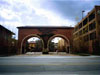
The General Services Administration wouldn’t pin it on a construction defect, but a spokesperson said that a pipe that was misaligned during installation was the likely cause of a flood in the Thomas F. Eagleton US Courthouse on August 23. According to the St. Louis Dispatch, the burst pipe caused a 17-story waterfall in the courthouse, soaking ceilings and floors, and drenching the building’s contents.
The building was dedicated eleven years ago. During the nearly ten years before the building was complete, there were construction disputes and soil contamination issues.
Read the full story…
Destruction of Construction Defect Evidence Leads to Sanctions against Plaintiff
July 10, 2012 — CDJ Staff
Stating that the plaintiff’s actions have left the defendants in a situation where they “cannot properly defend the action,” a judge in the US District Court of New York has sanctioned the plaintiffs in Aktas v. JMC Dev. Co.
The plaintiffs hired JMC Development and Stephen Jung, an architect, to renovate their vacation home in Adirnodack, New York. As work progressed, “due to disagreements regarding the completion date and payments for the project, the relationship began to deteriorate.” The plaintiffs hired George Villar as an owner’s representative who “testified that he deemed the workmanship to be ‘poor.’”
Subsequently, the locks where changed on the home, preventing JMC from performing any additional work, after which drywall was removed, which Villar stated was so that “the engineer come and look at the framing.” Subsequently, Villar sent a letter to JMC stating that the work was “performed in an inadequate, negligent and un-professional manner.” Villar informed JMC that they were not to visit the property. Subsequently, the plaintiffs hired another firm. “Plaintiffs testified that the materials were ‘carted away’ and ‘thrown out.’”
The plaintiffs filed a suit against JMC and others. JMC filed a motion requesting that the plaintiffs be sanctioned for their spoliation of evidence. The court noted that “the plaintiffs recognized that litigation was imminent,” and that they “had a duty to preserve the evidence. As all of JMC’s work was destroyed, there is no evidence of whether or not the work was defective. The court concluded that it will “issue an adverse inference charge that permits the jury to infer that the missing evidence was favorable to the defendants.”
In conclusion, the court granted in part the spoliation sanctions. They granted JMC a summary judgment dismissing the plaintiffs’ claims of fraud.
Read the court’s decision…
Limiting Plaintiffs’ Claims to a Cause of Action for Violation of SB-800
November 18, 2011 — Samir R. Patel, Esq. and Todd E. Verbick, Esq., Lorber, Greenfield & Polito, LLP
There has been a fair share of publicity about the SB-800 amendments to the Civil Code (Civil Code section 896, et seq.) that codified construction defect litigation in 2002. Most of the publicity is geared toward the pre-litigation standards allowing a builder the right to repair before litigation is commenced by a homeowner. Less focus and attention has been given to the fact that violation of the SB-800 performance standards is being used by plaintiff’s counsel as an additional tool in the plaintiff’s pleading tool box against builders. Closer scrutiny to SB-800 reveals that those provisions should in fact act as a limitation to the pleading tools available to plaintiffs and an additional tool for builders in the defense of cases governed by SB-800.
The typical construction defect complaint contains the boiler plate versions of numerous causes of action. These causes of action include Strict Liability, Negligence, Negligence Per Se, Breach of Contract, Breach of Contract – Third-Party Beneficiary, Breach of Express Warranties, Breach of Implied Warranties, among others. The wide array of causes of action leave a defendant “pinned to the wall” because they require a complex defense on a multitude of contract and tort related causes of action. Furthermore, the statutes of limitations as to these claims widely differ depending upon if the particular defect is considered latent or patent. The truth of the matter remains, no matter what the circumstances, if a construction defect matter ultimately goes to trial, it is inevitable that plaintiffs will obtain a judgment on at least one of these causes of action.
On its own, the Strict Liability cause of action can be a thorn in a defendant’s side. A builder is obviously placing a product into the stream of commerce and strict liability is a tough standard to defend against, particularly when it concerns intricate homes comprised of multiple components that originally sold for hundreds of thousands of dollars. A Negligence cause of action can also be difficult to defend because the duty of care for a builder is what a “reasonable” builder would have done under the circumstances. An interpretation of this duty of care can easily sway a jury that will almost always consist of sympathetic homeowners. A Negligence Per Se cause of action can also leave a defendant vulnerable to accusations that a builder violated the Uniform Building Code or a multitude of other obscure municipal construction-related code provisions during the construction of the home. Lastly, the Breach of Contract cause of action leaves a builder relying on dense and intricate purchase and sale agreements with dozens of addenda which leave the skeptical jurors turned off by what they view as one-side, boilerplate provisions. Ultimately, when a matter is about to go to trial, the complexity of these complaints can benefit a plaintiff and increase a plaintiff’s bargaining power against a defendant who is attempting to avoid a potentially large judgment.
Enter the SB-800 statutes. The SB-800 statutes apply to all homes sold after January 1, 2003. Civil Code section 938 specifically states that “[t]his title applies only to new residential units where the purchase agreements with the buyer was signed by the seller on or after January 1, 2003.” (Civil Code §, 938.) As time progresses, more residential construction defect cases will exclusively fall under the purview of SB-800. Slowly but surely more SB-800 governed litigation is being filed, and its exclusive application is looming on the horizon.
On its surface, this “right to repair” regime has left builders with a lot to be desired despite the fact that it is supposed to allow the builder the opportunity to cure any deficiencies in their product before litigation can be filed by potential plaintiffs. However, the application of the time line for repair has shown to be impractical for anything but the most minor problems involving only small numbers of residential units. Moreover, the fact that the fruits of the builder’s investigation into the claimed defects in the pre-litigation context can freely be used as evidence against it in litigation makes builders proceed with trepidation in responding with a repair. For these reasons, more SB-800 litigation can be expected to result due to the shortcomings of the pre-litigation procedures, and savvy defense counsel should anticipate the issues to be dealt with in presenting the defense of such cases at trial.
This fact should not necessarily be met with fear or disdain. Within the SB-800 statutes, the legislature made it clear that they were creating a new cause of action for construction defect claims, but it further made it clear that this cause of action is a plaintiff’s exclusive remedy. The legislature giveth, but at the same time, the legislature taketh away. Throughout numerous provisions within the SB-800 statutes, the Civil Code states that claims for construction defects as to residential construction are exclusively governed by the Civil Code, and that the Civil Code governs any and all litigation arising under breaches of these provisions. Civil Code section 896 specifically states:
In any action seeking recovery of damages arising out of, or related to deficiencies in, the residential construction … the claimant’s claims or causes of action shall be limited to violation of, the following standards, except as specifically set forth in this title. (Civil Code §, 896.)
Civil Code section 896 then provides approximately fifty-plus standards by which a construction defect claim is assessed under that provision. Civil Code section 896 covers everything from plumbing to windows, and from foundations to decks, and in several instances expressly dictates statutes of limitations as to specific areas of construction that severely truncate the 10-year latent damage limitations period. As for any construction deficiencies that are not enumerated within Civil Code section 896, Civil Code section 897 explicitly defines the intent of the standards and provides a method to assess deficiencies that are not addressed in Civil Code section 896. Civil Code section 897 states:
Intent of Standards
The standards set forth in this chapter are intended to address every function or component of a structure. To the extent that a function or component of a structure is not addressed by these standards, it shall be actionable if it causes damage. (Civil Code §, 897.)
Therefore, Civil Code section 897 acts as a catch-all by which defects that are not covered within Civil Code section 896 can be evaluated on a damage standard mirroring the Aas case (damages must be present and actual). The result of sections 896 and 897 being read in combination is a comprehensive, all-inclusive set of performance standards by which any defect raised by Plaintiffs can be evaluated and resolved under a single SB-800 based cause of action.
Civil Code section 943 makes clear that a cause of action for violation of SB-800 performance standards is a plaintiff’s sole remedy for a residential construction defect action. Specifically, Civil Code section 943 states:
Except as provided in this title, no other cause of action for a claim covered by this title or for damages recoverable under 944 is allowed. In addition to the rights under this title, this title does not apply to any action by a claimant to enforce a contract or express contractual provision, or any action for fraud, personal injury, or violation of a statute. (Civil Code §, 943.)
Civil Code section 944 provides the method for computing damages within a construction defect action, as follows:
If a claim for damages is made under this title, the homeowner is only entitled to damages for the reasonable value of repairing any violation of the standards set forth in this title, [and] the reasonable cost of repairing any damages caused by the repair efforts… . (Civil Code §, 944.)
A cursory review of these statutes yields the conclusion that the legislature was attempting to create an exclusive cause of action that trumps all other causes of action where SB-800 applies. The remedy available to plaintiffs is limited to that allowed by the Civil Code. As noted above, “[n]o other cause of action for a claim covered by this title…is allowed.” (Civil Code §, 943.) Therefore, Civil Code sections 896, 897, 943, and 944 specifically prohibit the contract-based and tort-based causes of action typically pled by plaintiffs.
Plaintiff’s counsel has seized upon the language of section 943 to advance the argument that SB-800 still allows a plaintiff to advance typical contract and tort based causes of action. On the surface, this argument may seem compelling, but a minimum of scrutiny of the express language of section 943 dispels this notion. Section 943 says that it provides rights “[i]n addition” to those under the SB-800 Civil Code provisions. Clearly, the language in section 943 is intended to expressly underscore the fact that a plaintiff is not precluded from seeking relief in addition to that allowed under SB-800 for damages not arising from a breach of the SB-800 standards or for damages in addition to those recoverable under Section 944. This language does not provide an unfettered license to bring a Strict Liability, Negligence or other cause of action against a builder where SB-800 applies.
In fact, this language only keeps the door open for plaintiffs to pursue such causes of action not arising from a breach of the SB-800 standards should there be such supporting allegations. For example, if a plaintiff alleges that a builder breached an “express contractual provision” related to the timing of the completion of the home and close of escrow, and the contract specifies damages in this regard, a plaintiff may have a viable separate cause of action for Breach of Contract for recovery of those damages precisely because that is not an issue expressly dealt with in SB-800 in the performance standards under sections 896 and 897, or in the damage recovery terms under 944. As it stands, the vast majority of complaints are seeking redress for violation of the same primary right; that is, defects specifically outlined in Section 896 and 897 or which result in damages as stated in Section 944.
So, how does a builder defend against a complaint that contains multiple causes of action regarding construction defects for a home sold after January 1, 2003? There are numerous ways to approach this. First and foremost, these superfluous and improper causes of action can be attacked by demurrer seeking dismissal of all causes of action other than the cause of action alleging violation of SB-800. If the the time period within which to file a demurrer has passed already, a motion for judgment on the pleadings can be utilized to attack the improper causes of action in the same way as a demurrer can be used for this purpose.
The limitation to a demurrer or motion for judgment on the pleadings is that the judge is restricted to viewing only the four corners of the pleading when making a ruling. It is typical for plaintiffs’ counsel to cleverly (or one might even say, disingenuously) leave the complaint purposely vague to avoid a successful defense attack on the pleadings by not including the original date the residence was sold. In that instance, a motion for summary adjudication can be used to attack a plaintiff’s complaint. By simply providing evidence that the homes were originally sold after January 1, 2003, the improper causes of action should be subject to dismissal by summary adjudication. If the plaintiff is a subsequent purchaser, the builder still has recourse to enforce the pleading limitations under SB-800. Civil Code section 945 states that “[t]he provisions, standards, rights, and obligations set forth in this title are binding upon all original purchasers and their successors-in-interest.” (Civil Code §, 945.)
Attacking a plaintiff’s complaint to eliminate multiple causes of action can have numerous benefits. The practical result is that a plaintiff will only have one viable cause of action. The advantage is that the SB-800 performance standards include the defined performance standards and shortened statutes of limitations periods with regard to specific issues. Furthermore, as to defects which are not specifically provided for in Civil Code section 896, Civil Code section 897 requires a proof of actual damages. Therefore, a plaintiff must provide evidence of current damages and not simply conditions that may potentially cause damage in the future.
The Appellate Courts have yet to directly address and interpret these SB-800 provisions. The time for that is undoubtedly drawing near. For now, however, plaintiffs will have to find ways to accurately plead construction defect claims within the confines of one cause of action for breach of the performance standards enumerated within the Civil Code.
Printed courtesy of Lorber, Greenfield & Polito, LLP. Mr. Patel can be contacted at spatel@lorberlaw.com and Mr. Verbick at tverbick@lorberlaw.com.
Seller Cannot Compel Arbitration for Its Role in Construction Defect Case<
March 1, 2012 — CDJ Staff
The buyer of a leaky home in Venice, California cannot be compelled to arbitration with the seller in a construction defect lawsuit, according to a decision in Lindemann v. Hume, which was heard in the California Court of Appeals. Lindemann was the trustee of the Schlei Trust which bought the home and then sued the seller and the builder for construction defects.
�The initial owner was the Hancock Park Trust, a real estate trust for Nicholas Cage. Richard Hume was the trustee. In 2002, Cage agreed to buy the home which was being built by the Lee Group. Cage transferred the agreement to the Hancock Park Trust. Hancock had Richard Nazarin, a general contractor, conduct a pre-closing walk through. They also engaged an inspector. Before escrow closed, the Lee Group agreed to provide a ten-year warranty “to remedy and repair any and all damage resulting from water infiltration, intrusion, or flooding due to the fact that the door on the second and third floors of the residence at the Property were not originally installed at least one-half inch (1/2”) to one inch (1”) above the adjacent outside patio tile/floor on each of the second and third floors.”
�Cage moved in and experienced water intrusion and flooding. The Lee Group was unable to fix the problems. Hume listed the home for sale. The Kamienowiczs went as far as escrow before backing out of the purchase over concerns about water, after the seller’s agent disclosed “a problem with the drainage system that is currently being addressed by the Lee Group.”
�The house was subsequently bought by the Schlei Trust. The purchase agreement included an arbitration clause which included an agreement that “any dispute or claim in Law or equity arising between them out of this Agreement or any resulting transaction, which is not settled through mediation, shall be decided by neutral, binding arbitration.” The warranty the Lee Group had given to Hancock was transferred to the Schlei trust and Mr. Schlei moved into the home in May 2003.
�Lindemann enquired as to whether the work done would prevent future flooding. Nazarin sent Schlei a letter that said that measures had been taken “to prevent that situation from recurring.” In February, 2004, there was flooding and water intrusion. Lindemann filed a lawsuit against the Lee Group and then added the Hancock Park defendants.
�The Hancock Park defendants invoked the arbitration clause, arguing that Lindemann’s claims “were only tangentially related to her construction defect causes of action against the Lee Group.” On June 9, 2010, the trial court rejected this claim, ruling that there was a possibility of conflicting rulings on common issues of law. “With respect to both the developer defendants and the seller defendants, the threshold issue is whether there was a problem with the construction of the property in the first instance. If there was no problem with the construction of the property, then there was nothing to fail to disclose.” Later in the ruling, the trial court noted that “the jury could find there was no construction defect on the property, while the arbitration finds there was a construction defect, the sellers knew about it, and the sellers failed to disclose it.” The appeals court noted that while Hancock Park had disclosed the drainage problems to the Kamienowiczs, no such disclosure was made to Sclei.
�The appeals court described Hancock Park’s argument that there is no risk of inconsistent rulings as “without merit.” The appeals court said that the issue “is not whether inconsistent rulings are inevitable but whether they are possible if arbitration is ordered.” Further, the court noted that “the Hancock Park defendants and the Lee Group have filed cross-complaints for indemnification against each other, further increasing the risk of inconsistent rulings.”
�The court found for Lindemann, awarding her costs.
Read the court’s decision…
Ensuing Loss Provision Found Ambiguous
April 25, 2012 — Tred Eyerly, Construction Law Hawaii
After the insurer denied coverage in a homeowner’s policy for construction defects under various exclusions, the court found the ensuing loss provision was ambiguous.Kesling v. Am. Family Mut. Ins. Co., 2012 U.S. Dist. LEXIS 38857 (D. Colo. March 22, 2012).
�After purchasing a home from the sellers, the insureds noticed problems with the deck of the home. Massive cracking appeared, causing lifting and leaking on the deck and water running through the exterior foundation wall into the home. There was also damage to the roof and crawlspace.
�The insureds had a homeowner’s policy with American Family, which covered accidental direct physical loss to property described in the policy unless the loss was excluded. They requested coverage for "conditions, defects and damages." American Family denied coverage because wear and tear, as well as damage to foundations, floors and roofs were excluded. The policy did provide coverage, however, for "any resulting loss to property described . . . above, not excluded or excepted in this policy.
�When coverage was denied, the insureds sued American Family.
� Read the full story…
��Reprinted courtesy of Tred R. Eyerly, Insurance Law Hawaii. Mr. Eyerly can be contacted at te@hawaiilawyer.com
��
In Colorado, Primary Insurers are Necessary Parties in Declaratory Judgment Actions
December 9, 2011 — Heather M. Anderson, Colorado Construction Litigation
The United States District Court for the District of Colorado recently ruled that primary insurers are necessary parties, under Fed. R. Civ. P. 19, in a declaratory judgment action being pursued by an excess carrier. See Insurance Co. of State of Pennsylvania v. LNC Communities II, LLC, 2011 WL 5548955 (D. Colo. 2011). Federal Rule of Civil Procedure 19 is almost identical to Colorado Rule of Civil Procedure 19 and pertains to the joinder of persons needed for “just adjudication.” The Insurance Co. of the State of Pennsylvania (“ICSOP”) sought a declaratory judgment that it did not have a duty to defend or indemnify the defendants (collectively referred to as “Lennar Companies”) with regard to the underlying lawsuit brought by The Falls at Legend Trail Owners Association, Inc. (the “HOA”). Id. at *2. In its lawsuit, the HOA alleged Lennar Companies were liable for construction defects at The Falls at Legend Trail residential development.
Lennar Companies held two primary insurance policies, one issued by OneBeacon Insurance Company f/k/a General Accident Insurance Company (“General Accident”) and the other issued by American Safety Risk Retention Group, Inc. (“American Safety”). Lennar Companies also carried excess policies issued by ICSOP and Ohio Casualty Insurance Company (“Ohio Casualty”).
Read the full story…
Reprinted courtesy of Heather M. Anderson of Higgins, Hopkins, McClain & Roswell, LLP. Ms Anderson can be contacted at anderson@hhmrlaw.com
Five Years of Great Legal Blogging at Insurance Law Hawaii
December 9, 2011 — CDJ Staff
Our congratulations to Tred Eyerly who has been blogging at Insurance Law Hawaii for five years now. Over the years, he has posted more than five hundred posts and has provided us all with fascinating insights into the laws on insurance coverage. He describes his blog as “a commentary on insurance coverage issues in Hawaii and beyond.” We are grateful that the “beyond” has just in the last few weeks included Colorado, Illinois, Washington, Minnesota, and Rhode Island (about as far from the island of Hawaii as you can get).
You can read his blog at Insurance Law Hawaii.
Court Voids Settlement Agreement in Construction Defect Case
September 1, 2011 — CDJ Staff
A U.S. District Court Judge in Florida has ruled in favor of a company that sought to void a settlement agreement. The case, Water v. HDR Engineering, involved claims of construction defects at Florida’s C.W. Bill Young Regional Reservoir. The Tampa Bay Water Authority attributed these to both HDR Engineering’s design and Bernard Construction Company which had built the embankment. Bernard Construction filed a complaint against their subcontractor, McDonald.
Tampa Bay Water settled with Bernard Construction and McDonald, in an agreement that set a minimum and maximum settlement, but also would “prohibit Barnard and McDonald from presenting any evidence on several claims and positions of TBW, to require Barnard to call certain witnesses at trial, to preclude Barnard and McDonald from calling other witnesses, and to restrict the filing of trial and post-trial motions.” HDR Engineering moved to void the agreement as collusive.
The judge that the agreement¬? contained “133 paragraphs of ‘Agreed Facts’ that the parties stipulated would survive any order declaring the Settlement Agreement void or unenforceable.” He characterized these as stipulating “that Barnard neither caused nor contributed to TBW’s damages.” HDR motioned that a summary judgment be given to Barnard Engineering.
The court found that “the evidence identified by TBW is patently insufficient to survive summary judgment.” Further, TBW’s expert initially held Barnard responsible for “lenses, pockets, streaks and layers within the embankment,” but then later withdrew this assigning the responsibility to HDR. Further, the court notes that, “TBW’s arguments that lenses, pockets, streaks, and layers in the soil wedge caused or contributed to its damages and that Barnard is liable for those damages have been foreclosed by the Agreed Facts.”
As TBW failed to provide sufficient evidence to withstand summary judgment, the court granted summary judgment, mooted the claim against McDonald, and terminated the agreement between TBW and the other parties.
Read the court’s decision…
Another Colorado District Court Refuses to Apply HB 10-1394 Retroactively
October 28, 2011 — David M. McLain, Colorado Construction Litigation
In Martinez v. Mike Wells Construction Company, 09CV227, Teller County District Court Judge Edward S. Colt refused to apply C.R.S. § 13-20-808 retroactively to provide coverage for the underlying construction defect allegations. According to the recitation of facts in Judge Colt’s March 2011 order, Martinez contracted with Mike Wells Construction to serve as the general contractor for the construction of a home. At that time, Mike Wells Construction was insured through ProBuilders Specialty Insurance Company, RRG. Disputes arose between Martinez and Mike Wells Construction, resulting in Martinez ordering it off of the project in mid-November 2007 and terminating its right to work there by letter dated November 28, 2007.
Mike Wells, the owner of the corporation, subsequently died. Martinez sued Mike Wells Construction in July 2009 for breach of contract and various claims relating to alleged defecting workmanship. Martinez provided notice of the suit to the special administrator of the probate estate. No answer having been filed, the court entered a default judgment against Mike Wells Construction and Martinez sought to garnish Mike Wells Construction’s ProBuilders insurance policy.
Read the full story...
Reprinted courtesy of Higgins, Hopkins, McLain & Roswell, LLC. Mr. McClain can be contacted at mclain@hhmrlaw.com
Homeowners Must Comply with Arbitration over Construction Defects
January 6, 2012 — CDJ Staff
The California Court of Appeals has upheld a decision by the Superior Court of Kern County that homeowners must comply with arbitration procedures in their construction defect claim. The California Court of Appeals ruled on December 14 in the case of Baeza v. Superior Court of Kern County, denying the plaintiff’s petition that the trial court vacate its order.
The plaintiffs in the case are homeowners in various developments built by Castle & Cook. The homes were sold with a contract that provided for “nonadversarial prelitigation procedures, including mediation, and judicial reference.” The homeowners made defect claims and argued that Castle & Cooke failed to comply with statutory disclosure requirements and that some of the contracts violate related statutes.
The appeals court found that there was no ground for appeal of the lower court’s order to continue with prelitigation procedures. The court noted that the plaintiffs could not seek a review of the mediation until a judgment was issued, but that then the issue would be moot. The court felt that there were issues presented that needed clarification, and so they reviewed this case. This was cleared for publication.
The court considered the intent of the legislature in passing the Right to Repair Act, noting that “under the statutory scheme, the builder has the option of contracting for an alternative nonadversarial prelitigation procedure,” as established in Chapter 4. The court noted that Chapter 4 “contains no specifics regarding what provisions the alternative nonadversarial contractual provisions may or must include.”
The plaintiffs contended that the builder was in violation of the standards set out in Section 912, however the court responded that these sections set out one set of procedures, but they concluded that “if the Legislature had intended the section 912 disclosure provisions…it could have made the requirements applicable to all builders by locating them in a section outside Chapter 4.”
Read the court’s decision…
New Buildings in California Soon Must Be Greener
June 19, 2012 — CDJ Staff
The California Energy Commission has approved new energy efficiency standards for new homes and commercial buildings. The 2013 Building Energy Efficiency Standards are set to go into effect on January 1, 2014, and will require 30% more energy efficiency for non-residential construction and 25% more for homes. The standards do not affect hospitals, nursing homes, or prisons.
Buildings covered under the standard will have to have roofs that ready for the installation of solar panels. Additionally, non-residential buildings will require high-performance windows, advanced lighting controls, and cool-roof technologies. Residential requirements include insulated hot-water pipes, whole house fans, and more efficient windows.
The new standards are expected to add 3,500 new building industry jobs. One thing these construction workers won’t be building are power plants, since over the next thirty years, the standards are expected to save as much as six power plants.
Read the full story…
Failure to Meet Code Case Remanded to Lower Court for Attorney Fees
May 24, 2011 — CDJ Staff
Judge Patricia J. Cottrell, ruling on the case Roger Wilkes, et al. v. Shaw Enterprises, LLC, in the Tennessee Court of Appeals, upheld the trial court’s conclusion that “the builder constructed the house in accordance with good building practices even though it was not in strict conformance with the building code.” However, Judge Cottrell directed the lower court to “award to Appellants reasonable attorneys' fees and costs incurred in their first appeal, as determined by the trial court.”
Judge Cottrell cited in her opinion the contract which specified that the house would be constructed “in accordance with good building practices.” However, after the Wilkes discovered water leakage, the inspections revealed that “that Shaw had not installed through-wall flashing and weep holes when the house was built.” The trial court concluded that:
“Separate and apart from the flashing and weep holes, the trial court concluded the Wilkeses were entitled to recover damages for the other defects they proved based on the cost of repair estimates introduced during the first and second trials, which the court adjusted for credibility reasons. Thus, the trial court recalculated the amount the Wilkeses were entitled to recover and concluded they were entitled to $17,721 for the value of repairs for defects in violation of good business practices, and an additional 15%, or $2,658.15, for management, overhead, and profit of a licensed contractor. This resulted in a judgment in the amount of $20,370.15. The trial court awarded the Wilkeses attorneys” fees through the Page 9 first trial in the amount of $5,094.78 and discretionary costs in the amount of $1,500. The total judgment following the second trial totaled $26,973.93.”
In this second appeal, Judge Cottrell concluded, that “the trial court thus did not have the authority to decide the Wilkeses were not entitled to their attorneys” fees and costs incurred in the first appeal.”
Read the court’s decision
Nevada Assembly Sends Construction Defect Bill to Senate
June 6, 2011 — CDJ Staff
In a 26 to 16 vote, the Nevada Assembly has passed Assembly Bill 401, which extends the time limit for legal action over home construction defects. According to the Las Vegas Sun, Assembly member Marcus Conklin, Democrat of Las Vegas, said the bill was about “keeping the consumer whole.” However, Ira Hansen, Republican of Sparks, told the sun that suits are happening before contractors can make repairs. The bill would allow attorney fees even if repairs are made.
�Read the full story…
Construction Law Client Alert: Hirer Beware - When Exercising Control Over a Job Site’s Safety Conditions, You May be Held Directly Liable for an Independent Contractor’s Injury
April 6, 2011 — April 6, 2011 - By Mark VonderHaar and Yvette Davis in the Haight Brown & Bonesteel Blog
On February 24, 2011, the California Court of Appeal held in Jeffrey Tverberg, et al v. Fillner Construction, Inc. that the imposition of direct liability on a hirer turns on whether the hirer exercised retained control of worksite safety in such a manner that affirmatively contributed to the independent contractor’s injury. Twice, Tverberg, an independent contractor hired by a general contractor's subcontractor, asked the general contractor to make the job site safe by covering up open holes created by another unrelated subcontractor while Tverberg was working at the site. After Tverberg was injured at the site by falling in a hole, he sued both the general contractor and the subcontractor which had hired him.
�The Court of Appeal reasoned that when the general contractor instructed another subcontractor to create a condition that was potentially dangerous (i.e., creating open and uncovered bollard holes), and simultaneously required Tverberg to perform unrelated work near the open holes, the general contractor s conduct may have constituted a negligent exercise of its retained control which affirmatively contributed to Tverberg’s injury. The Court also reasoned that the general contractor affirmatively assumed responsibility for the safety of the workers near the holes by only requiring stakes and safety ribbon, and negligently discharged that responsibility which resulted in injury.
�Read the full story...
�Reprinted courtesy of Mark VonderHaar and Yvette Davis of Haight Brown & Bonesteel. Mr. VonderHaar can be contacted at mvonderhaar@hbblaw.com and Ms. Davis at ydavis@hbblaw.com.
South Carolina “occurrence” and allocation
September 1, 2011 — CDCoverage.com
In Crossman Communities of North Carolina, Inc. v. Harleysville Mutual Insurance Co., No. 26909 (S.C. Aug. 22, 2011), insured Crossman was the developer and general contractor of several condominium projects constructed by Crossman’s subcontractors over multiple years. After completion, Crossman was sued by homeowners alleging negligent construction of exterior components resulting in moisture penetration property damage to non-defective components occurring during multiple years. Crossman settled the underlying lawsuit and then filed suit against its CGL insurers to recover the settlement amount. Crossman settled with all of the insurers except for Harleysville. Crossman and Harleysville stipulated that the only coverage issue was whether there was an “occurrence.” The trial court subsequently entered judgment in favor of Crossman, determining that there was an “occurrence.” The trial court also ruled that Harleysville was liable for the entire settlement amount without offset for the amounts paid by the other insurers.
Read the full story…
Reprinted courtesy of CDCoverage.com
Excess Carrier Successfully Appeals Primary Insurer’s Summary Judgment Award
December 9, 2011 — Tred R. Eyerly, Insurance Law Hawaii
Although the excess carrier was given inadequate notice of the underlying arbitration, the trial court determined it shared responsibility with the primary carrier for the arbitration award. Finding disputed issues of fact, the Washington Court of Appeals reversed in Am. States Ins. Co. v. Century Surety Co., 2011 Wash. App. LEXIS 2488 (Wash. Ct. App. Oct. 31, 2011).
The primary insurer, American States, issued two liability policies to Professional Home Builders (PHB), a siding contractor. The policies were for successive years, 1998-1999 and 1999-2000. Each policy had annual limits of $1 million per occurrence. PHB also had a commercial excess liability policy for 1999-2000 with Century Surety Company.
PHB was sued by Residential Investment Partners (RIP) for construction defects after moisture entered the building envelope, causing decay and damage. Century’s expert determined the decay started before the 1999-2000 policy period.
RIP and PHB went to arbitration.
Read the full story…
Reprinted courtesy of Tred R. Eyerly, Insurance Law Hawaii. Mr. Eyerly can be contacted at te@hawaiilawyer.com
Construction Case Alert: Appellate Court Confirms Engineer’s Duty to Defend Developer Arises Upon Tender of Indemnity Claim
January 27, 2010 — By
Steven M. Cvitanovic,
Haight Brown & Bonesteel, LLP, January 27, 2010
In the recent case of UDC-Universal Development, L.P. v. CH2M Hill, 2010 Cal.App.LEXIS 47 (filed January 15, 2010), the Sixth District Court of Appeal provided a stunning illustration of the far-reaching effects of the California Supreme Court’s holding in Crawford v. Weather Shield Manufacturing Inc. (2008) 44 Cal.4th 541. In Crawford, the Court held the duty to defend under an indemnity agreement arose upon the mere tender of defense of a claim covered by the indemnity.
�In the UDC case, CH2M Hill provided engineering and environmental planning services to developer UDC on a project that ultimately wound up in a construction defect lawsuit by the homeowners association ( HOA ). UDC tendered its defense to CH2M Hill, the tender was rejected, and UDC filed a cross-complaint for negligence, breach of contract and indemnity against CH2M Hill and others. After the HOA’s construction defect claims were settled, UDC proceeded to trial against CH2M Hill. The jury found in favor of CH2M Hill on the claims for negligence and breach of contract. At the request of the parties prior to trial, the trial court ruled on the application of the indemnity agreement in light of Crawford and, in so doing, found that the defense obligation arose upon the tender and that CH2M Hill breached that duty despite the jury finding in favor of CH2M Hill.
�The Court of Appeal affirmed, noting that the defense obligation arose as soon as the defense was tendered and did not depend on the outcome of the litigation, and that the HOA’s general description of the defects along with an allegation that Doe engineers were negligent triggered the duty to defend.
�Although this case did not expand the crushing impact of Crawford’s holding, it is
�Read the full story...
Statute of Repose Dependant on When Subcontractors Finished
July 10, 2012 — CDJ Staff
Scott C. Sandberg of Snell and Wilmer writes a post on the JDSupra site about the Colorado Court of Appeals decision in Shaw Construction v. United Builder Services. Sanberg notes that when the general contractor was sued by an HOA, the contractor turned around and sued its subcontractors. The contractor made three claims. They claimed that “improvement” referred to the whole project, that “substantial completion” was reached when the architect certified completion, and that the statute of repose was tolled by the HOA’s service of a Construction Defect Action Reform Act notice.
The subcontractors claimed that “improvement” only referred to their specific work, which reached “substantial completion” when they finished, despite work to be done by other later, and the HOA’s notice to the contractor did not affect the subcontractors. The Colorado court agreed with the subcontractors.
Sandberg notes that some of the contractor’s were not addressed by the court, noting that “the court did not decide whether an improvement triggering the statute of repose can be determined on a trade-by-trade basis,” and that “the court did not decide whether substantial completion occurs when a certificate of occupancy is issued or when the architect certifies completion.”
Read the full story…